
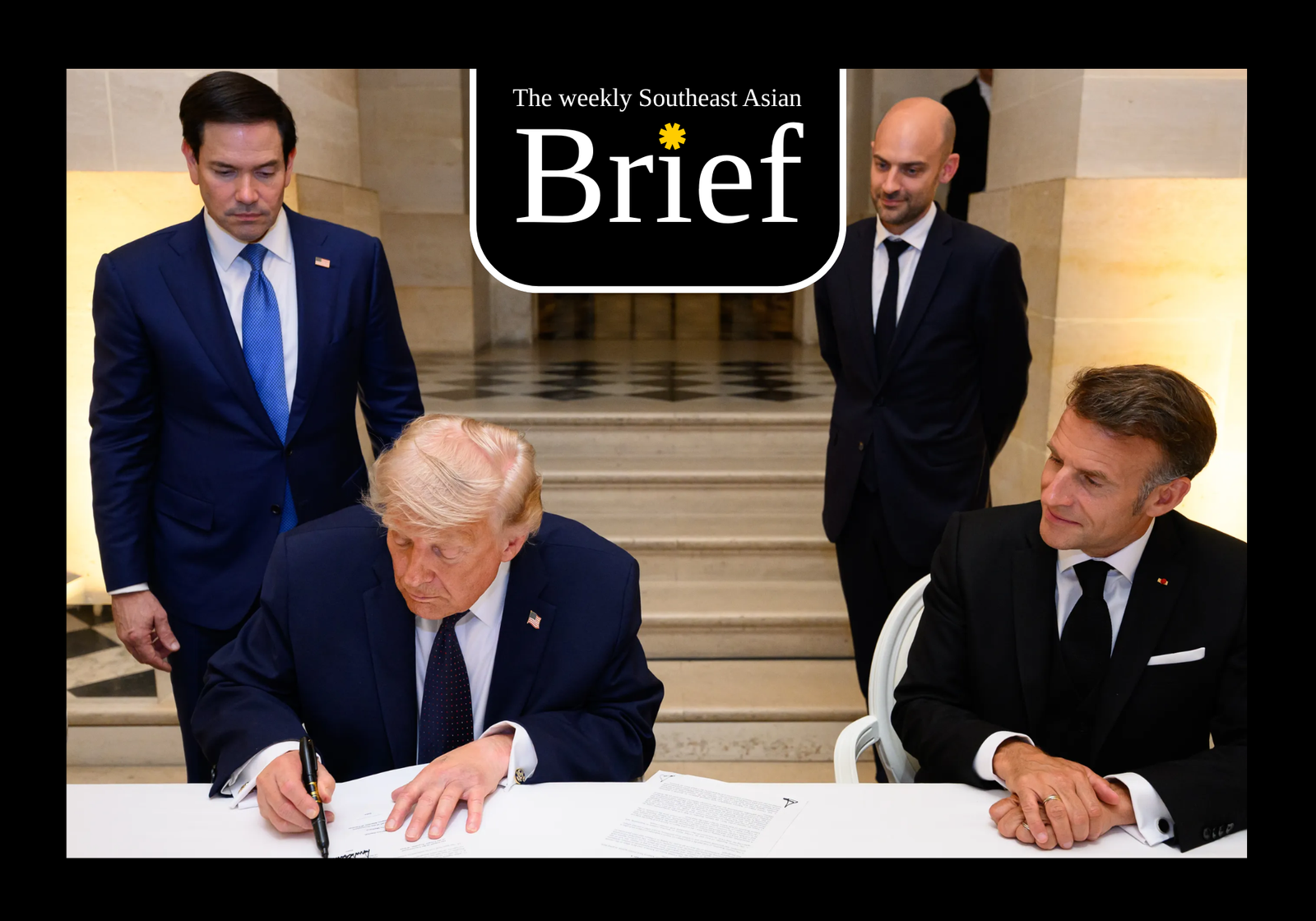
US President Donald Trump signs a Memorandum of Understanding between the Islamic Republic of Iran and the United States at the Palace of Versailles, France on June 17, 2026. (White House)
Southeast Asian governments will be closely watching developments over the next couple of months for a final truce to de-escalate the Middle East conflict that has, for the past four months, disrupted the region.
The third official peace talks between the US and Iran on June 14 produced a 14-point memorandum of understanding (MoU), the details of which were released by White House officials on June 17 following its electronic signing by both respective presidents. The pair is scheduled to meet in Geneva, Switzerland, in the near future for the official in-person signing ceremony to kick off the 60-day negotiations. During this period, both parties have agreed to cease hostilities and reopen the Strait of Hormuz.
Though still incipient, this preliminary agreement has proven to be a good confidence-building measure against the severe global economic fallout since the war broke out in late February. Just late on the same day when negotiations concluded on July 14, gold prices surged and various stock exchanges boomed, along with a dramatic drop in global oil prices.
Many governments, including those in Southeast Asia, welcomed and expressed optimism regarding the development. The Philippines, through its Department of Foreign Affairs, stated its hope that the agreement will lead to a “permanent cessation” of hostilities, as Manila was particularly hit hard by the conflict, having even declared an energy emergency and imported oil from Russia for the first time in five years. Indonesia, which experienced historic-low currency exchange rates during the conflict, also described the talks through its Ministry of Foreign Affairs as a “positive development”. Similarly, Malaysia, which witnessed a 21% surge in sectoral layoffs, reminded that “all parties and external actors must refrain from any action that could derail diplomacy and renew hostilities”.
Nevertheless, this temporary relief cannot be taken for granted as the agreement is likely to serve as a transitional ceasefire rather than a guarantee of long-term stability. Consequently, this period will act as a litmus test for Southeast Asian leaders compelled to construct a shock-resistant policy framework capable of insulating their economies against future geopolitical volatility. This obligation carries a much heavier fiscal burden, as analysts warn that the structural damage inflicted during the four-month war cannot be easily undone.
This vulnerability is underscored by the fact that Southeast Asia imports approximately 3 million barrels of oil per day (bpd) to bridge its 5 million bpd energy demand shortfall, the vast majority of which is seaborne cargo transported through the Strait of Hormuz. Concurrently, for most of these states, agriculture remains the backbone sector for both regional employment and food security. Because modern agricultural production is highly energy-intensive (meaning that mechanisation relies heavily on fossil fuels), any disruption to the maritime choke points exposes acute domestic vulnerabilities. Crucially, the spike in global energy prices rapidly reached local markets, translating into a direct inflationary threat to Southeast Asian households.
A glaring example is Thailand. As the region’s leading agricultural exporter, Bangkok paradoxically imports 95%of its chemical fertilisers, of which over 30% come from the Gulf region. The exorbitant cost of diesel has made harvesting financially unviable, especially for rural farmers. According to reports from Thailand’s Central Rice Belt (such as Uthai Thani province), an astonishing 80%-90% of farmers in certain villages have completely stopped planting rice.
Although crude oil prices have fallen, the severe domestic inflation that triggered food and basic commodity supply crises across developing Southeast Asian states will take months to repair mainly due to three economic and business realities.
First, even if oil prices fall, a severely weakened local currency (such as the Indonesian rupiah and the Philippine peso, which have dropped to historic lows against the US dollar) means it still requires significantly more of its domestic currency to import the exact same volume of commodity inputs, thereby sustaining domestic inflation.
Moreover, fiscal exhaustion will further exacerbate this burden. To prevent total economic collapse during the height of the conflict, governments across Southeast Asia spent billions of dollars from their national treasuries to artificially subsidise domestic fuel and food prices. One stark case is Indonesia, where the state budget was forced to absorb a massive 100 trillion Indonesian rupiah (6.3 billion US dollar) spike in emergency energy subsidies and compensation to keep fuel prices stable as crude oil soared. Now that oil prices are dropping, governments will likely keep domestic fuel prices slightly elevated for a few months rather than passing the savings on to consumers immediately. This will be done to recover the drained cash reserves and repair their own national budgets.
Finally, the domestic market recovery is also delayed by the “Rockets and Feathers” effect, as businesses, logistics companies and food retailers are highly risk-averse. The effect means that when global oil prices spike, they instantly raise their prices to protect their profit margins from crashing. However, when oil prices drop, these same businesses do not lower their prices immediately. They wait to see if the drop is permanent or just a temporary market fluctuation before adjusting retail costs.
In sum, the US-Iran MoU, though bolstering business confidence, does not address the primary prerequisite for the economy, which is operational certainty. Conversely, the only certainty to be taken for granted is that the end of the war does not necessarily mean that both sides’ political intentions have been fulfilled, which consequently does not guarantee peace.
From a grassroot, direct perspective, with agriculture already fragile, a prolonged crisis would lead to direct food shortages and, as history repeatedly demonstrates, triggers widespread protest and political instability.
In the broader context, a collapse in the Geneva negotiations will push Southeast Asian states past their fiscal breaking points, transforming temporary inflation into a deep, structural regional recession. In a worst-case scenario, if oil prices surge again, Southeast Asian treasuries will no longer have the cash reserves to absorb a second price shock. Consequently, credit rating agencies would likely downgrade the sovereign credit ratings of these energy-dependent nations, making it far more expensive for these governments to borrow money internationally.
Furthermore, strategic planning is hindered by the ambiguous status of the shipping lanes, specifically regarding the extent to which the strait will actually remain open. US President Donald Trump declared the strait will remain “permanently toll-free”. Conversely, Iran’s Foreign Ministry countered that future maritime management “will be different from the past” and will feature localized “maritime service fees”. This clearly signals that shipping traffic will not return to a frictionless, pre-war status quo.
About The Author


One thought on “US-Iran peace pact does little to resolve Southeast Asia’s economic uncertainty”