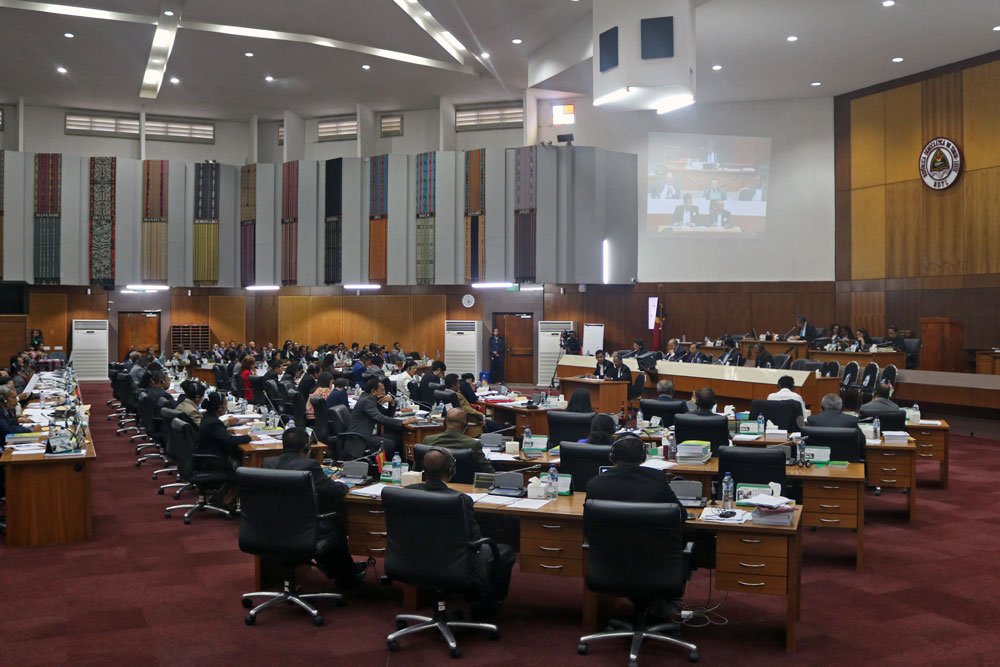
The Timor-Leste government’s presentation of the State Budget to the Parliament in 2018. (Government of Timor-Leste)
During a budget planning session on June 12, the Government of Timor-Leste announced that economic diversification and job creation will form the cornerstone of its 2027 State General Budget, as Dili moves to strengthen economic resilience, stimulate sustainable growth and reduce its long-standing dependence on petroleum revenues. Prime Minister Xanana Gusmão confirmed that the 2027 budget will be the first prepared under the new 2027-2030 Medium-Term Planning Framework, which is set to guide government spending and development policy over the next four years.
“The 2027 State Budget will play a critical role in our efforts to diversify the economy beyond oil and gas and foster more inclusive and sustainable growth, in line with the Blue Economy Policy 2025–2035 and Timor-Leste’s full integration into ASEAN,” the Prime Minister said at the Ministry of Finance in Dili.
He stressed the need for a realistic assessment of the country’s progress, noting that monitoring of the 2011-2030 Strategic Development Plan had delivered mixed results. Out of the 199 targets set under the plan, many recorded only partial progress while others have yet to advance significantly. He warned that conventional budgeting risked undermining long-term ambitions. “If we continue to rely on conventional budgeting approaches, we risk exhausting the Petroleum Fund without achieving the structural transformation that our people expect and deserve,” he said.
To anchor the shift, the government has identified a series of strategic priorities to guide ministries in preparing their 2027 proposals. These centre on accelerating diversification through the sustainable development of agriculture, fisheries, tourism, trade, services, mining and the strategic petroleum sector. Additional priorities include improving the efficiency of public investment, strengthening food and energy security, advancing digital transformation, promoting private sector development and reinforcing judicial and institutional reforms.
Finance Minister Santina Cardoso said the government is introducing a new planning and budgeting methodology that places development outcomes, rather than expenditure allocations, at the centre of the process. She underscored that a business-friendly environment requires coordinated action across institutions and cannot be delivered by a single ministry. “Boosting national production is not solely the responsibility of the Ministry of Agriculture, Livestock, Fisheries and Forestry. It requires coordinated efforts among multiple institutions, technical services and extension programs to ensure sustainable increases in productivity,” she said.
The diversification drive comes against a tightening fiscal backdrop. The Parliament approved a 2026 budget of 2.29 billion US dollar, down from 2.6 billion US dollar in 2025, while the sovereign Petroleum Fund stood at roughly 18.8 billion US dollar in early 2026. With oil revenues from the ageing Bayu-Undan field having effectively run dry, the fund financed close to three-quarters of state spending in 2025 and, on Ministry of Finance estimates, risks depletion by 2035 absent reform. Dili’s accession to ASEAN as the bloc’s 11th member in October 2025 has added urgency to its search for new growth engines.
What does this mean for business?
Timor-Leste’s pivot signals a deliberate opening of sectors that have long sat in the shadow of oil and gas. By naming agriculture, fisheries, tourism, mining and services as priority areas and pairing them with an outcomes-based budgeting methodology, Dili is attempting to convert donor and investor interest into bankable projects. For firms, the new framework functions as a de-risking signal, as clearer development priorities, stronger inter-agency coordination and a stated commitment to private sector growth lower the entry barriers that have historically deterred foreign capital in the frontier market. ASEAN membership compounds the appeal, granting access to regional trade frameworks and integrated supply chains.
That said, the structural risks remain considerable. The economy’s near-total reliance on Petroleum Fund withdrawals leaves little fiscal buffer, and the mixed record of the Strategic Development Plan underscores a persistent gap between ambition and delivery. Timor-Leste is projected to grow at a rate of 4% for 2026 and 2027, but durable returns will hinge on whether the government can translate its diversification rhetoric into execution. Investors would be prudent to treat 2027 as a test of implementation, prioritising sectors with visible donor backing and clear regulatory direction.
Kala Advisory helps investors turn openings like these, from a diversifying frontier economy to a newly minted ASEAN market, into a workable entry plan across Southeast Asia. Visit kala-advisory.com.
About The Author