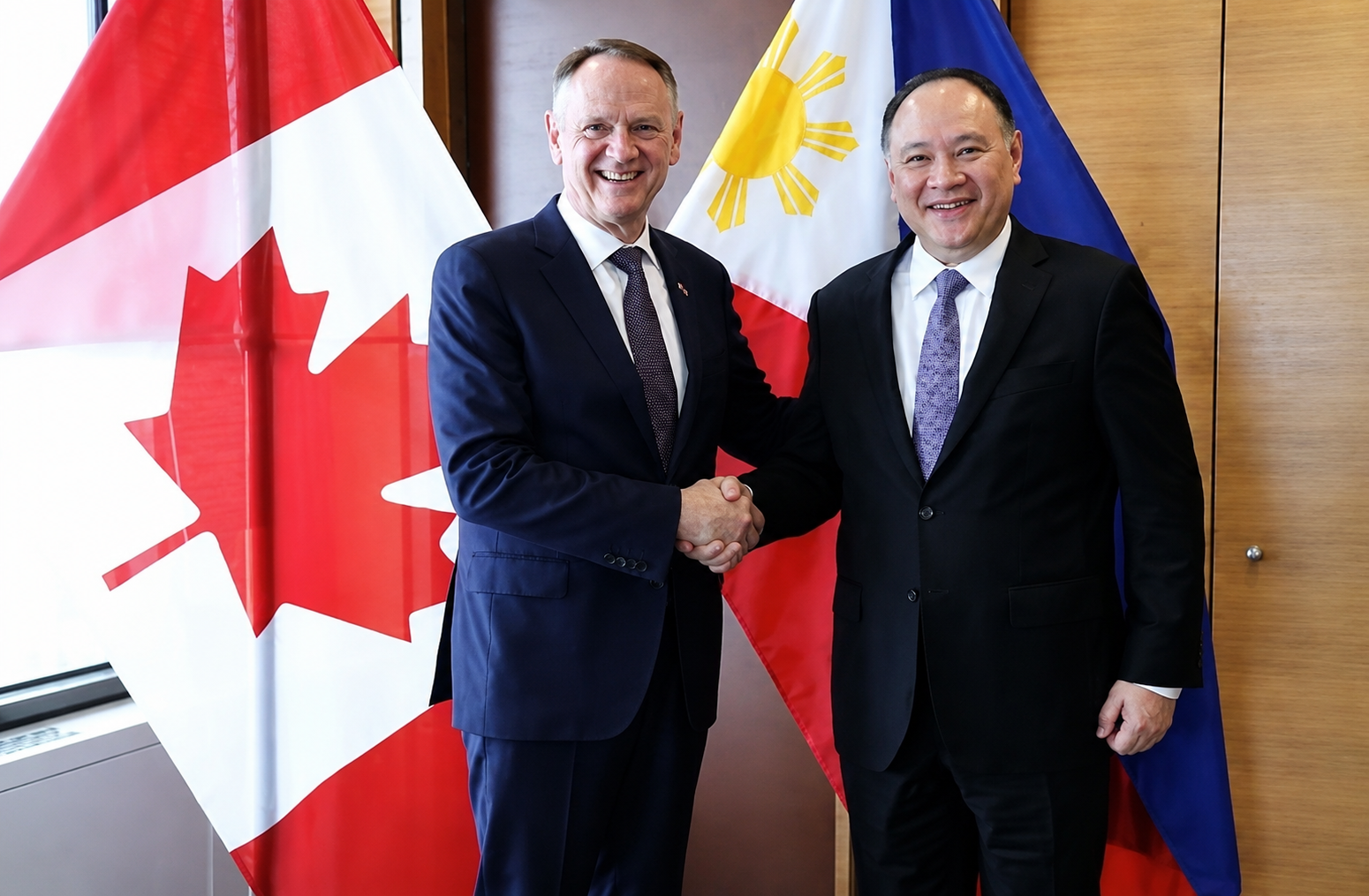
Canadian Defense Minister David McGuinty and Philippine Defense Secretary Gilberto Teodoro Jr. meet in Ottawa, Canada, on June 11, to sign a Statement of Intent on defense cooperation and a Mutual Logistics Support Arrangement. (Philippine Department of National Defence)
Philippine Defence Secretary Gilberto Teodoro Jr. noted that Manila perceives this pact as “a microcosm of the whole Canada-Philippines relationship,” where both nations will be “entering into partnerships for critical infrastructure, for critical minerals, for energy, for businesses to thrive, for industry to thrive, for telecommunications”. He further emphasised the obligation to “underpin the mutuality of activities, exchange of goods, services freely and safely,” under what he described as “a cladding of security of which is a sine qua non in today’s volatile world”.
In response, Canadian Defence Minister David McGuinty stated that the commitment will allow Canada to “provide logistical support” for the Philippines during “important military exercises, training activities and operations”.
Minister McGuinty underscored the accord reflects a growing momentum that must be nurtured. He specifically pointed to several recent joint military exercises, including the Exercise Sama Sama in October 2025 and the recent Exercise Balikatan.
To note, this newly endorsed MLSA builds upon the previously signed Status of Visiting Forces Agreement (SOVFA) in November 2025. Minister McGuinty highlighted that this treaty carries considerable weight as it represents Canada’s first SOVFA in the Indo-Pacific. Once it enters into force, the framework will enable the armed forces of both nations to “train, exercise and operate together more effectively”.
In addition, Secretary Teodoro emphasised the significance of this agreement as the Philippines will shortly commemorate the 10th anniversary of the Arbitral Award. He noted that the milestone is expected to showcase a mutual adherence to United Nations Convention on the Law of the Sea (UNCLOS) in determining maritime rights, ultimately safeguarding critical maritime trade routes and ensuring regional supply lane safety.
What does this mean for business?
The newly established security framework serves as a foundational pillar for commercial enterprise, particularly in transforming geopolitical alignment into tangible market stability and risk mitigation. At its core, this accord functions as a state-backed insurance policy that directly addresses sovereign risk. Multinational corporations are inherently hesitant to deploy billions of dollars into critical infrastructure, telecommunications, or manufacturing facilities if the host environment faces immediate geopolitical friction or volatile territorial disputes. By projecting a unified front and standardising legal frameworks, Canada and the Philippines provide the predictability required to greenlight long-term capital investments.
Beyond baseline security, this pact acts as an economic catalyst that accelerates corporate partnerships in highly strategic, capital-intensive industries. This is underscored by the Philippines’ recent move to forge a critical minerals deal with Canada. By anchoring the archipelago’s vast nickel and copper reserves within a trusted defence architecture, the framework positions Canadian mining giants and clean-tech innovators as preferred commercial partners, bypassing the regulatory hurdles that often stall foreign direct investment.
Kala Advisory helps investors turn openings like these into targeted, country-by-country entry plans across Southeast Asia. Visit kala-advisory.com.
About The Author