
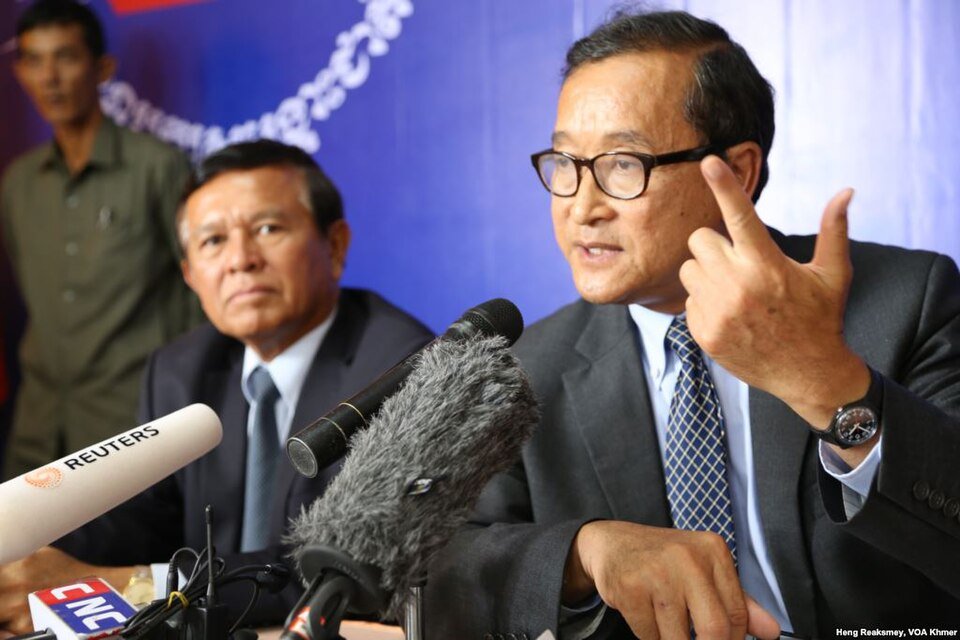
CNRP leaders Sam Rainsy and Kem Sokha at a press conference. The party was dissolved in 2017 following Sokha’s arrest. (VOA Khmer)
King Norodom Sihamoni of Cambodia granted a royal pardon to former opposition leader Kem Sokha on May 25, ending his eight years of arbitrary detention and lifting the treason charge immediately.
The decree, signed by Senate President Hun Sen in his capacity as Acting Head of State while King Norodom Sihamoni was in China for medical treatment, declared the amnesty “in the name of the King and by royal command”. While the pardon erased the remaining 27-year prison term, it still leaves “additional penalties” intact from his 2023 conviction.
For Sokha’s defence counsel, this decree carried significant weight. “After the rain, the sky is clear under the light of the moon or the sun. The people of Phnom Penh no longer experience traffic jams, and the sewage system is no longer clogged,” said Pheng Heng, one of his lawyers. Prime Minister Hun Manet echoed a similar sentiment, stating the pardon as “an additional step in strengthening national unity”.
Sokha, 72, co-founded the Cambodia National Rescue Party (CNRP), which was once the country’s most significant opposition force. His downfall began on September 3, 2017, when he was arrested in his private home without a warrant despite holding parliamentary immunity. First detained at a remote border prison for a year, he was later transferred to strict house arrest in late 2018 due to health concerns. Almost subsequently, his party, the Cambodia National Rescue Party (CNRP), was dissolved by the Supreme Court, effectively eliminating Cambodia’s main opposition.
These accusations stemmed from a 2013 video clip of a speech he delivered in Australia, whereby prosecutors charged him with an act of treason and “collusion with a foreign power”. Many international observers considered his case to be politically motivated to silence the most prominent opposition across Cambodia.
Following trial delays due to COVID-19, the Phnom Penh Municipal Court convicted him in March 2023, with a 27-year house arrest sentence and strict restrictions on any political activities. The legal battle culminated in mid-2026 after the Cambodian Appeals Court upheld his conviction on April 30, until the royal pardon overturned it weeks later.
Sokha’s amnesty underlines a new turning point in Cambodia’s political trajectory. While Sokha’s freedom may lead to a consolidation, the pardon may signify the government’s control rather than genuinely facilitating the opposition.
About The Author

One thought on “Cambodia grants royal pardon to former opposition leader”