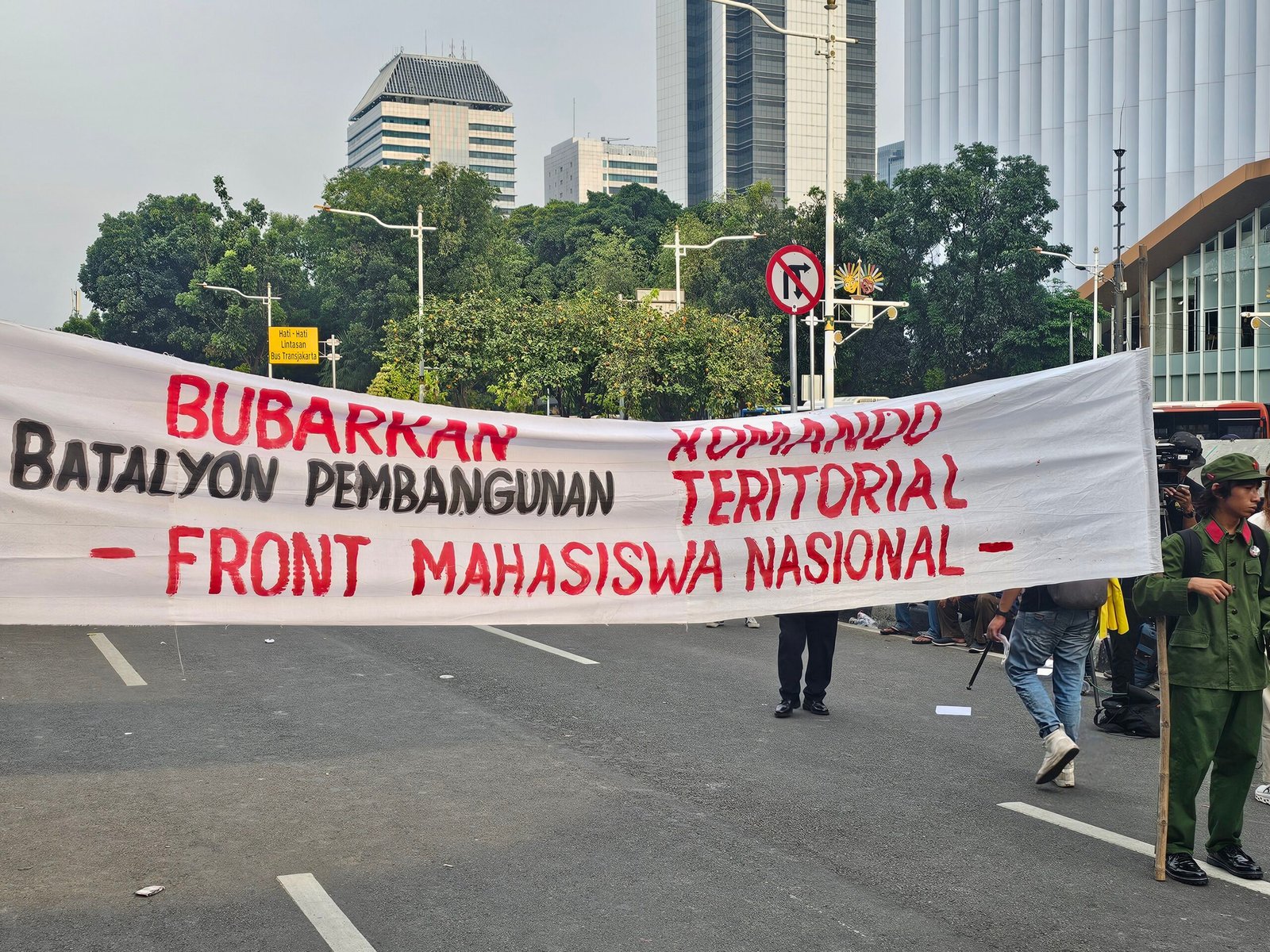
Protest banner opposing TNI military districts, created by the National Student Front, with a student dressed as a Maoist cadre on the far right. (Wikimedia)
The European Parliament adopted a Joint Motion for a Resolution (RC-B10-0248/2026) on May 21, calling on the Indonesian government to end impunity and protect civil liberties following the acid attacks against human rights activist Andrie Yunus and environmental activist Muhammad Rosidi.
The motion passed after receiving 469 votes in favour and 38 against, with 62 abstentions. It highlighted the shrinking “civic space in Indonesia” and the intensifying repression against various actors, including human rights defenders, journalists, trade unionists, students and activists. Beyond that, the Parliament also raised alarm over recurring violence in the eastern regions of Papua and West Papua, as well as criticising the expanding role of Indonesian military as a threat to democratic freedoms.
As one of the European Union (EU)’s biggest bilateral partners in the Indo-Pacific, the bloc expressed its serious concern over the attacks experienced by the activists and directed pointed criticism at Indonesia’s extractive industries. The resolution urged Jakarta to “amend repressive legislation” and guarantee the safety of journalists, activists and trade unionists.
The Parliament joined Indonesian civil society groups in demanding that Yunus’ case be transferred to an independent civilian court, warning that a military trial risks prompting institutional immunity for the defendants. It strongly urged the Indonesian authorities to ensure a safe environment for activists, thoroughly investigate abuses as well as to end legal immunity for human rights violators.
The gravity of the concerns is not without foundation. The attack on Yunus, the Deputy Coordinator of the Commission for the Disappeared and Victims of Violence (KontraS), was motivated by the victim’s protest against the newly proposed military law, which he had demonstrated during the meeting discussing the revision. In retaliation, four members of the National Armed Forces, identified asSecond Sergeant Edi Sudarko, First Lieutenant Budhi Hariyanto Widhi, Captain Nandala Dwi Prasetia, and First Lieutenant Sami Lakka, carried out a personal vendetta by dousing acid on Yunus’ body, while he was riding his motorcycle home after attending a podcast on militarisation.
Prior to Yunus, a similar incident occurred in Bangka Belitung province. Rosidi, an activist who actively highlights and opposes illegal tin mining activities, was attacked by unknown individuals with acid while stopped at a red light in mid-February 2026.
The resolution also addressed the situation in Papua, where gunfights between Indonesian security forces and the independentist Free Papua Organisation militias from March until April led to civilian casualties. In some cases, retaliatory actions by the security officers led to unarmed civilians being forcibly detained and tortured, prompting the Indonesian National Commission on Human Rights to open an inquiry into possible human rights violations.
The adopted resolution underlines the EU’s commitment to human rights, labour and environmental issues, as these commitments are central to EU-Indonesia relations. Moreover, the adoption of this resolution signals growing international scrutiny of Indonesia’s military accountability and democratic consolidation.
About The Author