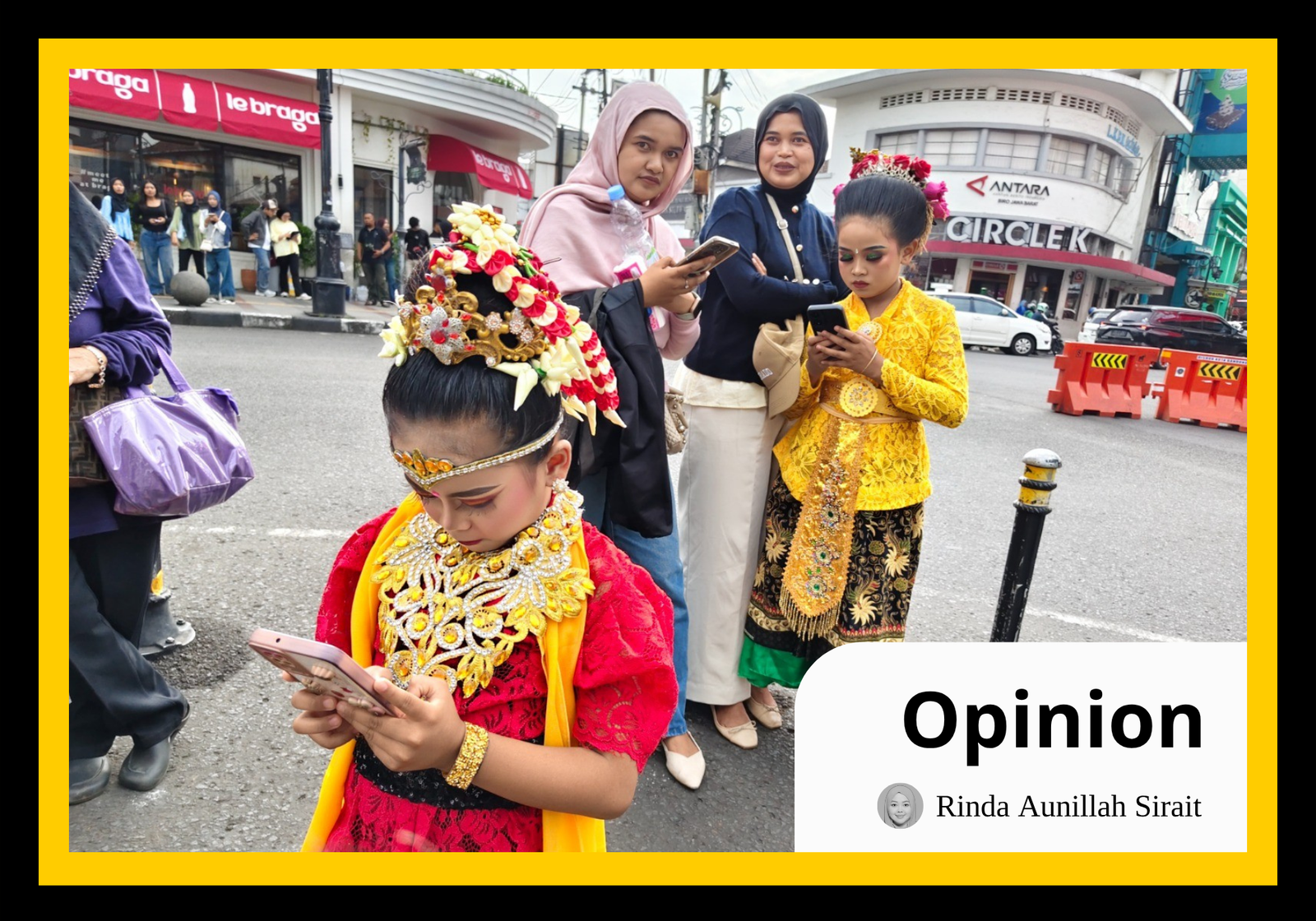
Two young performers in traditional attire remain absorbed in their smartphones amidst the bustle of an historical road in Indonesia. As Indonesia shifts toward “homeless media” and influencer partnerships to broadcast state narratives, this scene captures the tension between preserving cultural substance and chasing the hollow validation of digital reach. (Yogi Ardhi)
Rinda Aunillah is a lecturer and Head of the Newsroom Laboratory at Universitas Padjadjaran, specialising in journalism and creative media. Her extensive research and community service focus on advocacy journalism, environmental communication and disaster literacy based on local wisdom.
Amid the relentless cacophony of social media algorithms, the face of Indonesia’s public communication is undergoing a radical, albeit subtle, transformation. Imagine a citizen scrolling through entertainment content to unwind, only to “stumble upon” narratives of tax policy, legal updates or strategic national issues packaged as jokes, short sketches, or memes from their favourite accounts.
This is no longer an organic coincidence, but a calculated state strategy. It sparks a fierce debate over the essence of democracy: is the state engaging with its citizens, or is it merely marketing political commodities?
Bold Move or Number Delusion?
The decision by the Indonesian Integrated Communication Agency (BAKOM RI) to partner with several “homeless media” outlets (social media aggregator accounts with millions of followers but no formal editorial structure) marks a crucial turning point. On paper, the strategy of “meeting the ball” on platforms where the people “hang out” seems like a savvy way to reach a fragmented digital audience. The Indonesian government appears to feel the need to break out of the “bureaucratic box” to meet citizens where they are, shifting from a one-way communication model to a more fluid, organic interaction.
This move is not without its justifications. Given the massive internet penetration and the surge in social media users in Indonesia over recent years, digital platforms have transformed into the primary source of information for the masses. Data from Digital 2026, published by We Are Social & Meltwater, shows that the number of social media identities in Indonesia has jumped by 26% in a single year, reaching 180 million users (equivalent to 62.9% of the total population). Indonesians spend a staggering amount of time on social media: an average of 21 hours and 50 minutes per week, or over three hours every day.
This technological evolution offers a new chapter for government public relations (PR), where social media is no longer an optional add-on but an urgent necessity for remaining relevant and maintaining public trust amidst a decentralised flood of information.
However, behind the tantalising engagement metrics lies a systemic risk. The government seems to have begun assuming that millions of likes, shares and views equate to public understanding or consent toward a policy. In the digital realm, reach is not the same as understanding. Blind prioritisation of reach risks “idolising engagement” while abandoning accountability.
Diluting Substance for “Likes”

A couple enjoys a moment of digital connection amid a tranquil pine forest in West Java, Indonesia, illustrating the modern tendency to document and share experiences, even when surrounded by natural beauty. (Yogi Ardhi)
The use of Social Media Influencers (SMIs) as trusted community messengers is based on their ability to build emotional connections (something stiff, official government accounts often fail to do). Influencers help translate complex legal jargon into “bite-sized” content that is more human and digestible for the younger generation.
The problem arises when serious state messages, such as fiscal policies or legal regulations, are stripped of their substance to satisfy an algorithm. This aligns with the concept of the “Desacralisation of Politics”, where a shift toward informal and “relatable” communication risks repackaging state narratives into formats that are easy to swallow but lack critical depth.
Public communication that prioritises simplification without clear transparency risks triggering apathy or even digital resistance from citizens who feel they are being “tamed” through endorsed content that has lost its core substance.
Bypassing the Fourth Estate
The decision to prioritise partners without formal editorial structures indirectly diminishes the role of the press as the fourth pillar of democracy. Mainstream media builds credibility through rigorous verification processes and adherence to a Journalistic Code of Ethics, where there are clear faces and legal entities that can be held accountable if information is incorrect. Conversely, many influencers and homeless media build trust solely through emotional “relatability” and frequently ignore the function of social control.
If the Indonesian government feels more comfortable speaking through “algorithm-friendly” partners, concerns arise that the state is attempting to evade checks and balances. Without robust verification mechanisms, social media becomes fertile ground for hoaxes and disinformation, even when the government is attempting to spread information regarding its own performance. Public trust built on such a fragile foundation can easily crumble in this post-truth era.
Indonesia is not alone in this trend. This wave is sweeping across Southeast Asia, where digital narratives are often dominated by “cyber armies” or third-party partners to obscure criticism. In Thailand, military involvement is particularly striking, with the discovery of thousands of accounts linked to the Royal Thai Army launching coordinated information operations to attack pro-democracy activists and reinforce pro-establishment narratives. A similar phenomenon occurs in the Philippines, where skilled “disinformation architects” are recruited by politicians to build hyper-partisan information systems that prioritize engagement algorithms over public trust, making it difficult to hold them accountable in political campaigns. Meanwhile, in Malaysia (which ranks third highest in the region for the spread of fake news), the dissemination of such content often involves fake journalists or parties seeking to damage the reputation of specific individuals or groups for economic or political gain. Collectively, the use of political “buzzers” in these countries reflects a systematic effort to maintain the continuity of power by manipulating public opinion in the digital sphere.
However, other nations offer cautionary tales. In France, the government began using influencers to capture the attention of the youth, but this was accompanied by strict regulations regarding sponsorship transparency. Conversely, the case in the Netherlands serves as a bitter reminder: influencers hired to promote health policies suddenly pivoted to support anti-government groups, creating massive public confusion.
Even more extreme is Hungary, where networks of pro-government influencers are used in the context of autocratisation to dominate digital narratives and marginalise independent media. In the US, while the White House has begun embracing TikTok stars as new news sources, significant concerns remain regarding non-transparent “paid speech” and the potential for algorithmic manipulation by foreign interests.
The Demand for Accountability: Beyond the “Like” Button
To safeguard democratic integrity in the digital age, the Indonesian government must immediately shift from merely chasing virality toward substantive public communication. The state must not remain trapped in a delusion of numbers. Every partnership with an influencer must guarantee that information accuracy is maintained without oversimplifying complex national issues.
Credibility is an expensive yet fragile commodity. Every piece of content resulting from a collaboration with a digital partner must be explicitly disclosed as a form of public accountability, following global regulatory trends.
Rather than continuing to rely on third parties, government institutions need to strengthen their own internal creative teams to build high-quality, responsive interactivity with citizens. The quality of existing government social media content must be evaluated and improved immediately.
Crucially, the state must ensure the role of mainstream media as the verifier of truth. The press must not be sidelined by the dominance of social media, which often pursues only surface-level sensation. It must be remembered that mainstream media builds credibility through exhausting verification, the Law on the Press and right-of-reply mechanisms. There are faces and legal bodies to hold accountable if the information is wrong. This is the true form of public accountability.
Reach can indeed be bought, but trust can only be earned through transparency and tangible, accountable action. On the screens of its citizens, a nation’s integrity is defined not by a flurry of heart emojis in the comments, but by the honest information that truly empowers a democratic populace.
About The Author