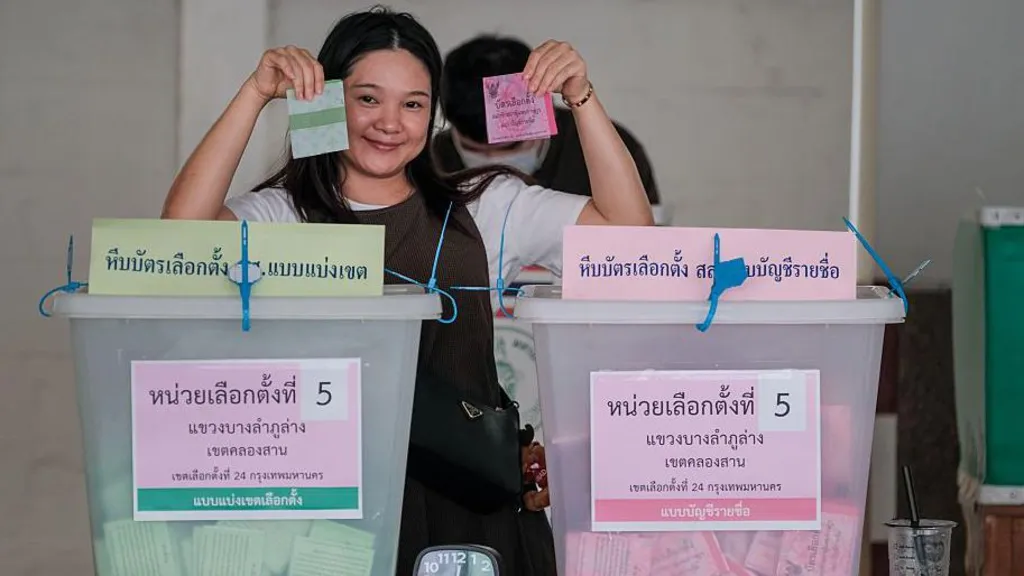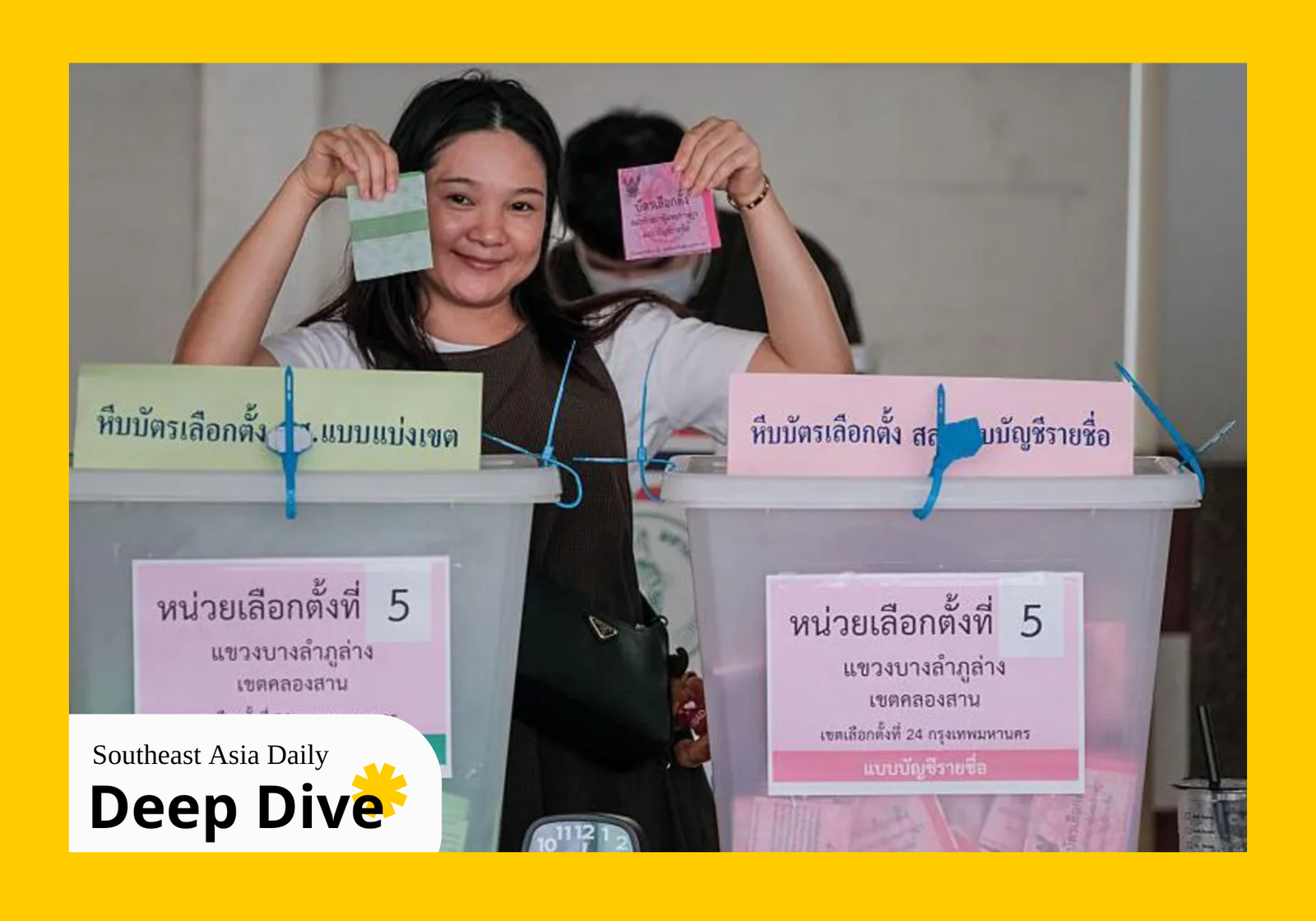
A voter displays her ballot papers beside sealed ballot boxes at a polling station in Bangkok during Thailand’s February 8 general election and constitutional referendum. Courtesy of Getty Images via BBC.
Paradox at The Ballot Box
For nearly a century since the transition from absolute monarchy to constitutional monarchy in 1932, Thailand has been hemmed in a vicious cycle as elections raise expectations of change but deliver continuity instead. The February 8 election was the latest turn in this cycle, as the conservative Bhumjaithai Party secured 193 of 500 parliamentary seats and stability once again triumphed over reform. However, the referendum that was held on the same day told a strikingly different story: nearly 20 million Thais, about 65% of voters, cast their ballots in favour of replacing the very constitution that underpins this conservative order. Why did Thai voters support constitutional reform in a referendum while electing a conservative, status quo–oriented government capable of slowing its implementation?
Central to this paradox is the 2017 constitution, ratified as a direct legacy of the 2014 military coup. Drafted under the supervision of the military-controlled National Peace and Order Council (NCPO), it was designed to preserve military influence under the guise of illiberal democracy, most notably by subordinating popular will to elite institutional control through a fully military-appointed Senate with joint authority in selecting the prime minister. This was most starkly manifested in the 2023 election, when the reformist Move Forward Party (MFP) became the frontrunner with 151 seats, but never stood a chance to govern as the unelected Senate members practically blocked its bid, and MFP was subsequently dissolved by the Constitutional Court over lèse-majesté allegations. Re-emerging as the People’s Party, they entered the 2026 election riding the momentum of the 2023 orange wave—the colour of the reformists—and pre-election polls favoured them particularly among young and urban voters. However, they secured only 118 seats, finishing a distant second. Their reform agenda, nevertheless, found reflection in the constitutional referendum.
The mandate for change, though, now rests in the hands of a government institutionally positioned to delay, dilute, or tightly manage any meaningful constitutional reform. Such divergence between electoral outcomes and constitutional sentiment is not merely an electoral irony, but reflects deeper structural constraints embedded within Thailand’s political order. To understand why this paradox persists, we must look beyond the ballot box and the entrenched architecture of power that has long kept reform at bay.
Time-tested Strategies
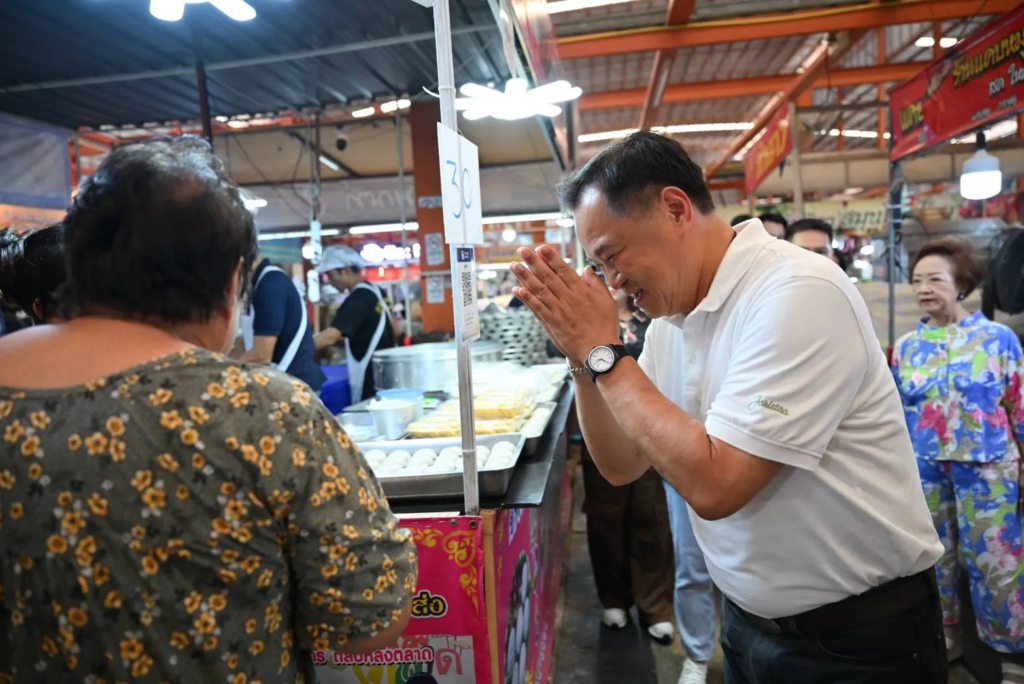
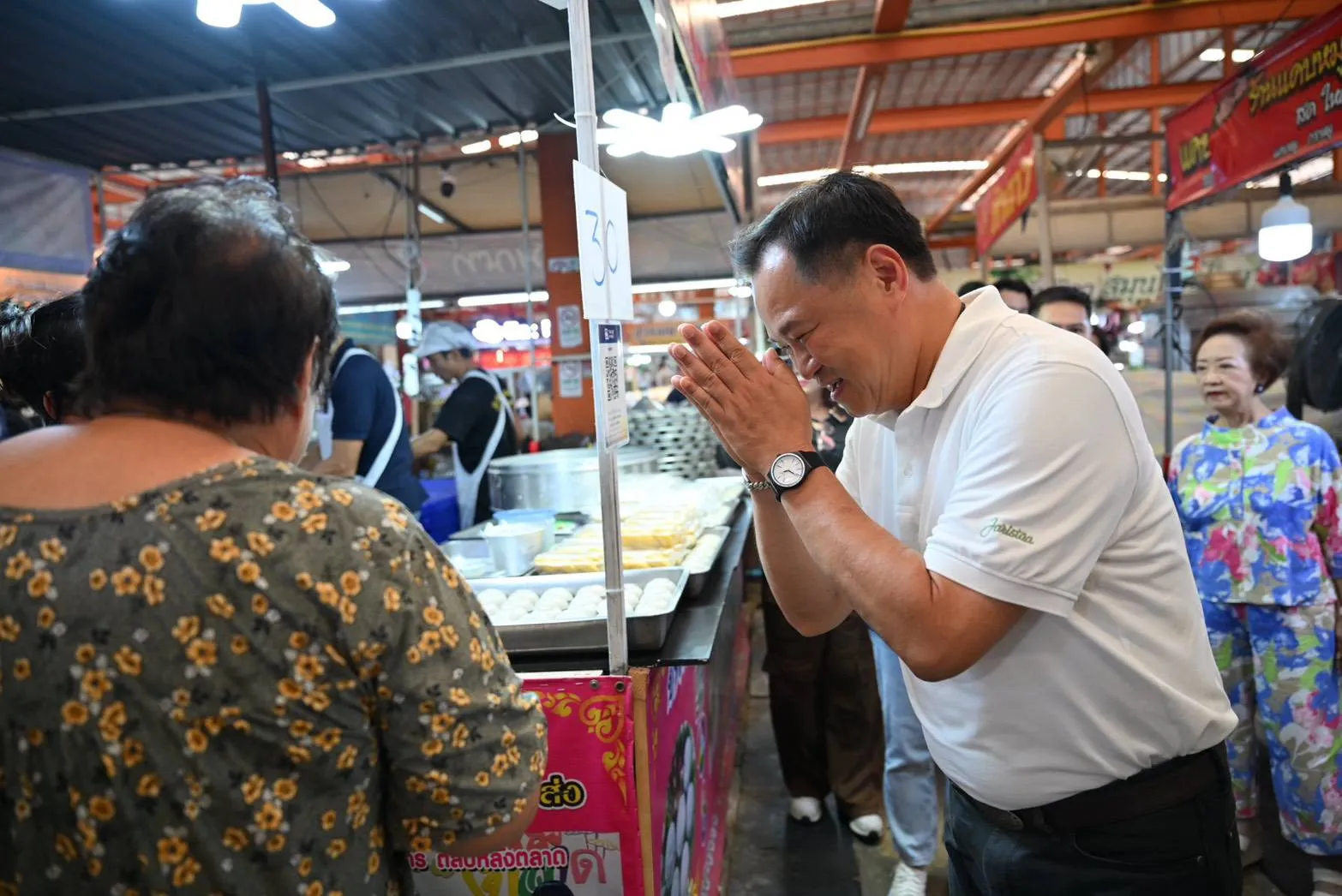
Anutin Charnvirakul, leader of the Bhumjaithai Party, greets voters during a campaign visit ahead of Thailand’s general election. Courtesy of Thailand NOW.
Unpacking the conservative lead begins with Bhumjaithai’s electoral strategy, whose unexpected dominance can be attributed to three compounding strategic advantages that collectively overwhelmed their opponents. First, following the dissolution of parliament in December 2025, a mass defection of 63 former members of parliaments (MPs) from rival parties nearly doubled Bhumjaithai’s parliamentary presence from 71 to 134, each bringing deeply entrenched local networks crucial to winning rural constituencies. These defectors spanned the entire political spectrum, including factions from Pheu Thai (liberal-populist), Palang Pracharath (national conservatist), and United Thai Nation (ultraconservatist), signalling a broad cross-camp consolidation behind Bhumjaithai, which further reinforced this through their strategic leveraging of Baan Yai, or literally ‘Big Houses’, informal networks led by influential local figures that effectively functioned as grassroots electoral machinery.
Closely intertwined with this was Bhumjaithai’s populist scheme, namely the revival of the Half-Half co-payment scheme, a continuation of a food and daily necessities subsidy programme that had proven popular since 2020, offering economically disadvantaged rural voters the immediate, tangible relief that People’s Party reform-oriented platform could not match. Faced with the choice between concrete economic certainty and lengthy, potentially unstable structural reform, non-urban voters unsurprisingly gravitated towards the former. In addition, the escalating border dispute with Cambodia provided Bhumjaithai with an unexpected electoral momentum. As nationalist sentiment surged, Bhumjaithai emerged as its primary beneficiary, with its leader and current Prime Minister Anutin Charnvirakul positioning himself as the candidate Cambodia would fear most. This resonated particularly strongly in affected rural constituencies, where People Party’s implied anti-military stance proved a significant liability againstBhumjaithai’s openly pro-military identity.
Bhumjaithai’s electoral mastery, however, tells only half the story. Beneath the campaign strategies and policy pitches lies a deeper, more enduring explanation: a political system designed to favour stability over change. Thailand’s democracy, in truth, has never truly taken root. Indeed, the 1932 revolution ended absolute monarchy, and established Thailand as a constitutional monarchy. However, instead of ushering in stable democratic governance, the country entered a turbulent political cycle, marked by 13 coups and 22 constitutional amendments. Power, in short, did not fully democratise. It was merely reallocated to the military and bureaucratic elite.
Stability Ahead?
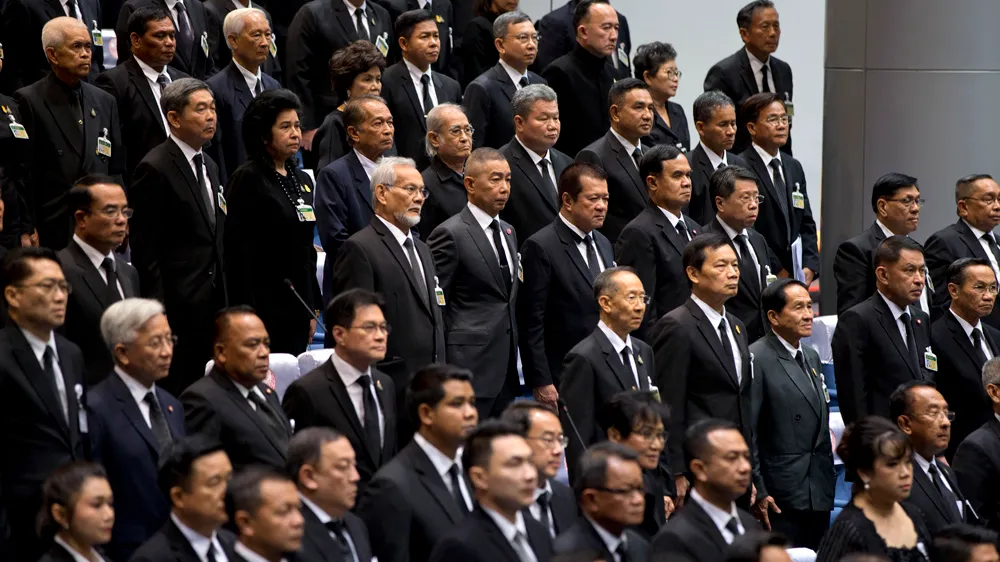
Thailand’s 250-member Senate, appointed in the aftermath of the 2014 coup. Courtesy of AP.
Thai politics illustrates an entrenched conservatism. As a result of repeated military coups and subsequent crises following the elections, Thailand has had a total of 20 constitutions. It is a staggering number that places it firmly in the global top five alongside Ecuador, and behind only the Dominican Republic, Venezuela, and Haiti. Thailand’s previous referendums, in 2007 and 2016, did not strengthen democracy but instead provided democratic cover for authoritarian constitutions, and none have proven durable. In 2014, when the military removed Yingluck Shinawatra’s elected government and redesigned Thailand’s political landscape through the 2017 Constitution,effectively checkmating democratic progress. At the heart of this deficit lies the newly-reformed Senate, whose deeply unrepresentative composition remains the primary obstacle to meaningful reform. Previously appointed directly by the junta and most recently elected only among candidates themselves rather than by the general public, the Senate holds disproportionate power over the appointment of members to independent organisations such as the Constitutional Court and the Election Commission—institutions designed to safeguard separation of powers but instead populated by figures chosen through an elite, non-representative process, creating conditions ripe for authoritarian capture.
Crucially, whether the upcoming constitutional revision will meaningfully address these imbalances remains deeply uncertain, as voters in the referendum endorsed the abstract idea of a new constitution with no draft, no framework, and no clear model presented for public scrutiny. Under Section 256, replacing it requires three separate referendums, and with the conservative government coalition tasked with negotiating the design of the new power structure before securing two further rounds of public approval, the prospect of a genuinely transformative constitution appears, at best, cautiously optimistic. Reformist actors such as the People’s Party, meanwhile, find themselves caught in a paradox—positioning themselves as agents of change while operating within an institutional space deliberately designed to neutralise their momentum.
The political implications of this conservative consolidation extend equally to Thailand’s economic trajectory. With conservatives at the helm, the continuation of populist fiscal commitments appears all but certain, most notably through the revival of promised subsidies on daily necessities. As Thailand has one of the highest household debt to gross domestic product (GDP) ratios at87.7% as of June 2025, compared to some of its ASEAN peers—with Malaysia faring at 69.9%, Singapore at 44.6%, and Indonesia at 15.8%—this policy might be particularly appealing to numerous households. In addition, Thailand could also expect a short-term increase in local consumption as well as more information on small-scale traders for future development purposes. Although this might be considered a quick win, the long-term economic implications and its structural impact are still uncertain. The second phase of this co-payment scheme will be sourced from tax revenue. The previous first phase of this aforementioned subsidisation has cost the Thai government over 44,000 million THB (US$1,400 million). Arguably, this is a resource that could instead be utilised to address Thailand’s structural problems, such as stagnant low agricultural productivity, inequality in education and job opportunities, as well as an ageing society.
The February 8 election should serve as a wake-up call for reformist actors. In a system where 400 of 500 parliamentary seats are determined at the constituency level, national popularity alone is insufficient. To remain competitive, reformist parties must move beyond broad reform promises and invest in candidates who are deeply embedded in local communities, with policies tailored to the specific needs of each province rather than a one-size-fits-all national platform.
Ultimately, the central question remains whether a conservative government anchored in populist short-termism can deliver the transformative policies needed to lift Thailand out of its prolonged post-COVID growth slump—a period that, across Southeast Asia, has broadly weakened economies and opened space for elite consolidation—and whether the upcoming constitutional revision will break the country’s cycle of instability or merely reinforce the dominance of its already entrenched institutions. These questions, moreover, do not belong to Thailand alone, as the dynamics it grapples with are increasingly mirrored across the region.
In Myanmar, elections held amid civil war and a banned opposition have laid bare how voting can be instrumentalised to legitimise military rule. Cambodia’s tightly managed leadership succession in 2023 illustrates how democratic institutions may endure in form while opposition space disappears in practice. Meanwhile, in the Philippines and Indonesia, dynastic consolidation and declining democratic quality signal that even competitive systems remain vulnerable to elite entrenchment. Viewed comparatively, Thailand is less an exception than a reflection of a broader regional pattern where popular demands for accountability persist, yet institutional architectures continue to shield entrenched power.
Drawing these threads together, Thailand’s February 8 election is, at its core, a story of two competing mandates—one conservative, one reformist—that the country’s political architecture has yet to reconcile. Bhumjaithai’s victory was not merely the product of superior campaigning, but the outcome of a system architecturally tilted against change, one that includes entrenched local networks, populist short-termism, and institutions deliberately designed to neutralise reformist momentum. The referendum result, meanwhile, hints that the appetite for genuine democratic transformation remains very much alive among the Thai public. Whether it can ever be satisfied, however, depends less on who wins the next election and more on whether Thailand would recalibrate the balance between electoral mandates and its longstanding political institutions, an equilibrium that has shaped the country’s politics for long.
About The Author