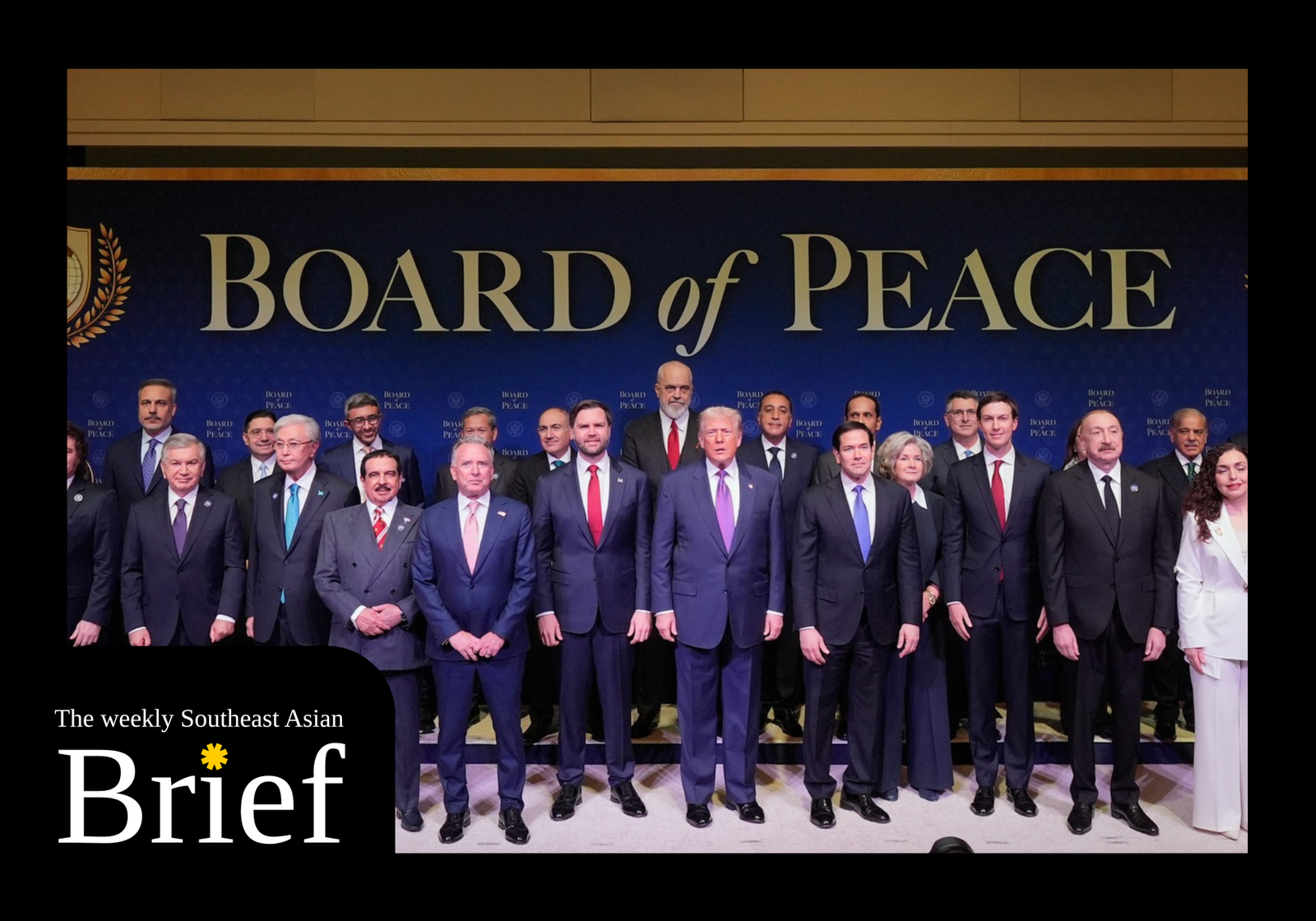
Attendees of the inaugural meeting of the Board of Peace meeting at the U.S. Institute of Peace, on Feb. 19, 2026, in Washington D.C., US. (AP)
On February 19, Donald Trump convened the inaugural meeting of the Trump-initiated Board of Peace (BoP) in Washington, D.C., drawing representatives from its 26 full members. At least 11 countries were represented by heads of state or government.
Notably,three Southeast Asian leaders were present, Hun Manet of Cambodia, Prabowo Subianto of Indonesia, and Tô Lâm of Vietnam.
Publicly, all three leaders voiced support for Trump’s stated objective of advancing peace in Gaza and beyond. Yet their Washington visits also unveiled more pragmatic priorities.
For them, participation appeared less about endorsing Trump’s worldview and more about engaging with a US administration whose economic and strategic decisions have significant regional consequences.
Cambodia’s Hun Manet used the occasion to garner diplomatic support in its continuing tension with Bangkok, accusing “Thai forces [of] occupy[ing] deep into Cambodian territory… beyond even Thailand’s own unilateral claim.”
Under his leadership, Phnom Penh has sought warmer ties with Washington, recently benefiting from a relatively lenient 19% US tariff rate. BoP membership, therefore, offers Cambodia another channel through which it might cultivate diplomatic backing as frictions with Thailand persist.
For Indonesian President Prabowo, engagement with Washington aligns with his broader ambition to elevate Indonesia’s global standing. Since taking office, he has pursued an energetic diplomatic agenda, including Indonesia’s entry into BRICS and a renewed presence at major multilateral forums.
Economic considerations are equally central. During his visit, Prabowo announced US$38.4 billion in business agreements with American partners and secured a favourable 19% tariff arrangement.
Tô Lâm of Vietnam arrived with more immediate economic concerns. Hanoi is currently subject to a temporary 20% tariff, and breaking the deadlock in negotiations is critical.
The US remains Vietnam’s largest export market, with a reported US$134 billion trade surplus last year, important to Tô Lâm’s ambitious 10% GDP growth target.
Elsewhere in Southeast Asia, governments are closely observing the BoP’s trajectory, seeking to balance reputational impact of membership with pragmatic gains. Thailand, initially cautious, has revealed that it is joining as an observer. The Philippines has indicated it is weighing participation.
By contrast, Malaysia has declined involvement, arguing on a moral basis that the Board is unlikely to meaningfully address global conflicts and leaves out the Palestinians from a peace process in Gaza.
For much of the region, the BoP is thus viewed less as a substantial peace mechanism and more as a pragmatic tool that may offer access, visibility, and potential economic advantage.
The move shows a broader shift in regional diplomacy, where engagement with Washington increasingly reflects calculated national interests rather than ideological alignment.
About The Author