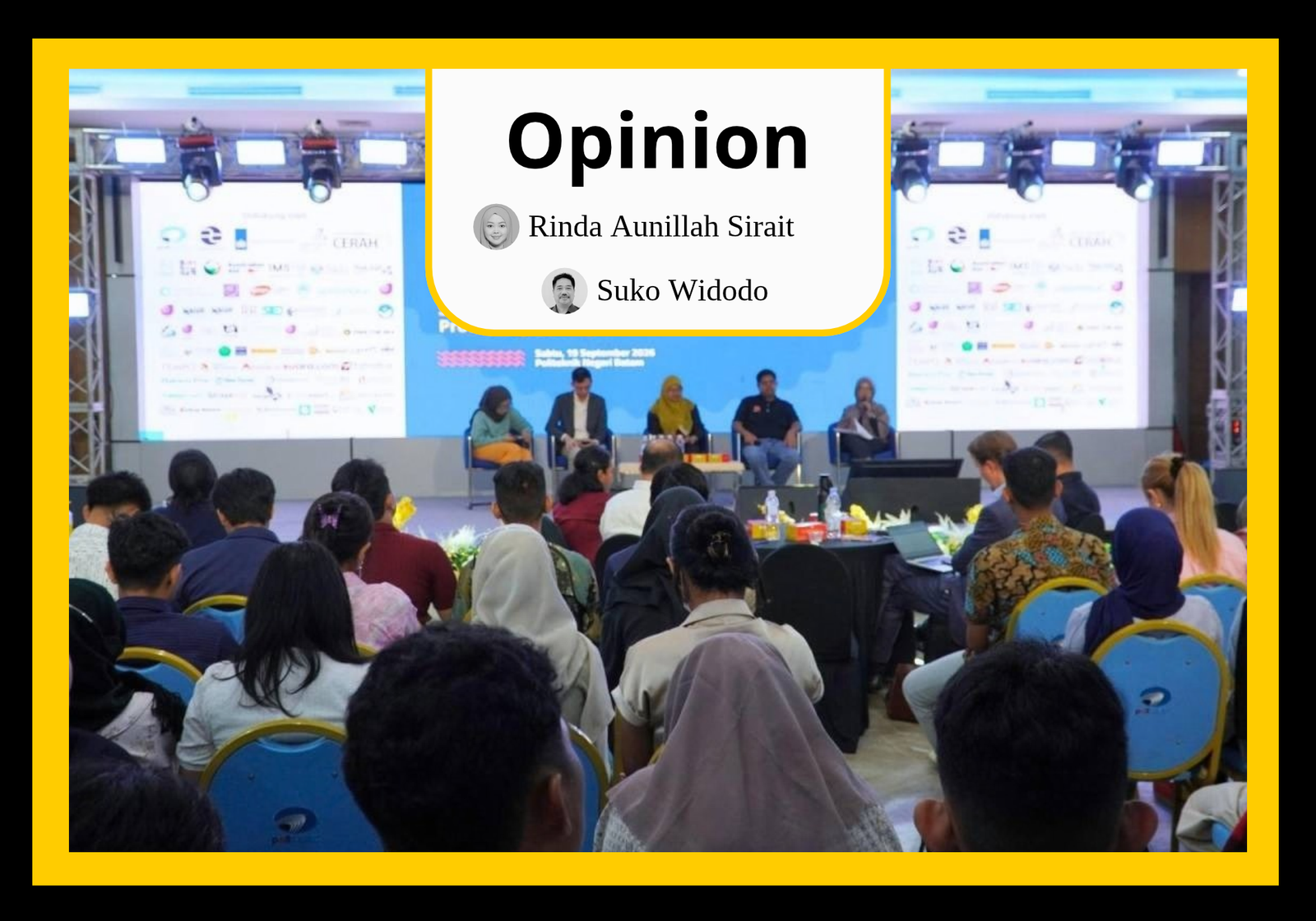
Participants attend the Malacca Strait Media Festival at Politeknik Negeri Batam, Indonesia, on September 19. (Fesmed Malacca Strait Committee)
Rinda Aunillah Sirait is a lecturer and Head of the Newsroom Laboratory at Universitas Padjadjaran, specialising in journalism and creative media.
Suko Widodo is a lecturer at Universitas Airlangga, specialising in public communication and founder of the Public Communication Research Center. The views expressed are their own and do not represent SEA Daily or any other organisation.
The Malacca Strait has long been a passage for ships, goods, people and ideas, but in September 2026 it also became an appropriate setting for a more urgent discussion: whether the flow of credible public information in Southeast Asia remains sufficiently free from political pressure, legal intimidation, economic dependency and digital manipulation.
At the 2026 Malacca Strait Media Festival in Batam and Tanjungpinang, journalists, academics and civil-society actors discussed press freedom and human-rights justice in the region. The setting was symbolically important. In one of the world’s busiest maritime corridors, the conversation turned to another vital circulation that is less visible but no less important for democracy: the movement of verified information from institutions of power to the public.
The central question, therefore, should not be framed simply as whether journalists are sufficiently protected. A more important question is this: who protects the public’s right to know when those who gather, verify and publish information themselves face pressure?
This distinction matters because press freedom is often misunderstood as a professional privilege belonging to journalists. In a democratic society, however, journalism has a broader function. It enables citizens to examine public decisions, scrutinise the use of authority, understand competing policy claims and hear voices that might otherwise remain excluded from public discussion. For that reason, when journalism is weakened, the first visible impact may fall on reporters and newsrooms, but the deeper loss is suffered by citizens whose access to independent information becomes narrower.
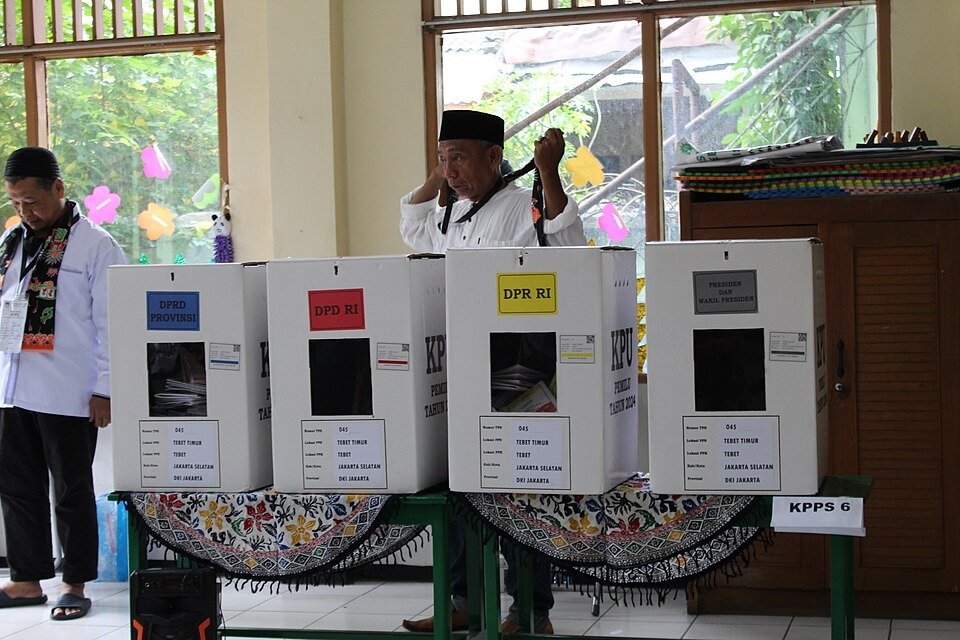
Ballot boxes at a polling station in South Jakarta, during the 2024 Indonesian general election. (Wikimedia/Faldi00)
Democracy Is No Mere Elections
Democracy cannot be reduced to elections, political parties and representative institutions. It also depends on the quality of information available to the public. Citizens cannot make meaningful judgements about government performance if important information is inaccessible, distorted or drowned in a constant stream of propaganda, disinformation and partisan messaging.
This is where the contemporary information crisis becomes more complicated than traditional censorship. In the past, traditional authoritarian control was easier to identify because it often appeared in visible forms: newspapers were banned, licences revoked, broadcasts restricted or journalists imprisoned. Today, pressure may operate more subtly through legal complaints, coordinated online attacks, restricted access to information, economic pressure, political patronage, cyber harassment or conditions that encourage editorial self-censorship.
The effects are equally serious. When journalists begin to question, not only whether a story is accurate and important, but whether publishing it is worth the legal, political or economic consequences, the public sphere has already become narrower.
Jürgen Habermas’ concept of the public sphere remains relevant here. Democracy requires a communicative space in which citizens can debate matters of common concern and critically evaluate those who exercise power. Yet such a space cannot function properly if public communication is dominated by manipulation, disinformation and unequal access to information.
The problem, therefore, is no longer simply whether people have access to information. In the digital era, people have an abundance of information. The deeper problem is whether they can distinguish credible information from manipulated content, political messaging, fabricated claims and algorithmically amplified outrage.
This is why independent journalism still matters. Journalism does not possess a monopoly on truth, nor should it claim one. Its democratic value lies in a method: verification, evidence, multiple sourcing, editorial scrutiny, correction and accountability. In a fragmented information environment, those practices are not merely professional routines; they are part of the infrastructure that allows citizens to make reasoned judgements.
When Law Becomes a Chilling Force

Banner instructing residents not to ‘like’ or ‘share’ non-mainstream views (that ‘insult the institution’, i.e. the monarchy) on social networks under direct threat of prison observed near Chit Lom, Bangkok, Thailand in 2014. (Wikimedia/Pratyeka)
Press freedom is inextricably intertwined with the law, which serves as both a shield and sword.No serious defence of press freedom should imply that journalists stand above the law. Journalism must remain accountable for accuracy, fairness, ethical conduct and respect for the rights of others. For instance, Indonesia has Law No. 40 of 1999 on the Press, which provides legal recognition for press freedom and establishes mechanisms for resolving journalistic disputes. At the same time, journalists also operate within broader legal frameworks, including the Electronic Information and Transactions Law and provisions of the new Criminal Code (KUHP). The problem arises when legal mechanisms are so broadly interpreted, selectively used or repeatedly invoked that they generate fear rather than accountability.
This is the point at which law can produce a chilling effect. Even when a journalist is eventually cleared, the burden of investigation, litigation, legal fees, repeated questioning and public intimidation may be enough to discourage further critical reporting. Censorship, therefore, does not always require an official ban. In many cases, fear becomes a more efficient instrument.
That is why the distinction between legitimate accountability and punitive legal pressure must remain clear. A democratic legal system should be able to address genuine violations without creating an environment in which investigative journalism becomes professionally hazardous.
A Regional Pattern with Different Faces
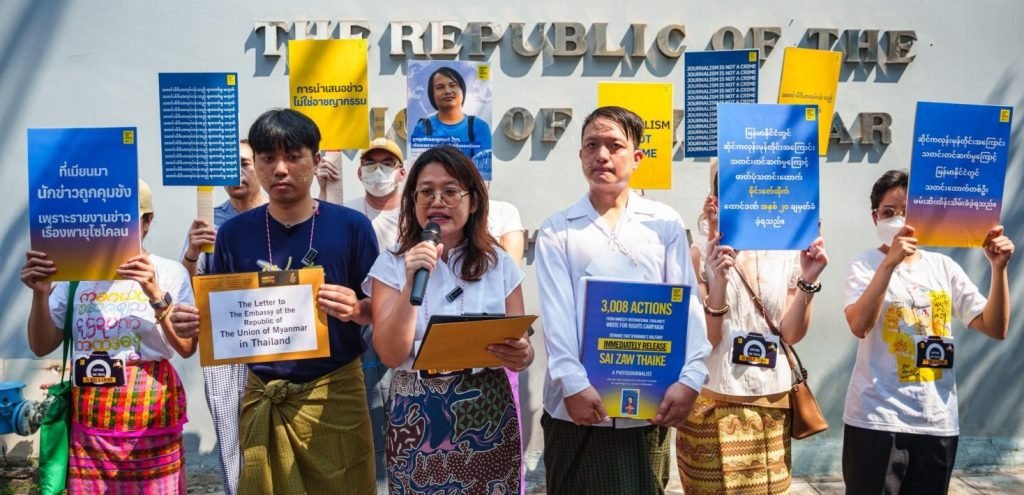
Amnesty International Thailand activists gather in front of the Myanmar Embassy in Bangkok Thailand, on April 8, 2026, submitting 3,008 signatures demanding the release of imprisoned Myanmar photojournalist Sai Zaw Thaike. (Amnesty International Thailand)
The journalism profession in Indonesia faces serious threats in the form of physical intimidation and legal criminalisation. In 2025, Tempo Magazine journalists were terrorised with the delivery of a pig’s head and rat carcasses as a result of their investigative reporting. Meanwhile, the Attorney General’s Office arrested Jak TV journalist Tian Bachtiar using an obstruction of justice clause for allegedly producing negatively framed news. This situation has raised major concerns among press organisations, as it risks setting a precedent for criminalising journalism, which directly threatens democracy.
Such pressures are not unique to Indonesia. Across Southeast Asia, different political systems produce different forms of constraint, yet several patterns recur: restrictive laws, ownership concentration, political influence, fragile media business models, digital intimidation and pressure on reporters covering sensitive issues.
Myanmar represents the most severe form of this regional crisis, with independent media organisations and journalists facing arrests, imprisonment and newsroom closures after the 2021 military coup. In Thailand, debates over freedom of expression remain closely connected to lèse-majesté laws and other regulatory instruments. Vietnam has relied on legal provisions to prosecute independent journalists and bloggers, while Cambodia has experienced restrictions and closures involving independent media organisations. The Philippines, despite its strong journalistic tradition, continues to confront legal pressure, digital harassment and violence against reporters.
These cases should not be treated as identical, because the political institutions and legal systems of each country are different. What matters is the broader pattern: press freedom can be weakened through many routes. In one country the pressure may be overtly coercive, in another it may be legalistic, while elsewhere it may emerge through media ownership, advertising dependency, restricted access or coordinated digital harassment.
The common democratic question remains unchanged: can citizens still obtain credible and independent information about those who exercise power?
If the answer increasingly depends on political permission, economic relationships or personal courage, then the problem is no longer merely professional. It has become a problem of democratic accountability.
Beyond the Myth of the Heroic Journalist

The Philippine News Agency celebrates its 50th anniversary of state newswire broadcasting on March 1, 2023. (PNA)
Discussions about press freedom often celebrate courage, and rightly so. Many journalists continue to report despite intimidation, digital harassment and legal threats. Yet there is something troubling about a democratic system that requires journalists to become heroes simply to perform ordinary professional duties.
Courage is an individual virtue; press freedom is an institutional condition. This distinction is crucial. A courageous journalist may expose one abuse of power, but public access to information cannot depend indefinitely on individual bravery. It requires an ecosystem of protection: appropriate laws, independent courts, professional media institutions, responsible law enforcement, sustainable news organisations, strong professional associations, universities that support critical literacy and citizens who understand the democratic value of verified information.
Press freedom, in other words, is too important to be left to journalists alone.
The Public’s Right to Know
The debate must therefore move beyond the language of protecting the press. What is ultimately at stake is the society’s ability to know how power is exercised, how public money is used, how policy decisions are made, whose interests benefit from those decisions and how citizens are affected.
Journalists are among the institutions that make this knowledge possible, but they are not owners of truth and should never present themselves as such. Journalism must remain accountable for upholding the integrity necessary to protect its own legitimacy. Their democratic legitimacy lies in a more modest but indispensable commitment: to search for verifiable facts, subject claims to scrutiny and place relevant information before the public. Ultimately, the stronger the ethical standards of journalism, the stronger its public claim to institutional protection.
This is why the title question matters. Who protects the public’s right to know?
The answer cannot be journalists alone. Law must protect legitimate journalistic work. Courts must remain independent. Public institutions must respect criticism. Media owners must defend editorial autonomy. Journalists must maintain professional standards. Technology companies must confront the distortions created by their own platforms. Universities must strengthen media literacy. Citizens themselves must continue to question authority and demand evidence.
Press freedom, then, is not a special privilege of the press. It is a democratic right exercised through the press. When a journalist is silenced, the visible victim may be the reporter. Yet the deeper victim is the citizen who never receives the information that might have been uncovered. When a newsroom chooses silence because the political or economic cost of publication is too high, society may never even know what it has lost.
That is why the condition of journalism in Southeast Asia should concern everyone, not only those who work in newsrooms. A democracy may continue to hold elections, maintain institutions and perform political rituals, but if citizens increasingly lose access to credible and independent information, democratic life itself becomes thinner.
The Malacca Strait has long connected societies through the movement of people and goods. The challenge now is to keep another passage open: the flow of credible information between power and the public.
Because when the public loses its right to know, it gradually loses its capacity to question, to judge and ultimately to govern itself.
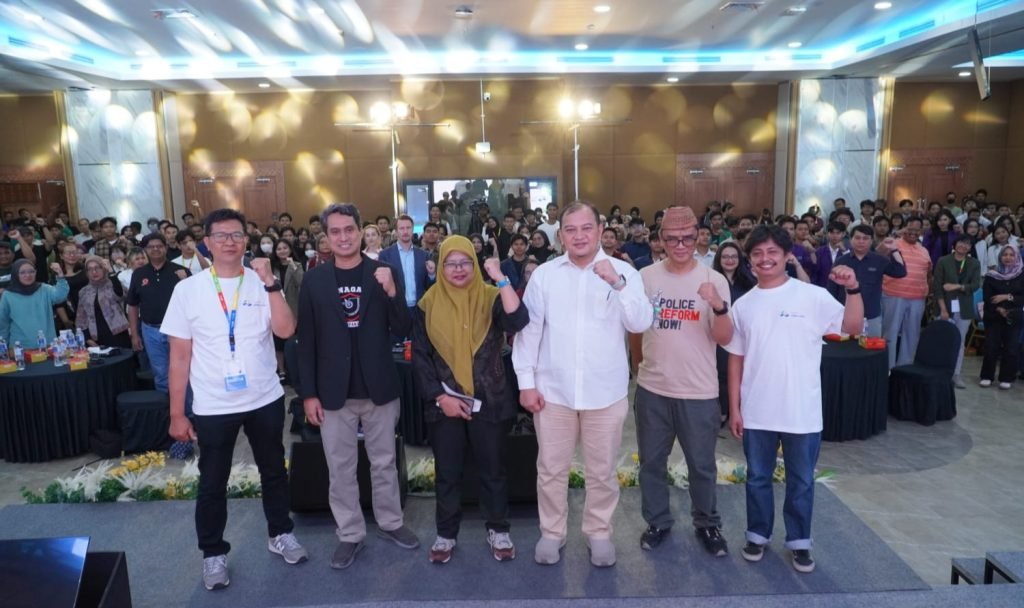
Journalists and civil society groups join hands at the Festival Media Selat Malaka on September 19. (Fesmed Malacca Strait Committee)
About The Author