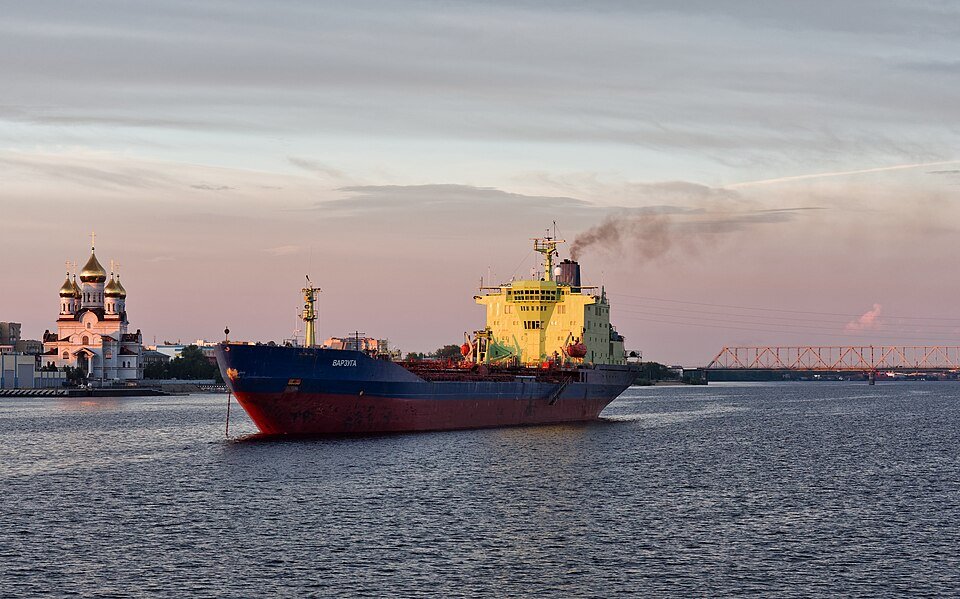
A Russian oil tanker sails along the Northern Dvina River in Arkhangelsk, Russia. (Wikimedia)
Southeast Asia’s largest economy has confirmed that it will persist with importing Russian crude oil, aiming to secure its energy supply despite heightening economic pressure from Washington.
Addressing the media in Jakarta on September 11, Energy and Mineral Resources (ESDM) Minister Bahlil Lahadalia, stated, “We are looking for a priority scale that can secure our crude supply first, as long as it does not violate the rules and is economically viable”.
For Southeast Asia, a trade-exposed region heavily reliant on energy imports, the recent Hormuz disruptions unveiled its business-as-usual vulnerability, proving that a collapse is inevitable without a structural transformation. Even Indonesia, regardless of its vast energy resources, wasn’t immune.
Turning to Moscow serves as a pragmatic stopgap move for Indonesia, which analysts view as part of the administration’s broader, long-term endeavour to achieve its aspiration for national energy self-sufficiency. The strategy appears justifiable given that the latest global energy crisis has inflicted severe, direct impacts on the households—impacts that will undoubtedly outlast the short term.
Minister Bahlil backed the diversification effort, saying, “The sovereignty of our nation cannot be interfered with by anyone,” referencing Indonesia’s long-standing free and active foreign policy principles.
With a multi-phase procurement framework for 150 million barrels of Russian crude secured since April, the Minister confirmed that the second phase is now underway. Per it was confirmed, reportedly Indonesia’s domestic crude oil production continues to fall short of targets, with ministry data from September 8 recording output at 571,731 barrels per day against the 2026 goal of 610,000 barrels per day.
Nevertheless, this intricate issue isn’t isolated from geopolitical risks. Discussions on the ever-uncertain, fragmenting world order continue dominating policy discourses, highlighting the necessity of a coordinated regional response. For countries like Indonesia, navigating such turbulence will substantially hinge on its neighbouring states’ synergy and harmonisation.
This complex intersection will be explored in the upcoming “Symposium on ASEAN and Geoeconomics: Energy, Security and Trade,” co-organised by FACTS Asia and the Institute for Strategic Policy (ISP) Thailand. Notably, thornier hurdles facing ASEAN nations as they navigate their future together are expected to be confronted.
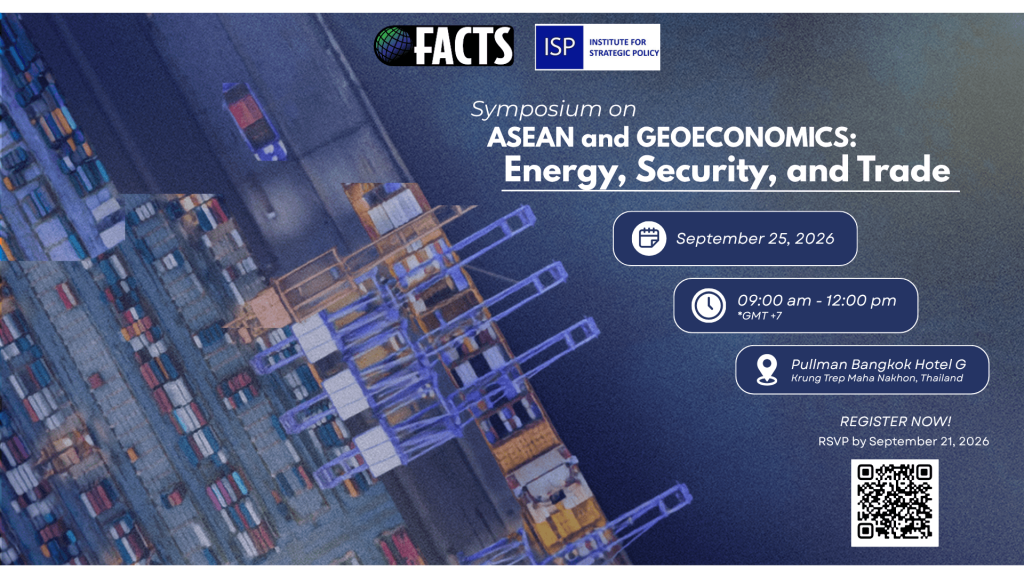
Find out more about the event here.
About The Author