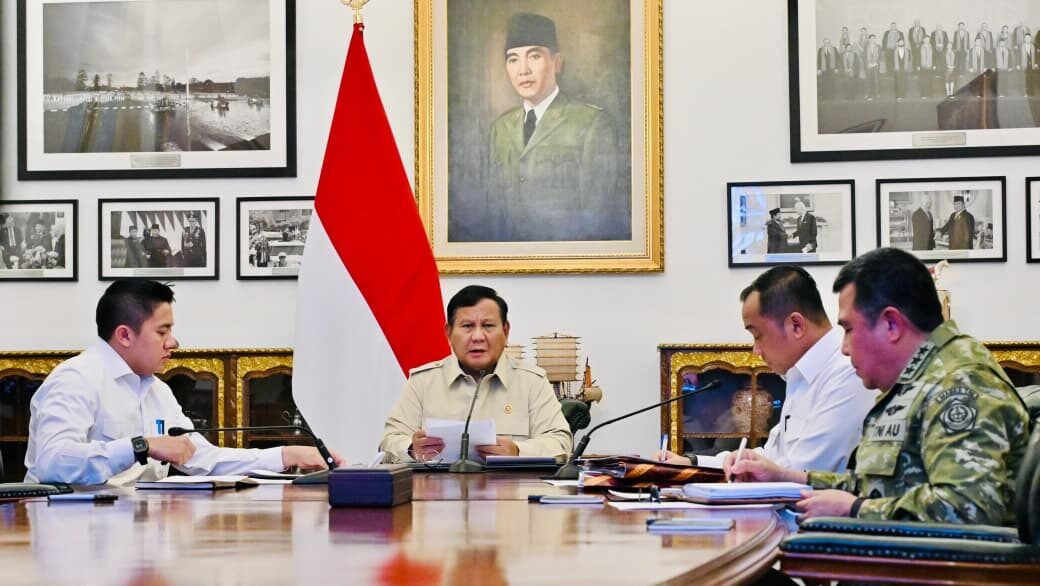
Indonesian President Prabowo Subianto leads a meeting on disaster preparedness and mitigation on September 7. (BPMI Setpres/Laily Rachev)
On September 7, Indonesian President Prabowo Subianto called for a significant increase in the budget for disaster mitigation as the government reviews its preparedness following an earthquake in Flores, volcanic activity at Mount Anak Krakatau and forest and land fires in several provinces.
Indonesian President Prabowo said Indonesia’s location on the Pacific Ring of Fire required the government to prepare for disasters before they occur. “The budget allocation for disaster mitigation must be significantly increased,” he said.
He added that planning should follow the principle of having sufficient capacity in advance, including personnel, equipment and other resources needed to respond to emergencies.
The emphasis comes as Indonesia continues to restore essential infrastructure in areas affected by recent disasters. The National Disaster Management Agency (BNPB) said infrastructure and public services in East Nusa Tenggara were gradually recovering after the last month’s earthquake, with electricity, communications, fuel supplies, clean water and transport routes generally functioning again.
The government has also continued firefighting operations while monitoring conditions during the dry season. BNPB said ground and air task forces remained active and that weather-modification operations were being used to support efforts to contain forest and land fires.
Disaster resilience has also been identified as part of Indonesia’s longer-term infrastructure agenda. During his 2027 draft state budget, Indonesian President Prabowo listed infrastructure, housing and disaster resilience among eight national priority programmes.
He also called for the construction of a Giant Sea Wall along Java’s northern coast, describing it as long-term protective infrastructure for densely populated and industrial areas vulnerable to rising sea levels, and the government’s response to recent disasters had become faster, but argued that preparations should be strengthened further before emergencies occur.
The policy signals a shift towards treating disaster mitigation as a long-term infrastructure and planning issue rather than primarily an emergency-response function. Improving the resilience of transport, water, communications and other essential networks could reduce disruption when disasters occur. The challenge will be translating higher budget allocations into durable infrastructure and preparedness measures across an archipelagic country exposed to disaster hazards.
About The Author