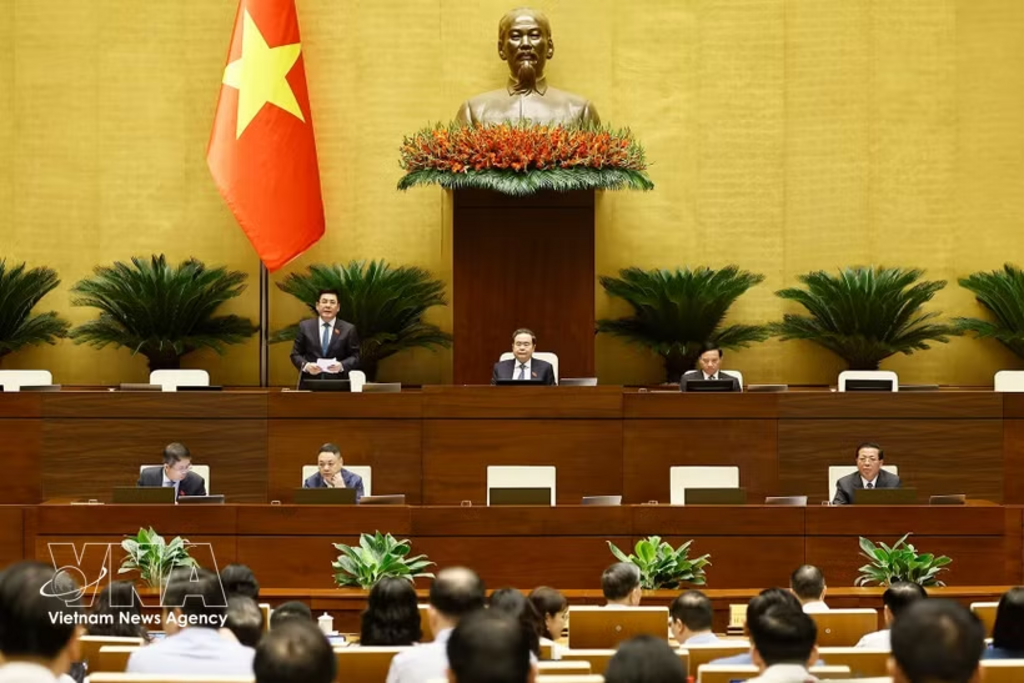
Vietnamese lawmakers attend a National Assembly session in Hanoi. (Vietnam News Agency)
On August 22, Vietnam’s 16th National Assembly is debating proposed changes to real estate regulations, public financial management and the implementation of the Ninh Thuận nuclear power project during its extraordinary session in Hanoi.
Lawmakers are reviewing amendments to the Law on Real Estate Business and mechanisms for sea-encroachment urban projects under the draft Law on Urban Development. The proposed changes seek to improve market transparency, accelerate digital transformation and reduce administrative and investment barriers.
The revised real estate law would simplify nine of 31 investment and business conditions, eliminate four administrative procedures and transfer authority to approve certain real estate project transfers from the Prime Minister to provincial People’s Committees, in line with Vietnam’s two-tier local administration model.
Vietnamese lawmakers will also discuss consolidating the State Budget Law and Public Investment Law into a unified public financial management framework. The government says the existing laws create overlaps in planning, authority and procedures. The proposed legislation would integrate five-year financial planning and state budget estimates with public investment plans to reduce administrative costs and improve the use of public resources.
The session will also consider separating the Ninh Thuận nuclear power project into independent projects, as Vietnam seeks to revive nuclear power development after suspending plans nearly a decade ago.
The discussion comes as Vietnam and Russia deepen cooperation in nuclear energy. Following Vietnamese Communist Party General Secretary Tô Lâm’s visit to Moscow, the two countries agreed to promptly negotiate and sign intergovernmental agreements on nuclear power plant construction in Vietnam, with advanced technology and nuclear and radiation safety requirements.
The legislative agenda reflects Vietnam’s broader effort to improve state efficiency, decentralise decision-making and create a more integrated framework for managing public resources. At the same time, the revival of nuclear power links institutional reform with long-term energy security and economic growth. Russia’s role could provide Vietnam with technological and investment support, while also requiring Hanoi to manage strategic dependencies, regulatory oversight and energy security considerations.
About The Author