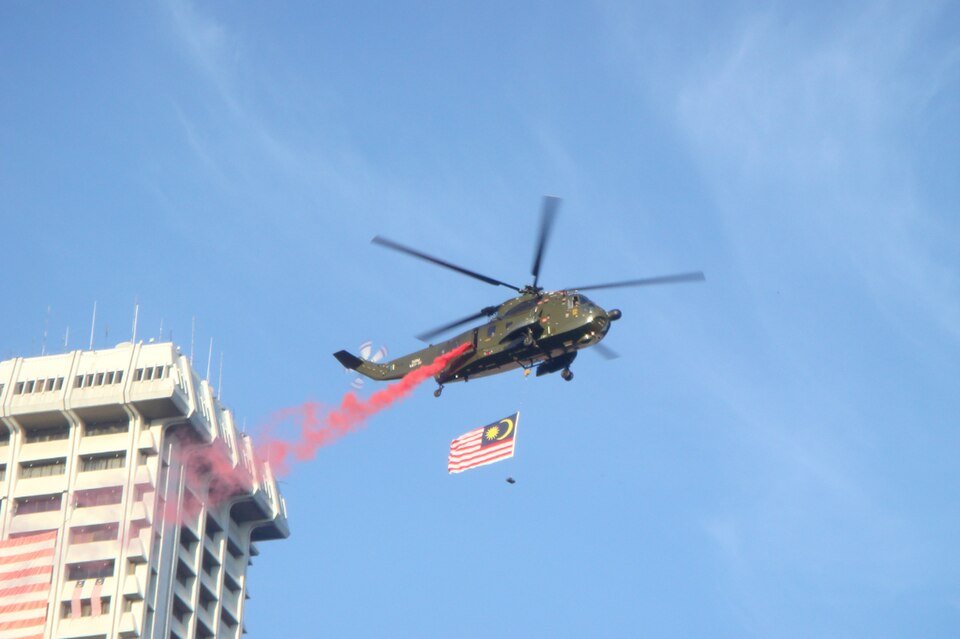
A Malaysian Armed Forces helicopter carries the national flag. (Wikimedia)
Malaysia is boosting its military spending and preparedness as geopolitical tensions heighten in an increasingly complex security landscape.
The minister further explained that “it is not that Malaysia suddenly sees any particular country as a threat, but there is clearly an increase in military activity and presence in the region, particularly as strategic competition between the major powers intensifies. “When one side increases its presence or capabilities, it is natural that others may respond accordingly. This creates a more complex security environment for countries like Malaysia,” he added.
Minister Khaled also clarified that upgrading Malaysia’ military, specifically modernising its armed forces, has long been a core goal, with a persistent effort to increase defence spending targeted to reach 1.5% of the country’s gross domestic product (GDP) by 2030.
This stance echoed the statement made a day earlier by Prime Minister Anwar Ibrahim, who also serves as Finance Minister, that additional defence spending is needed, “potentially reaching hundreds of millions to billions of ringgit”. The Prime Minister argued that such measures are to “ensure sufficient assets and capabilities to navigate an increasingly complex security environment”.
Crucially, Minister Khaled discussed developments in the South China Sea, noting that “any escalation in the area could have wider implications for national security”.
What does this mean for business?
From an economic perspective, Malaysia’s defence expansion could translate into tangible commercial shifts, as capital deployment potentially generates lucrative procurement contracts for companies specialising in maritime logistics, engineering and infrastructure. Furthermore, as the state intensifies its focus on emerging cyber and electromagnetic threats, the technology sector may expand significantly. This industrial shift could consequently increase workforce demand, aligning with Malaysia’s national focus on Technical and Vocational Education and Training (TVET) to supply the skilled labour required for these modernising supply chains.
Kala Advisory helps investors turn regional defence procurement and technological modernisations like these into targeted, country-by-country entry plans across Southeast Asia. Visit kala-advisory.com.
About The Author