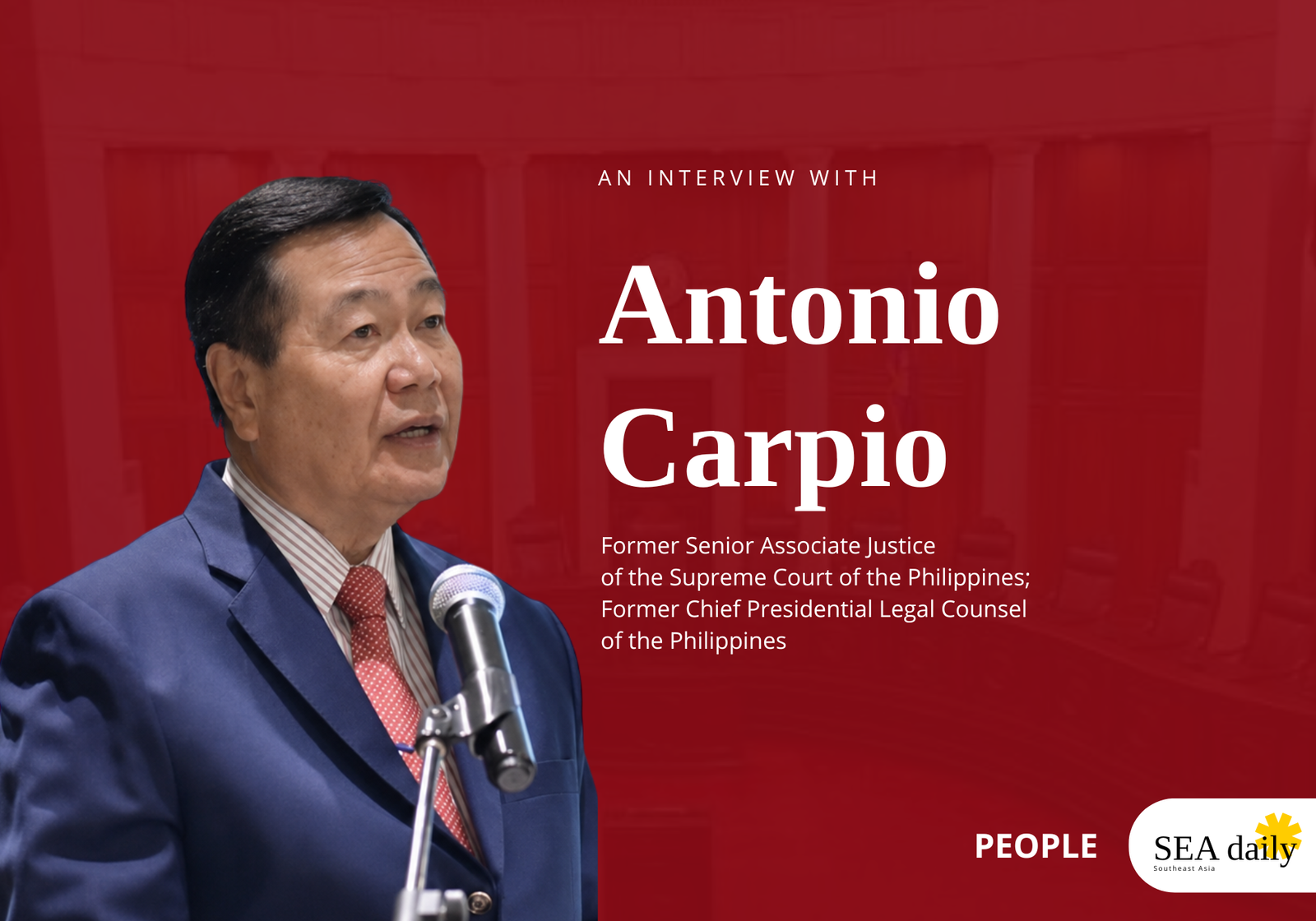
Former Senior Justice of the Supreme Court of the Philippines Antonio Carpio. (Philippines News Agency)
A single sheet of paper may seem insignificant against coast guard ships, offshore bases and competing territorial claims. Yet, for former Philippine Supreme Court Senior Associate Justice Antonio Carpio, that sheet of paper could make all the difference in the South China Sea.
Speaking at the 10th commemorative event of the 2016 South China Sea Arbitral Award in Jakarta, he flew more than 2,700 kilometres from Manila with one simple message: countries should never remain silent when their maritime rights are challenged.
SEA Daily had the opportunity to speak with Justice Carpio on the sidelines of the conference, held on July 13-14. During the conversation, the veteran jurist returned repeatedly to a principle that has shaped much of his work over the past decade, that under international law, silence can carry consequences just as significant as action.
That conviction reflects a career spanning nearly two decades on the Philippine Supreme Court. A graduate of the University of the Philippines College of Law, he built his career in both private practice and public service before joining the Philippine Supreme Court in 2001. He served as Associate Justice for nearly 20 years and later became the Court’s Senior Associate Justice—the second-highest-ranking official in the country’s highest court—until his retirement in 2019. Since then, he has become one of the Philippines’ leading advocates of the 2016 South China Sea arbitral award, explaining its legal significance to governments, universities and international audiences while championing the United Nations Convention on the Law of the Sea (UNCLOS) as the foundation for resolving maritime disputes.
The Law Behind the Dispute
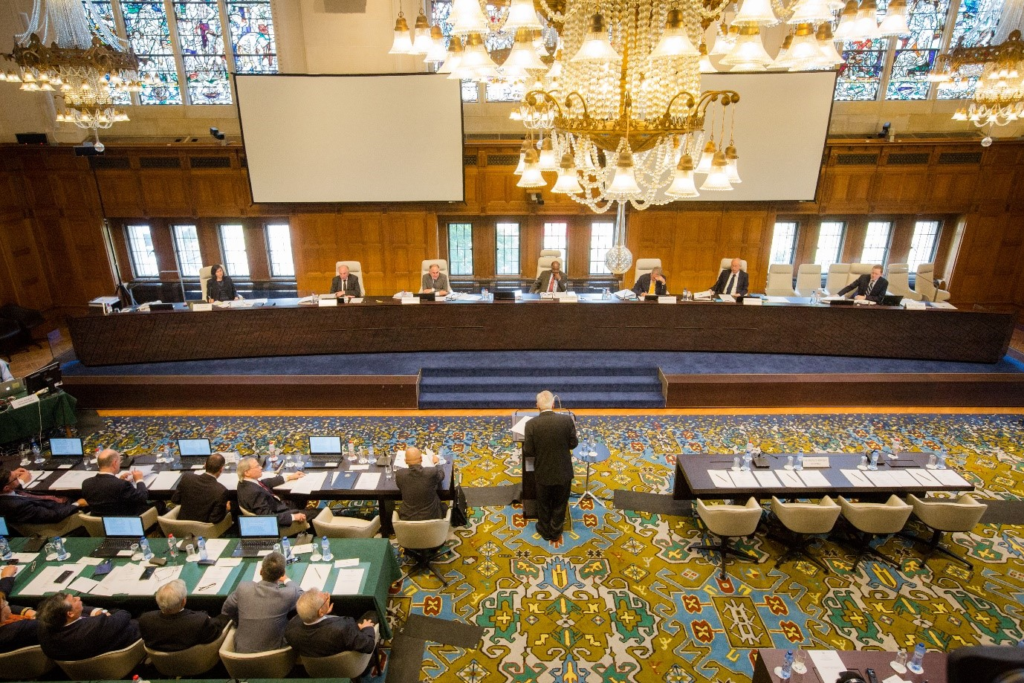
A photo released by the Permanent Court of Arbitration (PCA) after issuing its 2016 South China Sea Arbitral Award on July 12, 2016. (Permanent Court of Arbitration)
For Justice Carpio, the South China Sea dispute is not primarily about naval power or geopolitical rivalry. At its core, he argues, it is a question of maritime entitlements: who is legally entitled to claim and exercise rights over certain waters under international law?
That legal framework is provided by UNCLOS, often described as the “constitution of oceans.” Adopted in 1982 and ratified by more than 160 countries, UNCLOS establishes the rules governing territorial seas, exclusive economic zones (EEZ), continental shelves and the freedom enjoyed on the high seas.
Throughout the interview, Justice Carpio repeatedly highlights that UNCLOS is more than an international treaty, it is the legal foundation upon which the Philippines has built its case in the South China Sea. That belief ultimately led to the 2016 South China Sea Arbitral Award, issued by the Permanent Court of Arbitration (PCA)—an intergovernmental arbitration organisation of which both China and the Philippines are contracting parties—which he regards as the primary legal framework of the dispute. Initiated under UNCLOS, the arbitration concluded that China’s claim based on the nine-dash line has no legal basis under the convention and clarified the maritime entitlements of neighbouring coastal states. While the tribunal did not determine sovereignty over disputed islands, it established how international law should be interpreted in relation to maritime rights.
In his view, one principle remains irreplaceable: the value of the arbitral award lies not only in what it decided, but in its continued use. The ruling remains the strongest legal framework for states seeking to uphold their maritime rights and preserve the rules-based international order.
Why Silence Matters
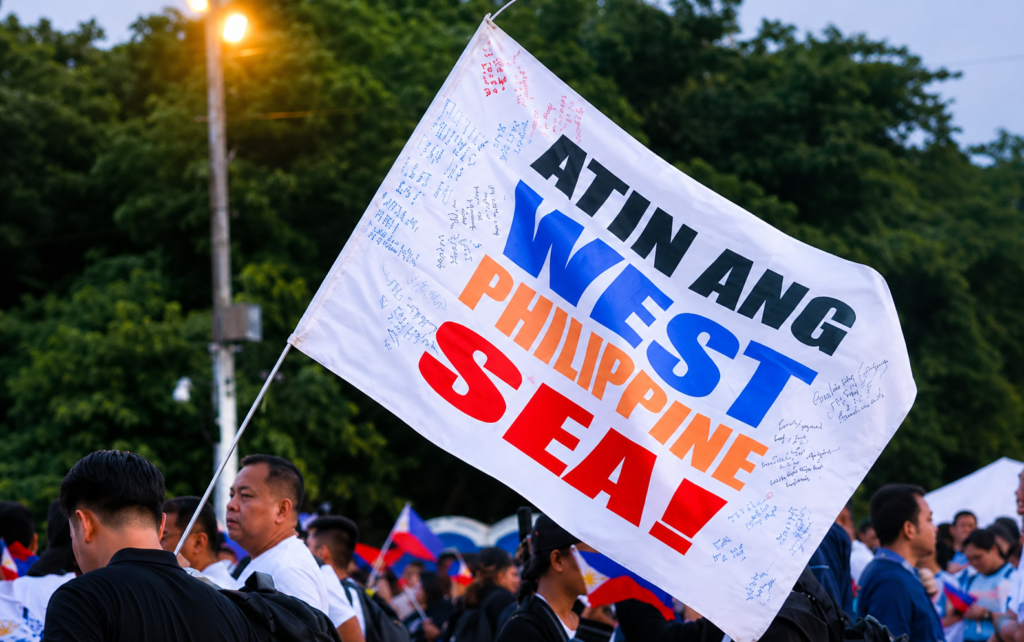
Personnel from the military, law enforcement agencies and other government offices wave Philippine flags and carry streamers during the National Peace Walk 2026 at the Quirino Grandstand in Manila on July 12, 2026, marking the 10th anniversary of the landmark 2016 South China Sea Arbitral Award. (Philippine News Agency)
Justice Carpio maintains that protecting maritime rights does not always require a warship or a courtroom. He said it begins with something far simpler: an official diplomatic protest. During the interview, he returned to what he described as a basic yet often overlooked principle of international law. Whenever a state disputes another country’s territorial or maritime claim, it should formally express its objection. In his view, such a protest is inexpensive, straightforward and legally essential.
“It doesn’t cost us anything except that piece of paper. But if we don’t protest, it will be a big problem,” he argued.
His arguments rooted back to the legal doctrine of acquiescence, under which prolonged silence may, in circumstances, be interpreted as implied consent. He maintains that if a state fails to challenge another state’s claim within a reasonable period, the claiming state may later argue that the absence of protest amounts to acceptance. A formal diplomatic note, he said, prevents such an interpretation from taking hold by making a state’s position clear from the outset.
To illustrate the point, he referred to China’s submission of its nine-dash line map to the United Nations (UN) in 2009. Although Beijing had used the map domestically for decades, he noted that it only became an international claim when it was formally communicated to the UN. Justice Carpio said that numerous countries including the Philippines, Vietnam, Malaysia and Indonesia, responded with diplomatic protests. He added that the tribunal later recognised that those objections had been made within a reasonable period, rejecting the argument that other states had acquiesced simply because the map had existed since 1947.
Justice Carpio believes the same principle now applies to the High Seas Treaty, the UN agreement that establishes the first legal framework to conserve marine biodiversity in waters lying beyond any country’s national jurisdiction. According to him, China is confirming its position that there are no high seas within the area enclosed by its ten-dash line, on the grounds that those waters fall under its jurisdiction. He argued that governments should respond as they did in 2009, by lodging formal protests rather than allowing the claim to go unchallenged.
Still Waiting on the Code

Former Senior Justice of the Supreme Court of the Philippines Antonio Carpio during a panel session of the French Embassy-Stratbase Institute forum on ocean governance in Makati City on June 9. (Philippines News Agency)
During the interview, he also expressed concern over the pace of negotiations between ASEAN and China on a long-awaited Code of Conduct (CoC) for the South China Sea. More than two decades after the 2002 Declaration on the Conduct of Parties on the issue called for such an agreement, he questioned why negotiations remain unfinished. According to Justice Carpio, China has repeatedly stated that the Code would be concluded only “when the time is right,” a position he views with skepticism.
In his assessment, the delay is significant because it could allow new developments in the disputed waters before any rules are finalised. He argued that a future CoC should explicitly incorporate the 2016 South China Sea Arbitral Award. Without recognising the tribunal’s findings, he believes the agreement could overlook the legal rights clarified by the ruling and weaken its value as a framework for managing future disputes.
Rather than viewing the Code as merely a diplomatic milestone, he sees it as another test of whether international law will continue to shape the region’s maritime order. In his view, any lasting agreement should reinforce, rather than replace, the legal principles established under UNCLOS and affirmed by the arbitral tribunal.
An Intergenerational Struggle

Former Senior Justice of the Supreme Court of the Philippines Antonio Carpio during the 10thcommemorative event of the 2016 South China Sea Arbitral Award in Jakarta on July 13-14, 2026. (SEA Daily/Sadina Aimee)
Ten years after the landmark arbitral award, Justice Carpio remains realistic about what international law can achieve. He does not expect a single ruling, or even a single generation to resolve one of Asia’s most complex maritime disputes.
Instead, he describes the defence of maritime rights as “an intergenerational struggle.” Reflecting on the future, he said his generation had laid the foundation by securing the 2016 Arbitral Award, but that the responsibility now rests with those who follow.
For him, the arbitral award should not be viewed as the conclusion of the South China Sea story, but as the beginning of a long-term legal effort. He believes future governments must continue invoking the ruling, lodging diplomatic protests when necessary and defending the principles established under UNCLOS. In his view, consistency, not confrontation, will determine whether the award retains its legal and practical significance over time.
As the twentieth anniversary of the arbitral award approaches in 2036, he hopes the region will continue to strengthen a rules-based maritime order through international law. Rather than measuring progress solely by political breakthroughs or shifting geopolitical dynamics, he believes success should also be judged by the willingness of states to uphold the legal principles they have already committed to.
Protecting the South China Sea is not simply about defending territory. For the veteran jurist, it is about ensuring that future generations inherit an international legal order where rights are preserved not through silence or force, but through the consistent application of law.
About The Author