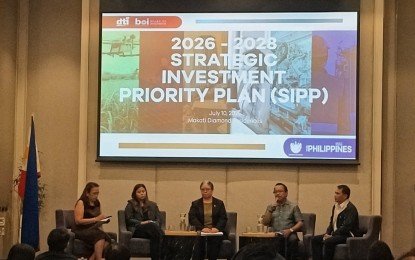
The Luzon-leg of the 2026-2028 Strategic Investment Priority Plan in Makati City, Philippines, July 10. (Philippine News Agency).
On July 10, the Luzon leg of the 2026-2028 Strategic Investment Priority Plan (SIPP) Roadshow commenced in Makati City, the Philippines. It served as the official venue for presenting Manila’s newly revised fiscal incentives and high-value investment paths.
The event was jointly coordinated by the Board of Investments (BOI), the Fiscal Incentives Review Board (FIRB) and various investment promotion agencies (IPAs).
Finance Secretary Frederick Go spearheaded the event. During his remarks, he described the SIPP as a “deliberate effort of the government” to “align investments with the country’s economic and development objectives”.
He added that the SIPP is a “policy tool that guides investments towards sectors that can generate jobs, strengthen industries, accelerate innovation and create lasting economic value,” emphasising that “around the world, countries are using industrial policy to boost competitiveness, building resilience and secure future growth”.
Echoing this sentiment, Trade and Industry and BOI managing head Ceferino Rodolfo stated that the SIPP is an “important instrument for building strategic industries and creating conditions needed for long-term competitiveness”.
He further explained that the BOI is “fast-tracking” the conclusion of general policies and specific guidelines scheduled to be published in the third quarter of 2026.
Reportedly, the new framework introduces a significantly more structured approach to investment promotion by establishing the ‘New Modern Basic Needs’ category. This core classification centralises and aligns prioritised activities across seven pivotal sectors, namely manufacturing, agriculture, services, infrastructure, logistics, healthcare and energy.
What does this mean for business?
While on the surface this event reflects a concerted drive for fiscal incentives, the newly introduced SIPP should be understood as a profound framework shift. Crucially, the policy addresses deep-seated, structural challenges facing the Philippines, focusing heavily on critical areas such as energy, food and water security.
Furthermore, following the World Bank’s recent elevation of the Philippines to Upper Middle-Income Country (UMIC) status, the nation will gradually lose its eligibility for low-interest Official Development Assistance (ODA) loans. This structural reality underpins the state’s aggressive strategy to utilise the SIPP to capture high-value private capital. Ultimately, the government plays a pivotal role here, ensuring that robust regulatory frameworks and streamlined processes actively enhance the ease of doing business.
Kala Advisory helps investors turn openings like these into targeted, country-by-country entry plans across Southeast Asia. Visit kala-advisory.com.
About The Author