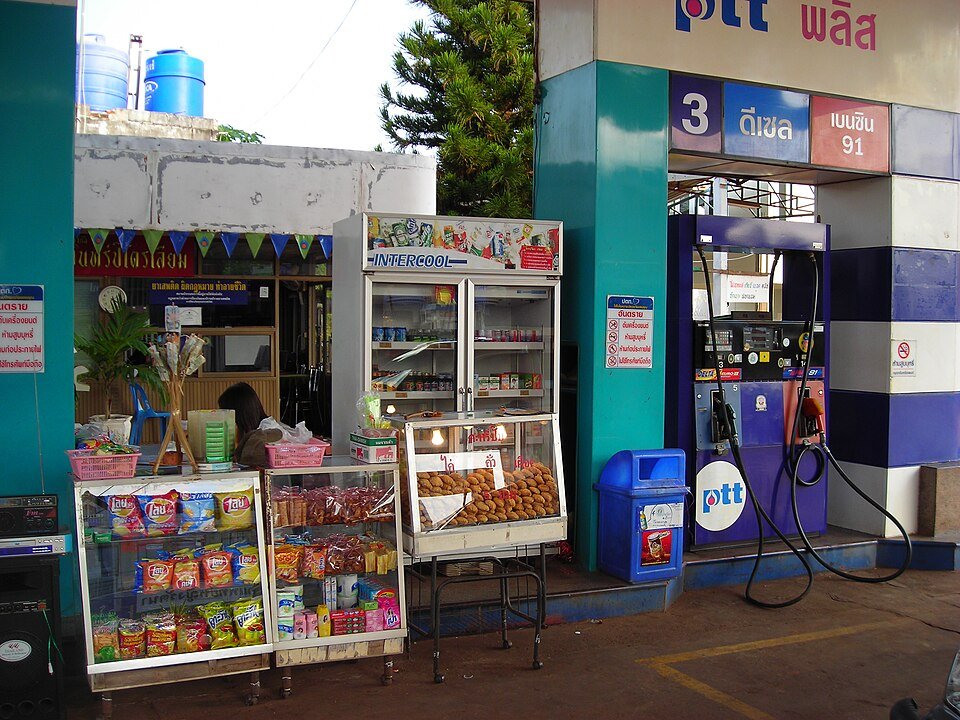
A gas station with a small roadside shop in the Isan region of Thailand. (Wikimedia/Mattes)
As of July 8, Thailand has cut oil prices, with diesel decreasing by 2.56 Thai baht (0.08 US dollar) per litre, while gasoline and gasohol dropped by 2.51 Thai baht (0.07 US dollar) per litre across all grades.
This adjustment was regulated by the Energy Policy Administration Committee under Section 3 of the Emergency Decree on Remedy and Prevention of Shortage of Fuel Oils, BE 2516 (1973) and Clause 3 of the Prime Minister’s Order No 15/2019 to address fuel shortages. The Committee has also approved a retail fuel price framework limiting gasohol and high-speed diesel to a maximum of 35 baht per litre (1.05 US dollar).
This is a swift response from Thailand’s Energy Ministry following a direct order issued to the Oil Fuel Fund Executive Committee by Prime Minister Minister Anutin Charnvirakul just a day before.
Speaking on July 7 at the Government House in his capacity as Interior Minister, the Premier affirmed that he had instructed Energy Minister Akanat Promphan to “work on measures to bring down pump prices as much as possible”.
Given that global fuel prices have declined since the latest US-Iran peace pact, Prime Minister Anutin argued that such market calming must be passed on to consumers entirely and right away, rather than through gradual adjustments.
Prime Minister Anutin further elaborated that the price cut is part of a wider economic relief package, considering the daily household budgets that have been severely impacted by previous skyrocketing oil prices.
“When global prices rose, we asked the public to accept higher prices. Now that global oil prices have fallen, we do not need to ask people before lowering prices. Just lower them straight away, immediately and properly, not gradually,” he explained, noting that the public knew global rates had fallen and thus a domestic adjustment was non-negotiable.
What does this mean for business?
As an importer of roughly 80% of its crude oil (much of it sourced from the Middle East) Thailand was heavily exposed to the recent regional crisis. Spikes in jet fuel and transport costs hit agriculture, crippled fisheries and dampened tourism, prompting economists to warn that GDP growth could slide below 2%.
While the government initially deployed its Oil Fund to cap diesel, the recent US-Iran peace accord has finally allowed developing economies a moment to breathe. Financially, it would be rational for the state to maintain higher pump prices to recover from heavy subsidy exhaustion; however, by enforcing an immediate price cut, the Thai government is explicitly prioritising consumer relief and macroeconomic stability. This reflects a strategic bet that a revitalised economy will naturally offset the state’s fiscal recovery in the long run.
Kala Advisory helps investors read policy shifts like these, and the fiscal priorities behind them, before committing capital in Southeast Asia. Visit kala-advisory.com.
About The Author