
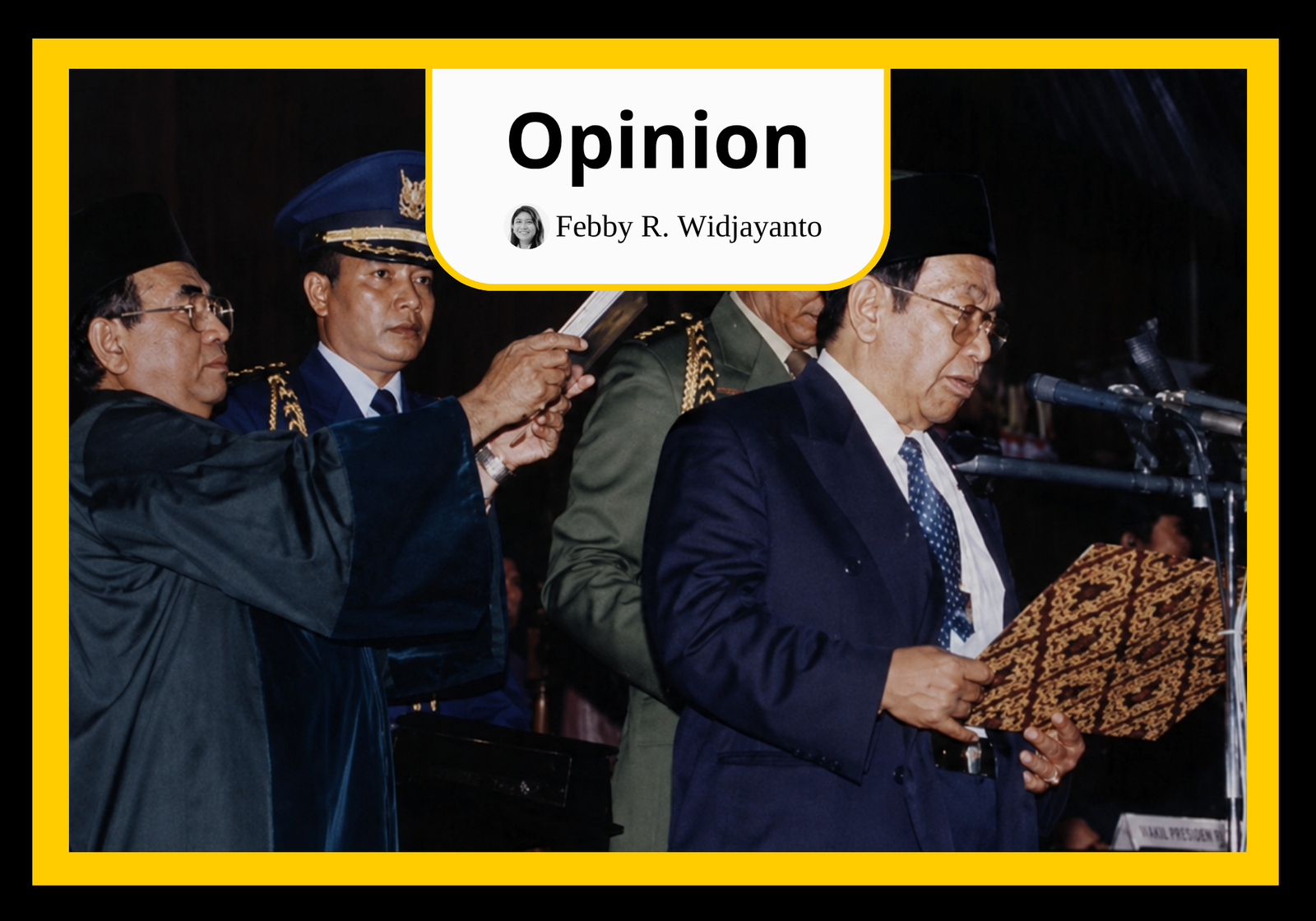
Inauguration of Abdurrahman Wahid on 20 October 1999, under whom the first two of Indonesia’s four constitutional amendments took place. (Wikimedia)
Febby R. Widjayanto is a faculty member and assistant professor at the Department of Politics, Faculty of Social and Political Sciences, Universitas Indonesia. Her areas of research interest include political economy, development studies, and the politics of science and technology. The views expressed are the author’s own and do not represent SEA Daily or that of another organisation.
Indonesia’s Reform era (Reformasi) commenced in 1998 with the resignation of President Soeharto, ending more than three decades of authoritarian rule. His resignation followed a week of widespread civil unrest amid the economic turmoil caused by the Asian financial crisis. More than two decades after the Reform era began, Indonesia still struggles with familiar political pathologies: excessive centralisation, uneven development, strained centre-periphery relations, entrenched oligarchic power and weak mechanisms of accountability.
This raises an uncomfortable question: are these recurring problems simply the product of flawed leadership or do they reveal fundamental shortcomings in the constitutional architecture of the Indonesian state itself?
The Problem with The Integralistic View
To understand why these institutional problems persist, it is worth revisiting the philosophical foundations of Indonesia’s constitutional design. Among the ideas that shaped the drafting of Indonesia’s constitution—domestically known as the 1945 Constitution after its year of conception—was the conception of an integralistic state of Soepomo, Indonesia’s first Minister of Justice. Influenced by the notion of the state as an organic entity, this approach emphasised unity and harmony over competition and contestation among societal interests. In this framework, the state was conceived as the embodiment of the common good, standing above competing social groups and particular interests.
By contrast, modern democracy does not regard the state as the ultimate objective of political life. It is an instrument for advancing the public interest and safeguarding the rights of citizens, rather than an entity whose authority stands above them. Therefore, the state is instead understood as a means to realise societal interests, subject to public scrutiny, institutional constraints and the sovereign will of the people.
Yet traces of a state-centric political culture remain visible in contemporary Indonesian bureaucracy. Public institutions often continue to act in a way superior to citizens. Rather than the state serving the public, it apparently operates the other way around. This tendency can be observed in bureaucratic practices that place disproportionate administrative burdens on ordinary people, even in areas where the state should be facilitating rather than complicating public compliance. Tax administration—for example, is frequently experienced not as a public service but as a cumbersome obligation imposed on citizens, despite the fact that taxpayers are the very source of the state’s fiscal capacity.
This reflects a broader constitutional and political dilemma. The integralistic conception of the state assumes a harmonious relationship between state and society and places considerable trust in state institutions to act on behalf of the common good. However, democratic constitutionalism posits that public power must always be treated with caution because those who wield it are neither infallible nor immune from corruption, abuse or capture by powerful interests.
The central principle of democracy is therefore not the supremacy of the state, but the sovereignty of the people. The state derives its legitimacy from its populace and not the other way around. Civil society, citizens and democratic institutions collectively constitute the ultimate source of political authority. Their role is not merely to obey the state but to scrutinise, constrain, and, when necessary, challenge it.
When constitutional arrangements place excessive faith in the benevolence of state institutions while providing insufficient safeguards against the concentration of power, the result can be a gradual inversion of democratic principles: citizens become accountable to the state to a greater extent than the state is accountable to citizens. It is precisely this imbalance that constitutional democracy seeks to prevent.
The Constitutional Blind Spot
Article 33 of Indonesia’s 1945 Constitution reveals a deeper constitutional dilemma. Although it reads “the land, the waters, and the natural resources contained therein shall be controlled by the State and utilised for the greatest prosperity of the people”, but it should not stop here because it is somewhat an unfinished premise. Hence, what kind of state does it imply? Either authoritarian or totalitarian one is also a state.
If natural resources are controlled by the state for the greatest prosperity of the people and it is somehow a sort of ideation about the country’s tailored welfare state, then why does it say relatively little about the democratic conditions under which such authority should be exercised. The crucial questions therefore remain: what kind of state is entrusted with such extensive authority, who controls the state, through what mechanisms and under what forms of accountability?
The article grants the state a central role in managing natural resources, but offers little guidance on the institutional safeguards required to ensure that such power is exercised transparently, accountably and in the public interest. This ambiguity becomes particularly significant when state institutions are vulnerable to elite capture, corruption, or excessive concentration of power. In such circumstances, constitutional promises intended to promote public welfare may instead serve narrower political or economic interests.
These questions are not merely theoretical. In practice, the benefits of state control over strategic resources depend heavily on the quality of institutions governing that control. Where public oversight is weak and political power becomes concentrated, state authority can be captured by narrow elite interests. Under such circumstances, resources that are constitutionally intended to serve the public good risk becoming instruments of oligarchic accumulation.
From this perspective, the challenge is not the principle of state stewardship itself. Many successful democracies grant the state an important role in managing strategic resources. The real issue is whether the constitution provides sufficiently strong safeguards to ensure that state power remains accountable to citizens rather than being vulnerable to capture by political and economic elites.
By the same token, the rise of oligarchic power in Indonesia illustrates the limits of relying on the state as the principal custodian of public welfare without equally strong constitutional safeguards. In practice, access to state institutions has often translated into access to economic privilege. The result is a political economy in which wealth and influence become mutually reinforcing.
Recent data illustrate the extent of this concentration. A study by CELIOS found that the wealth of Indonesia’s 50–55 richest individuals is comparable to that of approximately 50–55 million Indonesians. While inequality is not caused by constitutional design alone, such figures invite a broader question: has Indonesia’s constitutional framework provided sufficiently effective safeguards against the accumulation of economic and political power in the hands of a narrow elite? Thus, a sole constitutional order cannot simply assume that the state will always act benevolently. It must also establish clear mechanisms through which state power can be scrutinised, constrained, and held accountable by citizens.
Executive-heavy Issue

Indonesia’s first president, Suharto, announcing Presidential Decree of 5 July 1959 that practically centralised power in the hands of the executive. (Wikimedia)
Another enduring challenge in Indonesia’s constitutional development is the persistence of an executive-centric political system. The roots of this problem can be traced to Indonesia’s first leader, President Sukarno’s, Presidential Decree of 5 July 1959, which dissolved the Constituent Assembly and reinstated the 1945 Constitution. The decree marked a decisive shift toward a political order that concentrated authority in the presidency and weakened the role of representative institutions.
The consequences extended far beyond President Sukarno’s regime. The restoration of the 1945 Constitution reinforced a constitutional tradition in which executive authority occupied a dominant position within the state apparatus, while legislative and oversight institutions remained comparatively weaker. This executive-heavy orientation was further consolidated during the New Order era under the authoritarian President Suharto.
To be sure, the four constitutional amendments adopted between 1999 and 2002 significantly strengthened democratic institutions and introduced new mechanisms of accountability. Nevertheless, important remnants of executive dominance continue to shape Indonesian governance. The presidency remains the central node of political power, and the effectiveness of checks and balances often depends less on constitutional design than on the configuration of political coalitions and party alignments. As a result, the concentration of power in the executive branch remains a recurring concern in Indonesia’s democratic trajectory.
Partial Decentralisation
A similar contradiction can be observed in Indonesia’s approach to decentralisation. Although the country formally embraced regional autonomy following the democratic reforms of 1998, important elements of governance remain highly centralised. Fiscal resources continue to be concentrated in the hands of the central government, key policy decisions are frequently made in Jakarta and the scope of local authority remains subject to significant constraints.
As a result, decentralisation has often fallen short of its original promise. Large disparities in infrastructure, public services, and economic opportunities persist across regions, particularly between Java and many outer provinces. While some degree of regional inequality is inevitable in a vast archipelagic state, persistent perceptions of unequal treatment have fuelled frustration toward the central government in several parts of the country.
More importantly, excessive centralisation risks weakening the sense of political ownership among local communities. When decisions affecting local development are perceived to be imposed from the centre, demands for greater autonomy can intensify. In some cases, such grievances have contributed to anti-central government sentiment and strengthened separatist movements, particularly in regions with distinct historical, ethnic, or political identities.
This suggests that the challenge facing Indonesia is not merely one of administrative decentralisation, but of constitutional design. A democratic state as geographically, culturally, and economically diverse as Indonesia requires institutions capable of balancing national unity with meaningful regional self-government. Without such a balance, centralisation may preserve formal state authority while simultaneously undermining political legitimacy at the periphery.
Are constitutional amendments enough?
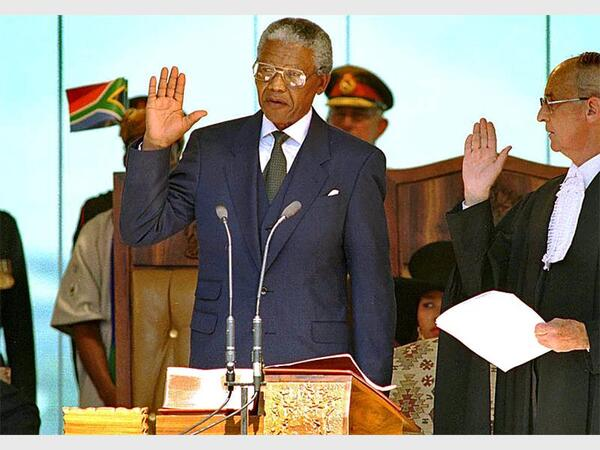
South Africa’s first black president, Nelson Mandela’s, speech following his election in 1994, which marked the end of the apartheid-era constitution. (South Africa History Online)
This raises a question that has long remained outside mainstream political debate: are four constitutional amendments enough? The issue is not whether Indonesia’s Constitution has failed, nor whether it should be discarded altogether. Rather, the question is whether the constitutional framework inherited from the twentieth century remains adequate for addressing the political, economic and governance challenges of the twenty-first.
Across the world, constitutional systems have periodically undergone fundamental redesign when existing institutional arrangements were no longer capable of accommodating new democratic aspirations. Constitutional scholars often refer to this process as constitutional refounding—the deliberate reconsideration of a country’s foundational political compact. Such processes are not necessarily signs of constitutional failure. Rather, they can represent efforts to renew democratic legitimacy and adapt state institutions to changing realities.
South Africa’s post-apartheid Constitution is often cited as an example of constitutional refounding designed to replace an exclusionary political order with a more democratic and rights-based framework. More recently, Chile embarked on a constitutional reform process driven by widespread public dissatisfaction with institutional arrangements inherited from the authoritarian era.
Indonesia’s circumstances are undoubtedly different. Yet the persistence of oligarchic influence, executive dominance, regional disparities and unresolved questions of state accountability suggests that a broader constitutional conversation may be warranted. The issue, therefore, is not whether Indonesia should abandon its constitutional foundations, but whether it is time to re-examine them.
Ultimately, Indonesia’s greatest challenge may not be who governs, but the constitutional framework through which power is exercised. Political leaders come and go, yet the institutions that shape their authority endure far longer. If a constitution serves as the foundation of a nation’s political house, then the central question is not merely how to repair cracks in the walls or replace those occupying it. Conversely, it is whether the foundation itself remains strong enough to support the demands of a twenty-first-century democracy. As Indonesia confronts rising concerns over accountability, oligarchic influence, regional inequality, and executive dominance, a broader conversation about the adequacy of its constitutional design may no longer be avoidable.
About The Author



One thought on “Is It Time for Indonesia to Rewrite Its Constitution?”