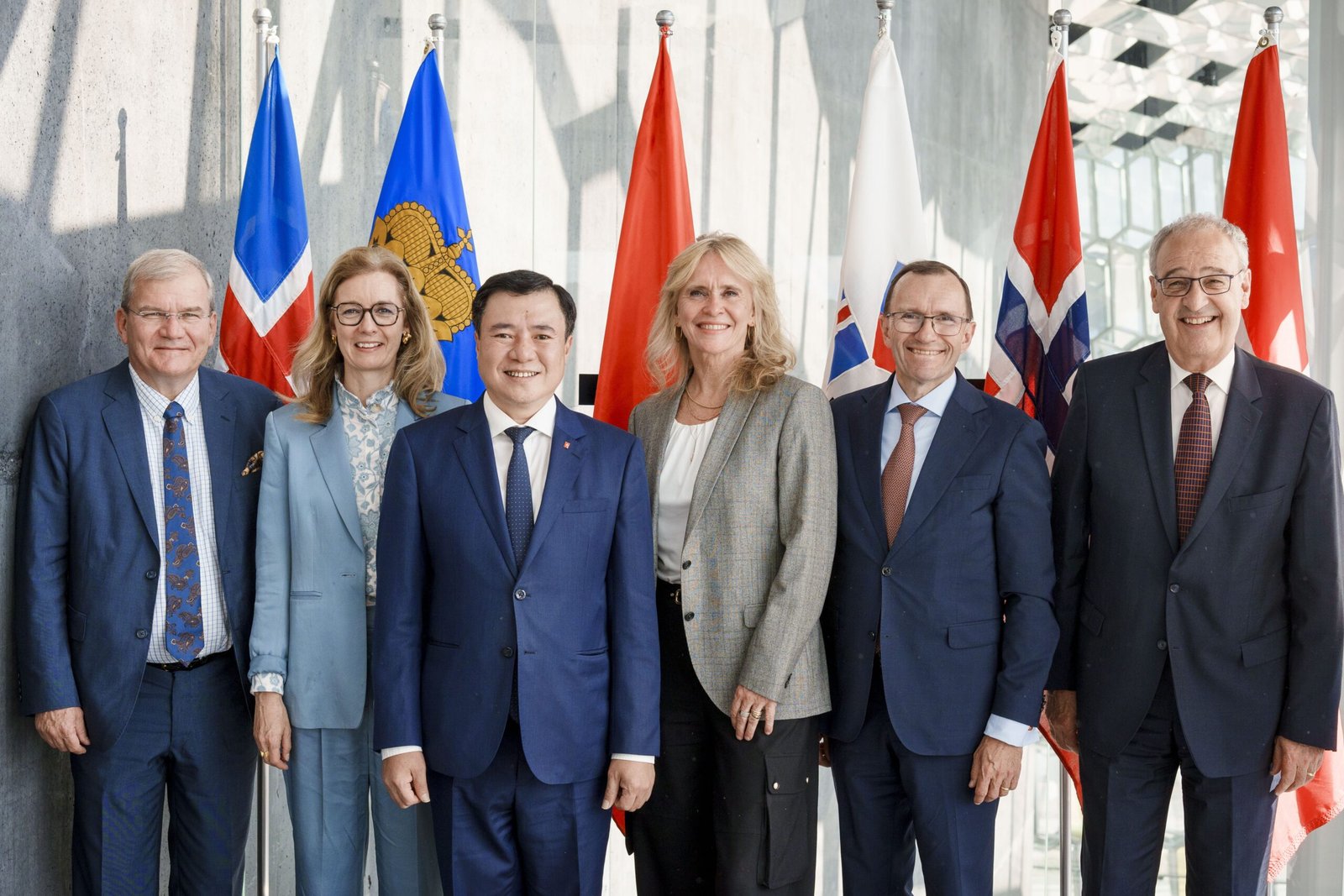
Trade ministers from Vietnam and the four EFTA states (Iceland, Norway, Liechtenstein and Switzerland) during EFTA–Vietnam FTA negotiations in Reykjavík, Iceland, on June 22. (EFTA)
This landmark deal is the culmination of a five-round negotiation phase which began in September 2025 in Geneva, Switzerland. Technical finalisation was completed during intensive discussions in Reykjavik, Iceland, followed by ministerial-level talks on June 22.
The comprehensive and modern FTA covers a wide range of areas. These include trade in goods and services, rules of origin, sanitary and phytosanitary measures, as well as technical barriers to trade. It also encompasses investment, intellectual property rights, trade remedies, government procurement, sustainable development, micro, small and medium enterprises (MSMEs), alongside cooperation and capacity building.
EFTA spokesperson and Minister of Foreign Affairs of Norway, Espen Barth Eide, thanked both parties, saying that “at a time of global uncertainty, strengthening ties with trusted trade partners is more important than ever”. He believed that both sides have “reached an ambitious and forward-looking FTA that will significantly improve market access for goods and services”.
In his capacity, Vietnam’s Deputy Minister of Industry and Trade, Nguyễn Sinh Nhật Tân, emphasised that the main objective of the agreement is to leverage both parties’ strengths. On one hand, the EFTA states (comprising Switzerland, Norway, Iceland and Liechtenstein) are leading the way in terms of green innovation, finance technology (fintech) and sustainable development, while Vietnam stands as an emerging regional hub for manufacturing as well as one of the most vibrant economies in its region.
Deputy Minister Tân also noted, “the agreement establishes a foundation for elevating economic relations between Vietnam and the EFTA states to a new stage of development,” adding that “with its comprehensive and high-standard commitments, the agreement will help create a stable, transparent and predictable business environment, further facilitating the flow of trade, investment, technology and knowledge between the two sides”.
For context, trade between Vietnam and the EFTA states has expanded steadily over the past decade, reaching 4.8 billion Euro (5.5 billion US dollar) in 2025. During this period, Vietnam’s trade surplus grew significantly, rising from 0.5 billion Euro (572 million US dollar) a decade ago to 2.5 billion Euro (2.86 billion US dollar) in 2025
What does this mean for business?
The Vietnam-EFTA trade agreement establishes a tariff-free corridor connecting a major European investment bloc with a key Southeast Asian manufacturing hub, driving immediate cost reductions for key industrial trade components, namely seafood and pharmaceuticals. This pact provides a legal framework for supply chain diversification while securing long-term European market access for Vietnamese electronics and textile exporters.
Beyond tariff elimination, the deal harmonizes intellectual property and regulatory standards, catalyzing foreign direct investment from EFTA states into Vietnam’s green energy and logistics sectors. Moreover, dedicated MSMEs frameworks are included to enhance cross-border customs efficiency, supporting the creation of resilient, dual-region supply networks.
Kala Advisory helps investors move on openings like these as new trade corridors open up across Southeast Asia. Visit kala-advisory.com.
About The Author