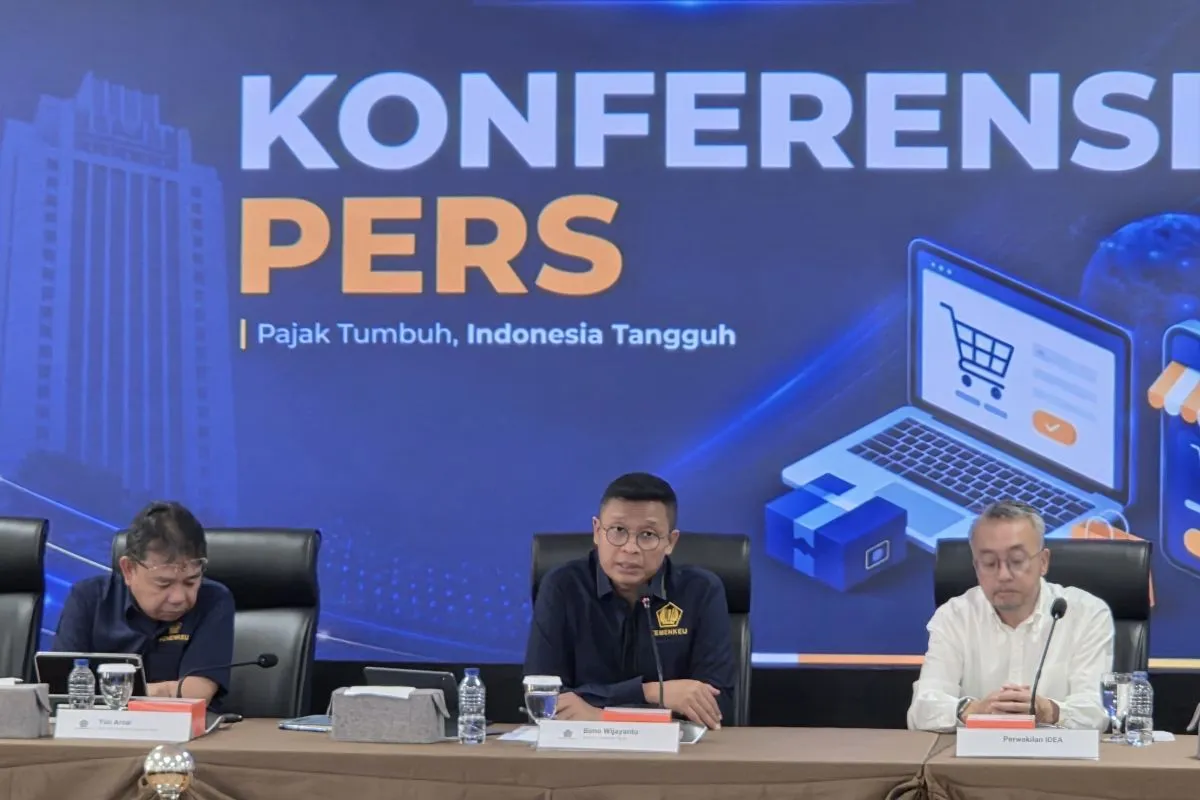
Indonesia’s Director General of Taxes Bimo Wijayanto speaks at a press conference on July 1. (ANTARA/Bayu Saputra)
This policy updates the administration of existing income tax obligations under Finance Ministry Regulation (PMK) No. 37/2025.
There are four initial platforms appointed for this new taxation scheme, namely Tokopedia, Shopee, Lazada and Blibli. Director General Wijayanto elaborated that these marketplaces were selected based on their system readiness, high transaction volume and administrative capacity. Finance Minister Purbaya Yudhi Sadewa indicated that more platforms will be added gradually.
According to Indonesian E-Commerce Association (idEA) Chairman Budi Primawan, while official appointment letters were issued one month prior, the period serves as a provided transition window to allow platforms to adjust their technological and escrow account billing systems.
Director General of Taxes Bimo Wijayanto emphasised that “this is not a new tax,” rather, “it is an income tax on business activities conducted through marketplaces”. He explained that “the only change is the collection mechanism, from sellers paying the tax themselves to designated marketplaces collecting it on the government’s behalf”.
Under the new policy, the platforms will deduct an Article 22 Income Tax (PPh 22) rate of 0.5% from the seller’s gross sales turnover. This amount excludes Value Added Tax (VAT) and luxury goods sales tax.
Notably, the automated collection applies only to merchants who generate an annual gross turnover exceeding 500 million Indonesian rupiah (27,800 US dollar). Smaller enterprises below this limit remain exempt from this deduction mechanism.
Director General Wijayanto reiterated that the policy “is not intended to hamper the digital economy,” but to ensure that “the digital economy grows under a sound, fair and level governance framework”.
What does this mean for business?
The implementation of automated e-commerce income tax collection marks a pivotal shift towards formalising Indonesia’s vast digital shadow economy by integrating real-time transaction data directly into the state’s Coretax tax management infrastructure. By utilising major marketplaces as withholding agents, the government boosts non-oil and gas revenues while shifting the technological and administrative burdens of tax compliance entirely onto the private sector, creating a level playing field between digital storefronts and traditional retailers. These structural changes will reshape domestic market dynamics, offering large-scale merchants streamlined reporting whilst potentially reducing their cash flow and creating inflationary pressure on consumer prices.
Kala Advisory helps investors navigate regulatory shifts like these before committing capital in Southeast Asia. Visit kala-advisory.com.
About The Author