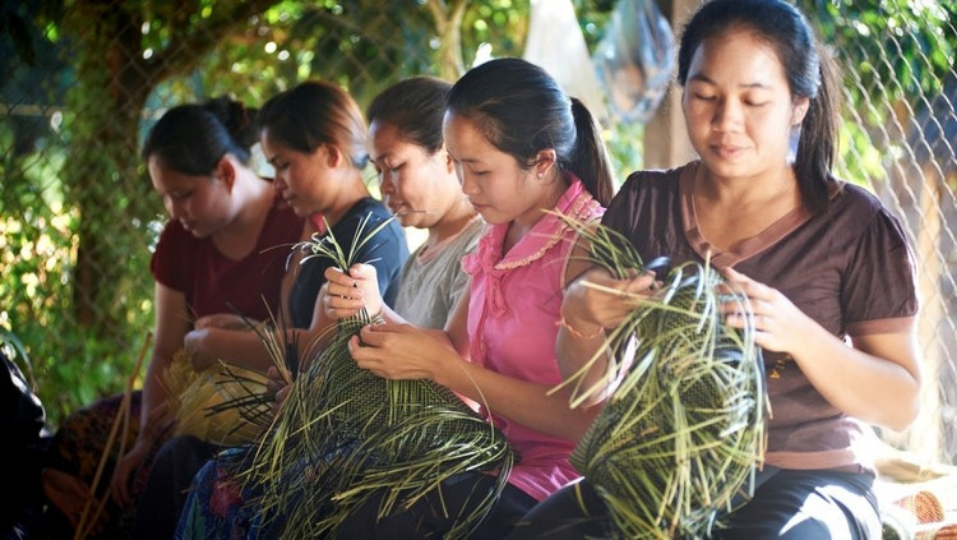
Artisans weaving traditional handicrafts in rural Laos. (World Bank)
The Lao government initiated a series of meetings in the last week of June, with a focus on reviewing the country’s development progress throughout the first half of the year and further identifying priority deliverables for the subsequent second half of the year (H2).
Most prominent was the Ministry of Industry and Commerce’s cabinet meeting on June 30, where it publicised the country’s first-half economic performance.
Overall, the economy expanded by 5%, with state revenue hitting 52% of the annual target and average inflation held at 8%.
Some notable accomplishments include a stable domestic fuel supply amid the ongoing global energy crisis, rapid response protocols for illegal mining operations and industrial accidents, as well as accelerated initiatives to promote the adoption of electric vehicles (EVs).
The most significant success came from the country’s strongest sector, agriculture, with crop commodity exports hitting 752 million US dollar in the first five months of 2026, achieving 62.6% of the annual target.
Another stark number stemmed from livestock products whose exports grew to over 80 million US dollar, accounting for 40.6% of this year’s projection. Additionally, exports for timber products and non-timber first products were valued at nearly 160 millions US dollar, reaching 31.7% of the target.
The data was initially presented by the Ministry of Agriculture and Environment during an expanded government cabinet meeting on June 25. Crucially, the ministry underscored a milestone attainment in export expansion, as Vientiane secured market access for 84 agricultural and livestock product lines in neighbouring countries.
Subsequently, discussion shifted to assessing ongoing challenges and addressing priorities for the next six months. Reportedly, the government will prioritise executing the 12th Party Congress resolutions and the 10th Five-Year Development Plan (2026-2030), while advancing economic self-reliance and achieving annual socio-economic and budget benchmarks.
What does this mean for business?
Laos is charting a path toward stabilisation following an acute economic crisis that began in late 2021. Analysts attributed this crisis, which subsequently triggered severe inflation (31% in 2023; 23% in 2024), to an over-reliance on foreign investment that swelled external liabilities. In response, the government’s 2026 framework (anchored by the 10th Five-Year Plan) enforces strict mandates for new-era economic self-reliance. By maximising domestic manufacturing, restructuring state-owned enterprises and promoting EVs, the state is actively trying to curb import reliance and structurally insulate the economy from future shocks. Operational data from the first half of 2026 suggests these corrective measures are yielding early, optimistic results, though long-term resilience remains tightly linked to state execution.
Kala Advisory helps investors read recoveries like these, and the execution risks behind them, before committing capital in Southeast Asia. Visit kala-advisory.com.
About The Author