
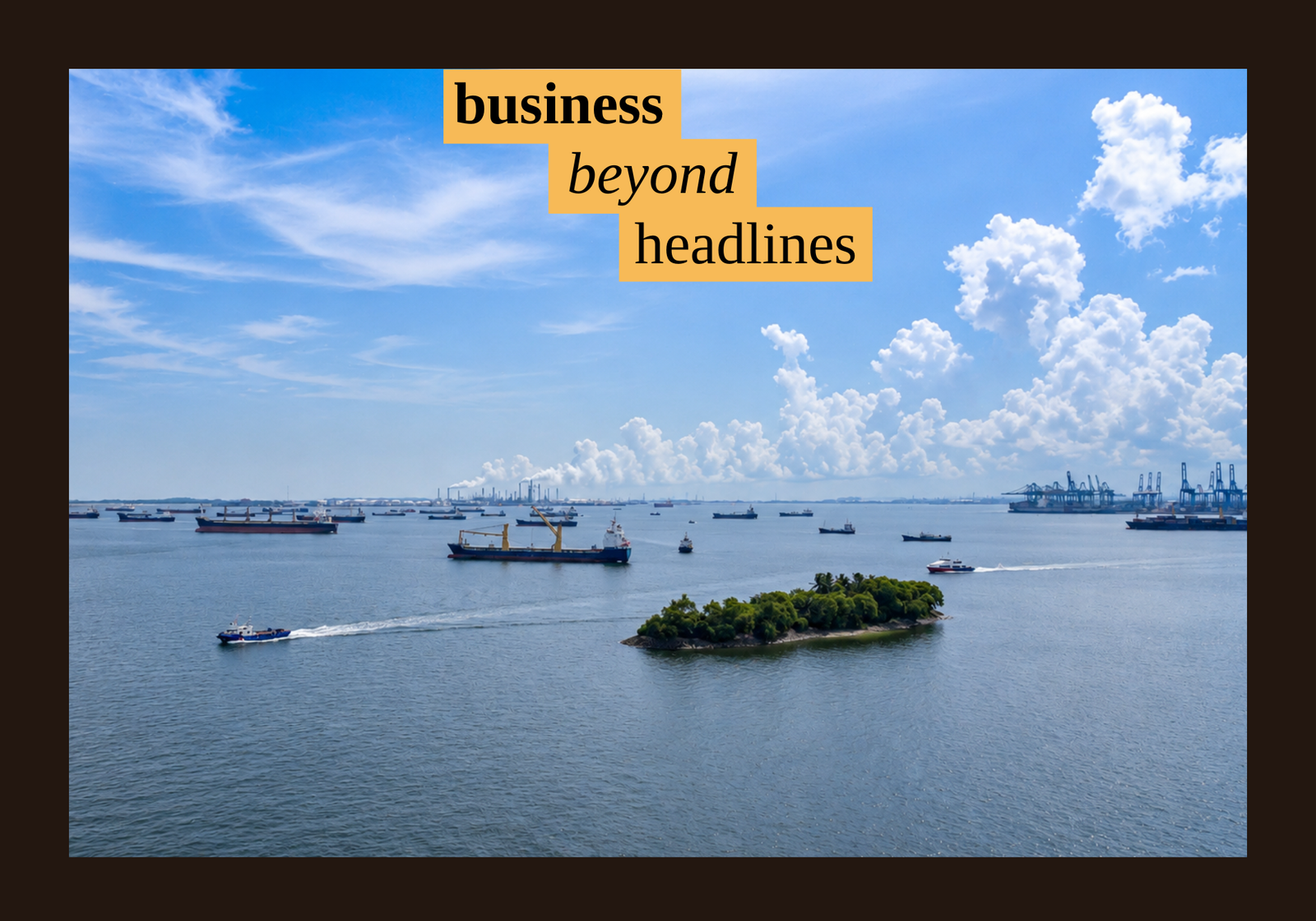
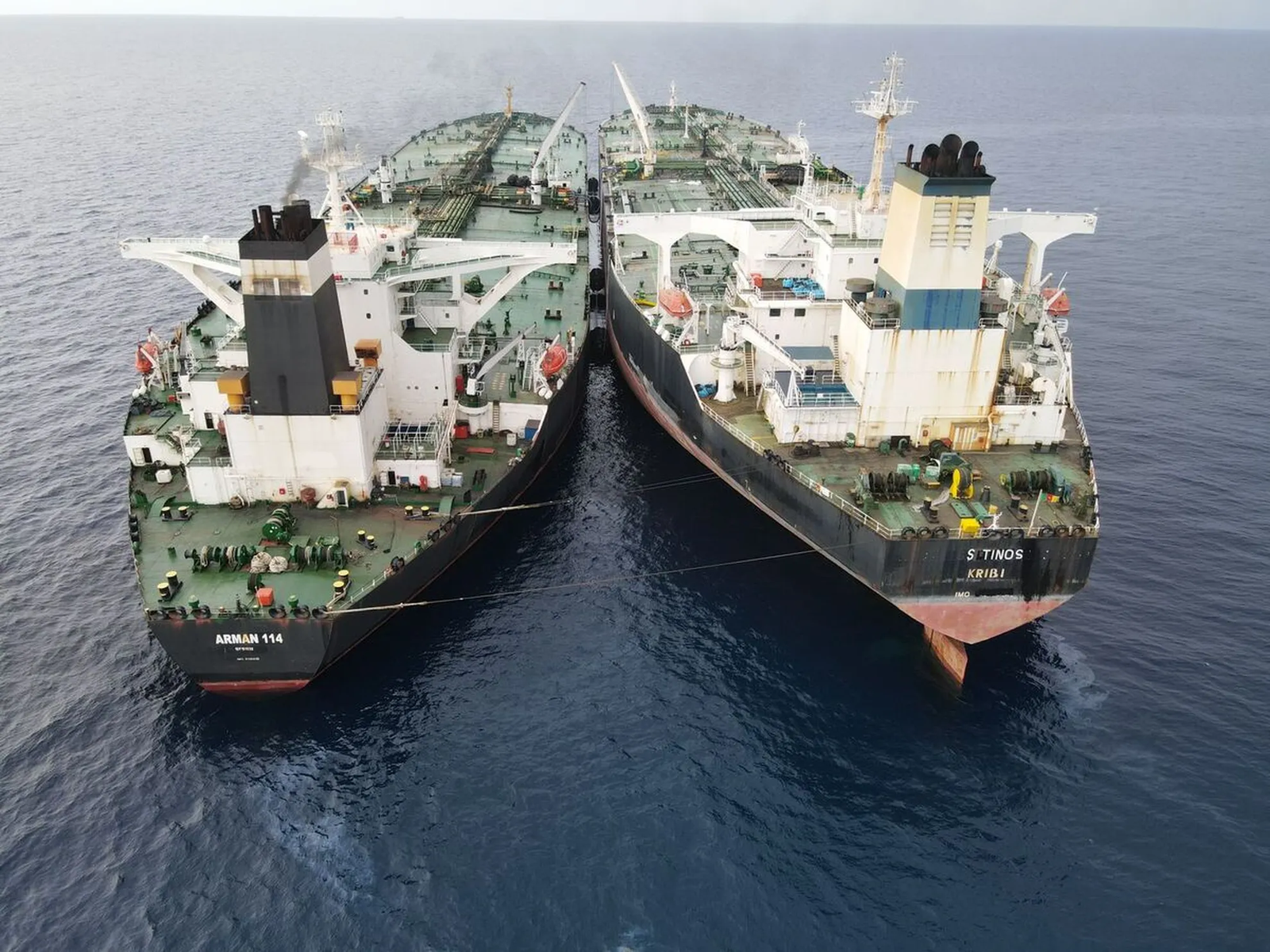
Strait of Malacca in 2017. (Wikimedia/dronepicr)
The Shock That Hit Southeast Asia
On 28 February 2026, the US and Israel launched a joint military offensive against Iran. Within days, the Strait of Hormuz, where roughly a fifth of the world’s oil supply passes, was effectively closed. The lesson that followed was not just about the Middle East. It was about an energy chokepoint closer to East and Southeast Asia, the Strait of Malacca, one that is perhaps more consequential than the Strait of Hormuz.
The consequences of the Hormuz fiasco for Southeast Asia were immediate. Around 84% of crude oil and 83% of liquefied natural gas (LNG) transiting Hormuz in 2024 were bound for Asian markets. By April 7, maritime traffic through the strait had fallen to less than 10% of pre-war levels, oil prices had risen to 113 US dollar per barrel and LNG costs across Asian markets had spiked sharply. The International Energy Agency (IEA)’s Southeast Asia Energy Outlook 2026 confirmed that the Middle East supplies 60% of Southeast Asia’s crude oil imports, and nearly half of the oil products refined or consumed in the region originate from Middle Eastern crude. The region’s energy import bill is projected to reach 160 US dollar billion this year alone, and could rise to 400 billion US dollar, or equivalent to 5% of its economy, by mid-century under current policy settings.
In terms of country-level impacts, the Philippines for instance, which has a reliance of 95-98% of its crude from the Persian Gulf, declared a national energy emergency. Vietnam also saw diesel prices surge approximately 84% from the conflict’s outset. Indonesia, whose fuel subsidies were assumed at an oil price of 70 US dollar per barrel, faced a fiscal overrun of extraordinary scale. Its subsidy bill is projected at 381.3 trillion Indonesian rupiah (22.5 billion US dollar), with oil prices far above the budget assumption. Cambodia closed approximately 2,000 of its 6,300 fuel stations. Across the region, governments have fallen back on demand suppression. As a result, four-day work weeks, work-from-home orders, odd-even vehicle rationing and emergency fuel import tariff cuts were introduced. These reactive measures reveal the depth of the underlying vulnerability.
What is also notable is the pivot in supply sourcing that the crisis has forced. With the easing of US sanctions on Russian energy, Malaysia, Indonesia and Vietnam are negotiating long-term oil supply deals with Moscow. This shifts one dependency for another, and introduces a new layer of geopolitical risk. For example, the Trump administration’s oscillating stance on Russian sanctions means these arrangements carry no guarantee of continuity. Southeast Asian governments have, for now, managed the immediate crunch. Yet, the structural foundations of their energy security remain unchanged.
What the Hormuz crisis has most clearly revealed is not just import dependency but the absence of any collective ASEAN mechanism capable of managing an energy emergency at scale. National responses have been reactive and bilateral: negotiating safe passage with Iran, pivoting toward Russian crude under US sanction waivers, drawing down reserves that were already inadequate. Most Southeast Asian economies hold strategic petroleum reserves below the IEA’s 90-day emergency benchmark, with most operating at between 20 and 60 days of supply, against Japan’s 254 days and South Korea’s 208 days as of early 2026. A regional oil-sharing framework, i.e., the ASEAN Petroleum Security Agreement exists in principle, yet ASEAN energy ministers were still calling for its “expeditious” ratification, underscoring that it remains far from operational. To make things worse, no ASEAN member state is part of the IEA’s collective emergency response mechanism, which coordinated the largest-ever strategic reserve release of 400 million barrels in March 2026, a response available only to IEA member states.
Strait of Malacca, The Larger Chokepoint
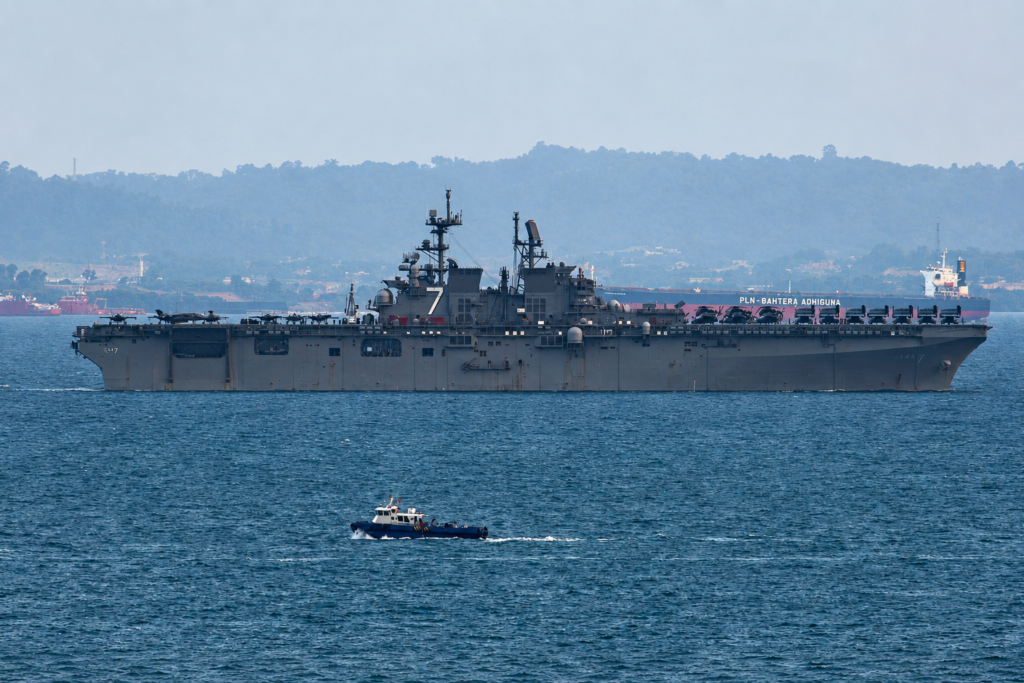
USS Tripoli (LHA 7) America-class amphibious assault ship westbound in the Singapore Strait on March 17. (Military Aviation Photography Singapore)
The Hormuz crisis has forced attention onto the Strait of Malacca, another critical energy checkpoint of the region that is, by volume, even more consequential to global energy trade. In the first half of 2025, 23 million barrels of oil per day transited the Strait of Malacca, exceeding Hormuz’s 21 million barrels and making it the world’s largest maritime oil chokepoint. Roughly a third of global trade and more than a quarter of the world’s seaborne oil pass through its narrowest point near Singapore, which measures barely 2.8 kilometres wide. For China, approximately 80% of oil imports and 60% of LNG imports move through Malacca. 90,000 vessels pass through it annually. Viable bypass routes seem not to exist currently. The potential alternatives, such as Lombok Strait and the Sunda Strait adds thousands of nautical miles, or cannot accommodate Very Large Crude Carrier (VLCC) tankers, and sailing around the southern tip of Australia is effectively impractical for commercial shipping.
Moreover, Malacca sits at the intersection of multiple overlapping risk vectors that are structurally different in character and far harder to attribute or deter. In geopolitical perspective, Beijing has long understood what strategists call the “Malacca Dilemma” that its energy security rests on a corridor it does not control, running through waters where the US Navy operates with significant presence. This structural anxiety is part of what drove the Belt and Road Initiative’s overland pipeline corridors through Pakistan (CPEC) and Myanmar, attempting to construct partial alternatives to maritime dependency. In a scenario involving US-China military confrontation over Taiwan or the South China Sea, the Malacca chokepoint becomes not just a logistical concern but a potential theatre of economic coercion.
Moreover, as Iran has inadvertently demonstrated to other states controlling a critical maritime passage, this may translate into extraordinary economic leverage. The signal was not lost on Southeast Asia’s littoral powers. In April, Indonesia’s Finance Minister Purbaya Yudhi Sadewa floated the idea of placing tolls on ships transiting Malacca, even proposing split management of the strait. The proposal was walked back after Indonesia’s Foreign Minister publicly rejected it, but the fact that it was raised at ministerial level and that Malaysian and Thai officials used it as an opening to advance their own strategic interests marks a meaningful shift in how regional states conceptualise the strait as an economic and political instrument, not merely a shared commons.
Malaysia’s Foreign Minister Mohamad Hasan responded that no country has the power to determine access to Malacca unilaterally, and that any decision must involve all four littoral states: Indonesia, Malaysia, Singapore, and Thailand. Singapore, whose economic model is structurally dependent on free navigation through the strait, has taken the firmest stance against the tolling idea. Thailand, meanwhile, has seized on the discussion to revive its long-standing proposal for a “land bridge” across its southern isthmus: a 90-kilometre road and rail corridor connecting deep-sea ports on the Andaman Sea and the Gulf of Thailand, bypassing Malacca entirely. The geopolitical imagination around the strait is, in short, already shifting.
Consequently, the implications for Malacca are critical. If Hormuz, a chokepoint that runs through a region of active military conflict, can be partially closed and produce cascading economic disruption across Southeast Asia within days, a sustained disruption to Malacca through military escalation in the South China Sea, a normative breakdown in freedom of navigation, or a serious non-traditional security incident, would produce shocks of greater magnitude. This crisis has exposed how vulnerable the global economy remains to the geography of energy supply in a geopolitically fragmenting world. For years, the assumption was that integrated markets, strategic buffers, and diversified supply had made the system broadly resilient. Hormuz demonstrated that assumption was wrong. Malacca has not yet been tested in the same way. But it is larger, more complex, and sits at the intersection of more competing interests than Hormuz ever did.
What Businesses Are Facing
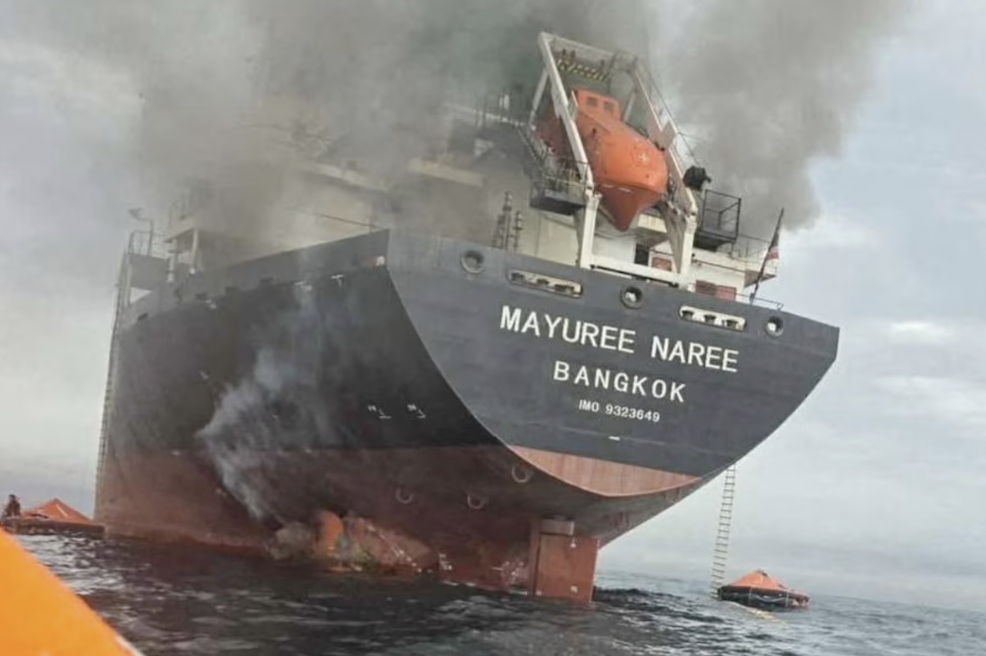
The Thailand-flagged cargo ship Mayuree Naree engulfed in black smoke in the Strait of Hormuz, approximately 11 nautical miles north of Oman, March 11. (Royal Thai Navy)
The structural exposure for the private sector is direct and multi-layered. For manufacturers in Vietnam, Thailand and Indonesia, whose competitive positioning in global supply chains depends partly on energy input costs, sustained price volatility represents a fundamental threat to the value proposition that has attracted decades of foreign investment. Energy costs are not easily hedged at the operational level and the asymmetry of exposure between Southeast Asian manufacturers and their competitors in energy-rich or energy-diversified economies is now sharply visible.
Shipping and logistics operators are already repricing risk. Maritime insurance premiums for tankers transiting both straits have risen significantly and the costs are flowing through to freight rates, feedstock prices and ultimately, consumer goods. LNG contract structures face new scrutiny: Asian importers have historically paid a premium over European buyers for long-term supply contracts and spot market exposure in a disrupted environment amplifies that premium further. For energy-intensive industries, particularly petrochemicals and fertilisers, the crisis has already translated into supply shortfalls and force majeure declarations. Malaysia’s semiconductor sector has flagged helium supply disruption as a collateral concern, illustrating how energy chokepoint stress radiates into adjacent industrial dependencies in ways that are difficult to anticipate and nearly impossible to hedge in the short term.
The crisis has also reopened the coal question in ways that will shape regional energy investment for years. Indonesia and Thailand have both lifted caps on coal-based power generation as a bridge measure. The IEA warns that coal could receive additional policy support from the renewed focus on energy security, creating a direct tension with the region’s stated decarbonisation commitments and with the green investment flows that have been building momentum. At the same time, renewable deployment is accelerating in parallel. The IEA estimates that Southeast Asia’s renewable energy investment reached 17 billion US dollar in 2025, a record driven largely by solar. The Philippines became the second-largest destination for Chinese solar exports in Q1 2026, with imports approximately three times higher than the same period in 2025. The crisis is simultaneously pushing the region toward coal and toward renewables and the long-term investment environment will be shaped by which of those two forces proves more durable in policy terms.
The Hormuz crisis has made abstract chokepoint risk viscerally real for every business operating in Southeast Asia. Energy costs are no longer a background variable to be managed at the margin. For manufacturers, logistics operators, and energy-intensive industries across the region, the question is no longer whether supply disruption risk needs to be priced in, but how. The Strait of Malacca, as more complex in its threat landscape, and surrounded by a geopolitical conversation that is already shifting, is the next variable that has not yet been priced.
Build Resilience Before the Next Shock, Not After
The most urgent priority for businesses with significant regional exposure is a supply chain energy audit: a systematic mapping of how much of their input cost structure, freight exposure, and feedstock dependency runs through either straight, stress-tested against 30, 60, and 90-day disruption scenarios. Most companies operating in Southeast Asia have not done this. The Hormuz crisis has demonstrated that the window between “geopolitical tension” and “operational disruption” can close within days.
Contract structure deserves equal attention. The crisis has exposed the liability of spot market dependence in a disrupted environment, particularly for LNG and refined product buyers. Locking in longer-term supply arrangements with geographically diversified counterparties, including emerging suppliers in the Americas and Africa, is now a risk management imperative rather than a commercial preference. For energy-intensive sectors, particularly petrochemicals, fertilisers, and advanced manufacturing, the region’s 160 billion US dollar annual energy import bill reflects a structural vulnerability that bilateral supply pivots alone cannot resolve.
Renewables Are Now an Energy Security Play, Not a Climate One
The longer-term structural opportunity surfaced by this crisis is one that forward-looking businesses should not treat as a policy story. Southeast Asia’s renewable energy buildout reached a record 17 billion US dollar in investment in 2025. It represents an energy security arbitrage as much as a decarbonisation commitment. Companies that invest now in on-site generation capacity, power purchase agreements with domestic renewable producers, or energy efficiency infrastructure are effectively purchasing insurance against the next chokepoint disruption. The calculus has changed: in a world where most ASEAN economies operate well below the IEA’s 90-day emergency reserve benchmark and where the ASEAN Petroleum Security Agreement remains unratified despite the ongoing crisis, businesses cannot rely on collective governmental buffers to absorb the next shock. Reducing import exposure at the firm level is the most actionable hedge available.
Businesses with regional footprints also have standing to engage the policy process directly. The ASEAN Power Grid and APSA ratification are not abstract institutional projects: they are the infrastructure on which collective resilience depends, and their implementation timelines are shaped in part by private sector pressure. The costs of continued inaction fall disproportionately on the private sector. That gives businesses both the incentive and the legitimacy to make their voice heard in a policy conversation that has, until now, moved too slowly.
About The Author


One thought on “The Next Hormuz: Strait of Malacca, Asia’s Unspoken Energy Risk ”