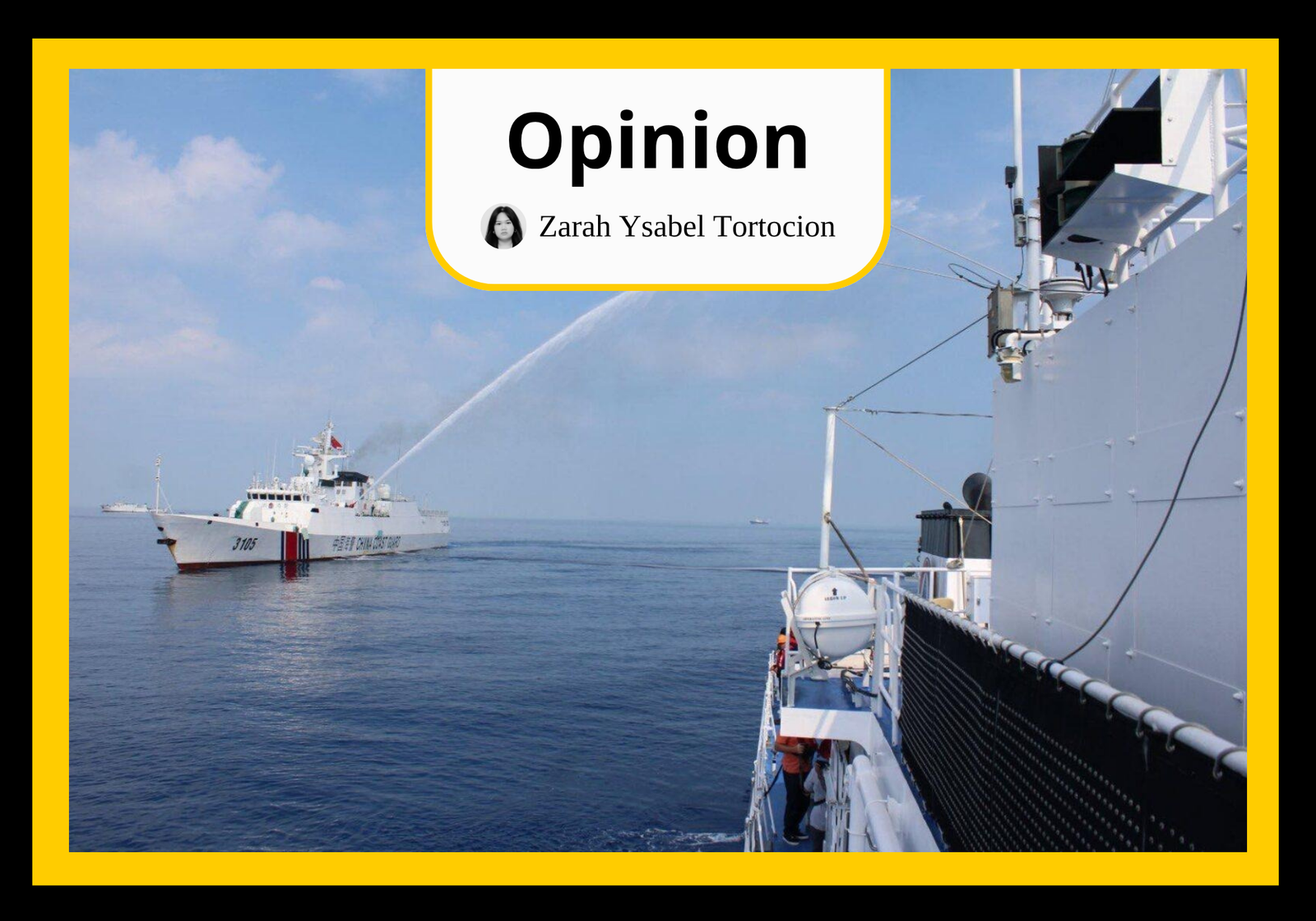
A China Coast Guard vessel fires a water cannon toward a Philippine government ship during a standoff in the West Philippine Sea. The encounter follows a series of maritime confrontations tied to competing territorial claims in the strategic waterway. (Philippine Coast Guard)
Zarah Ysabel Tortocion is a Diplomacy and International Affairs student at De La Salle College – Saint Benilde. The views expressed are her own and do not represent SEA Daily or that of another organisation.
Data as the New Munition
When Chinese water cannons shattered the cockpit windscreen of a Philippine Coast Guard (PCG) vessel and injured crew members in the West Philippine Sea (WPS), the incident was reported as another act of maritime harassment. But what made this confrontation different was not just the violence, it was the technology. China has developed the world’s first ‘smart’ water cannon, an AI-controlled system that autonomously identifies targets and adjusts trajectory with an error of just 2 metres in rough seas; it has a 33-54% improvement over traditional cannons and while its actual deployment in the WPS is not yet confirmed, the technology’s advancement alone signals a shift in maritime coercion capabilities. This is no longer simple coercion. This is Artificial Intelligence (AI) turning familiar tools of pressure into instruments of surgical, deniable aggression in Southeast Asia’s most contested waters.
The WPS is not simply a dispute between the Philippines and China. The implication of rising tensions extend far beyond the two countries, testing regional stability. If China succeeds in establishing AI-enabled coercion within the disputed territory, the same tactics could spread to Malaysia, Vietnam and Indonesia’s maritime zones. ASEAN’s credibility as a regional body that resolves disputes peacefully will collapse if it cannot address technological asymmetry that happens below the threshold of war.
Modern warfare increasingly turns on datasets as its main weapon. Satellite imagery, open-source footage, biometric databases train the models that identify and target. In the Russia-Ukraine war, AI helps defenders analyse drones and satellite feeds to locate missile sites within minutes. The same tools, deployed by an adversary, can deliver precise pressure without firing traditional weapons.
China’s investment in AI-enabled maritime systems–unmanned vessels, autonomous control systems and “smart” lethal weapons creates a gap that no ASEAN member states can close alone. Small states lack resources for counter-AI defence. Technology amplifies proximity and coercion. An AI water cannon that can track and aim autonomously turns a routine patrol into a potentially crippling strike.
In the WPS, this asymmetry matters. The Philippines cannot out-invest China overnight, but it can insist on rules that stop AI from becoming a tool of unchecked coercion and ASEAN must lead that effort.
The Accountability Vacuum
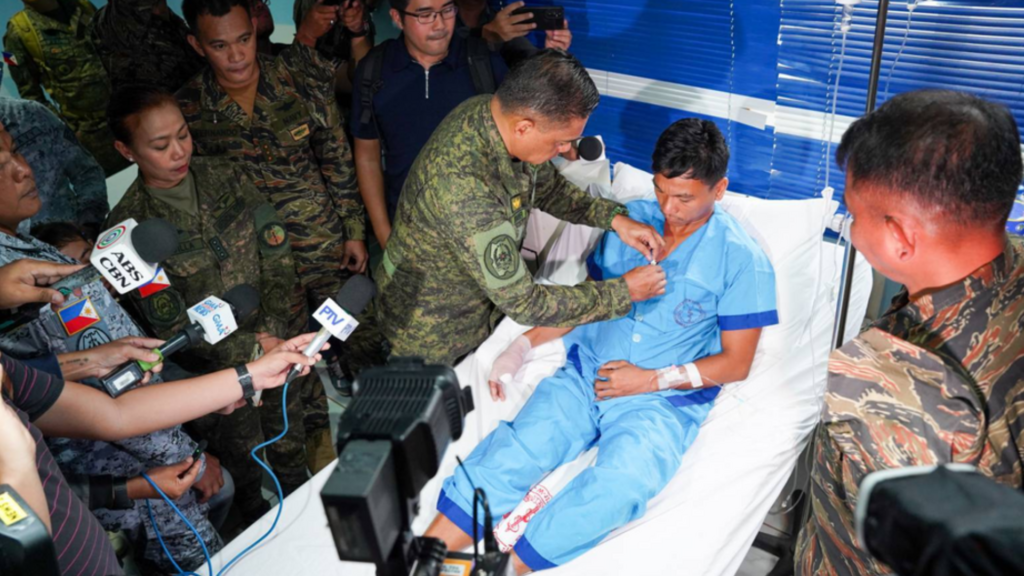
Chief of Staff of Armed Forces of the Philippines General Brawner visits the soldier who lost his right thumb to the China Coast Guard. (Armed Forces of the Philippines)
The greatest danger of AI in warfare is that machines will become the main decision maker in the mobilisation of potentially lethal force. Harm will become easier, while accountability harder. International humanitarian law evolved to hold human commanders and states responsible for decisions in war. Algorithms disrupt that chain. When an AI system recommends, refines and executes actions, who bears responsibility if civilians are harmed–the operator, procuring state or the opaque machine learning itself?
Governments exploit this opacity. By deploying systems with degrees of autonomy, states gain plausible deniability. They can claim “the machine erred” or “the operator misunderstood” while achieving political goals: coercion, territorial assertion and disruption. For the Philippines, the consequences are immediate: damaged vessels, injured crew, erosion of maritime rights without legal recourse. For ASEAN, the consequence is the erosion of maritime sovereignty across the region.
There is no adequate international law or policy governing AI in warfare. Without binding treaties, accountability becomes a vacuum. And in that vacuum, impunity breeds reckless escalation.
Advocates for a “centaur model”, in which human oversight is paired with machine speed, argue this keeps humans in charge. That is reassuring in theory, but in practice cognitive overload, trust in automation and opaque decision logic mean human approval can become perfunctory. “Human-in-the-loop” becomes “human-out-of-the-loop” practice.
Even worse, AI systems can reproduce societal biases. As UN human rights experts have warned, past prejudices become future algorithmic discrimination. If models are trained on skewed datasets, they may misidentify or disproportionately target certain nationalities or crews, creating discriminatory outcomes with deadly consequences. In multi-ethnic maritime zones like the South China Sea (SCS), biased models could systematically disadvantage Filipinos, Vietnamese, or Malaysian fishermen, escalating injustice into violence.
The Philippines Must Lead
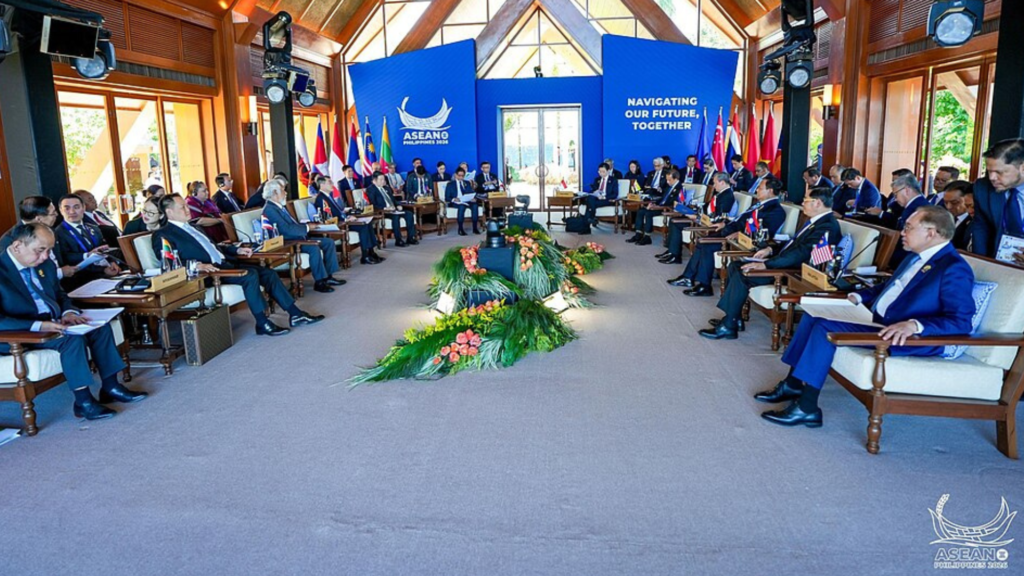
As ASEAN Chair, the Philippines calls for stronger regional coordination and the effective implementation of collective action plans to enhance the region’s preparedness against emerging global risks. (Presidential Communications Office)
The Philippines has unique credibility in leading the charge against this phenomenon. It is directly affected by repeated Chinese water cannon incidents in the WPS, even as concerns grow over the possible use of AI-enabled maritime systems. In September 2025, the Philippines urged the UN Security Council to regulate AI-enhanced weapons. Now it must propose an ASEAN working group on AI maritime coercion at the upcoming ASEAN Summit in November, share incident data from WPS confrontations as a regional case study and request ASEAN support for a UN Security Council resolution on autonomous weapons.
This matters for the Philippines in protecting their fishermen, strengthening maritime law enforcement, building alliances against Chinese coercion and positioning the country as a regional security leader.
ASEAN cannot wait for the UN to act. The region could establish its own norms before the WPS becomes a lawless zone. Through the ASEAN Summit Declaration, member states may set clearer limits on autonomy in maritime systems, require human authorisation for any use-of-force decision and mandate reaction windows that preserve genuine human judgment. Joint investigation mechanisms and a regional legal framework on accountability would clarify liability for civilian harm caused by AI-enabled systems, while ASEAN may press the UN for global restriction on autonomous targeting and confidence-building measures.
Yet achieving this will be politically fraught. ASEAN’s consensus model and different strategic alignments make bold, binding language difficult, especially when some members will prefer caution over confrontation. The Philippines, as one of the region’s most exposed claimants, can build on its current push for a stable SCS and use ASEAN chairmanship leverage in diplomacy, technical templates and pilot arrangements with fellow members like Vietnam, Malaysia, and Indonesia to make the idea less abstract and more usable. Pragmatic, stepwise leadership by the Philippines could create attainable regional norms without pretending consensus will come easily.
If ASEAN does not act, the WPS and the wider SCS would become a grey zone where AI coercion is unchecked. Miscalculation escalates into accidental conflict. The same tactics would spread to Vietnam’s Paracel and Spratly claims, Malaysia’s Sabah waters, and Indonesia’s Natuna Sea. Thousands of fishermen and coastal families across Southeast Asia are displaced, while China’s AI dominance in maritime shifts the global balance away from smaller states.
This is not just about the Philippines. It is ASEAN’s test of whether regional cooperation can handle AI-era coercion. Regional states such as Vietnam, Malaysia, and Indonesia also have maritime and security interests in the SCS and the current ASEAN Chair, Philippines could help lead a coordinated diplomatic campaign that supports each member state’s respective position while reinforcing shared principles of restraint, transparency and peaceful dispute resolution. The WPS should not become ASEAN’s failed test case. We must choose: will AI enhance power unbound by responsibility, or will ASEAN ensure algorithms serve human dignity, accountability and shared responsibility? The choice is urgent. Without clear regulations and enforceable accountability, AI in warfare will not make conflict cleaner, thus it will make it faster, more opaque, and harder to prevent. ASEAN must act now.
About The Author