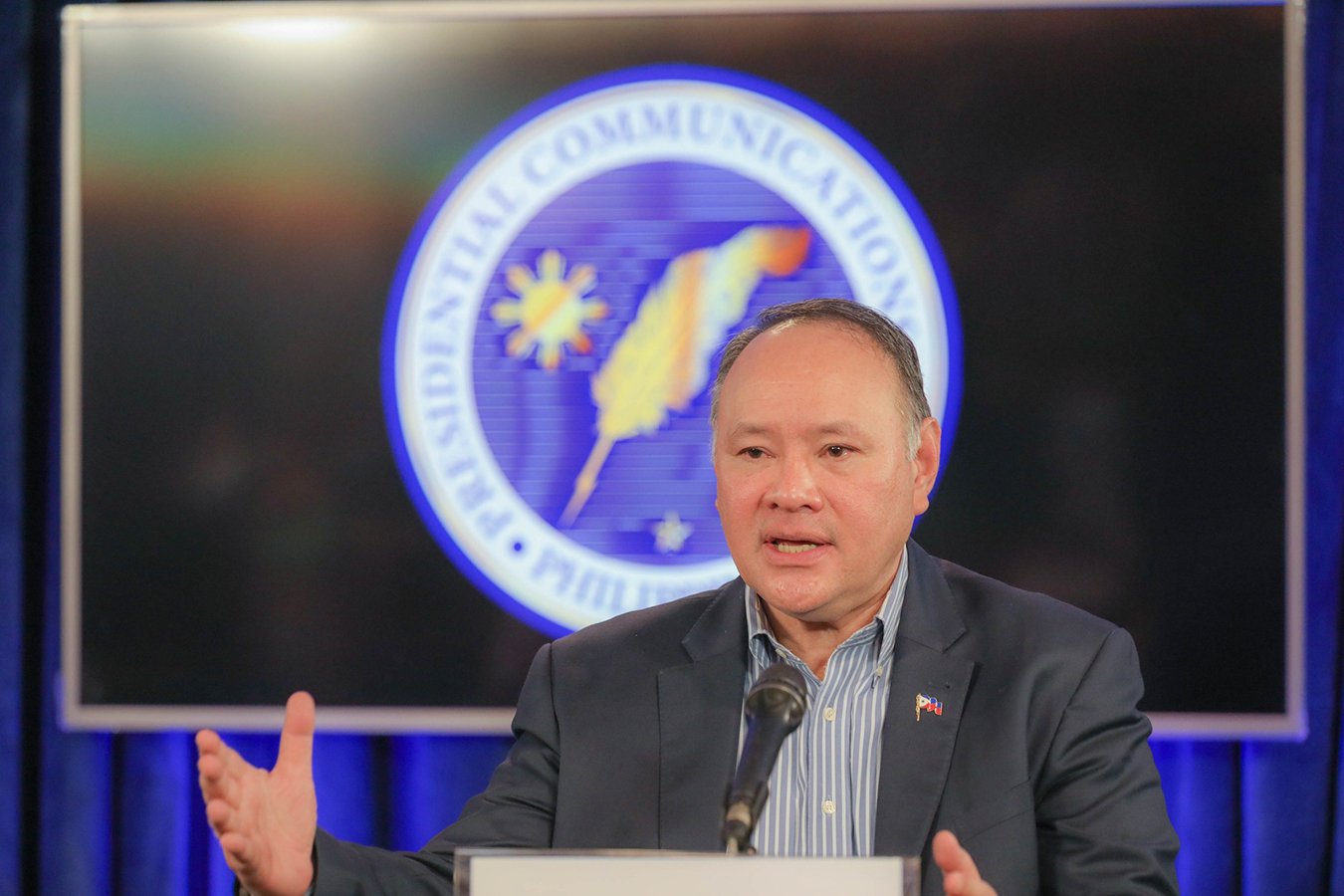
Defense Secretary Gilberto Teodoro Jr. pledges review of military pensions, reforms, and modernization at a media briefing. (Presidential Communications Office)
On June 11, China formally announced sanctions on Philippine Defense Secretary Gilberto Teodoro Jr. and his family, prohibiting them from entering mainland China, Hong Kong and Macau, and banning them from conducting business with firms originating from these areas. The decision to sanction him was in response to what Beijing called Teodoro’s “irresponsible remarks on China” in relation to China’s claim in the South China Sea.
Chinese Foreign Ministry spokesperson Lin Jian said on 12 June, “Let me stress that Teodoro is one of the most blatant among the handful of hostile actors towards China in the Philippines. His reckless behavior will backfire and it is in the interests of the Philippines and all its people that will bear the brunt.”
In response, Teodoro dismissed the sanctions as an anticipated consequence of challenging Chinese actions, stating, “[t]hat is their right. That is truly what they do to those who speak the truth against their deception.”
He further reaffirmed, “Their own countrymen and the others under their control suffer far worse. I will just keep doing my duty and uphold our nation in the face of the wickedness they are committing here and even in our seas.”
China’s unilateral ban also drew criticisms from the Philippines’ Department of Foreign Affairs (DFA). DFA spokesperson Analyn Ratonel stated on June 11 that “While the imposition of sanctions is China’s sovereign prerogative, the Philippines views it as an unfriendly act that further complicates the bilateral relations.”
Teodoro has been among the most fierce and outspoken Philippines officials against Beijing’s sweeping territorial claims over the South China Sea.
At the 23rd Asia Security Summit, he reaffirmed Manila’s position based on the 2016 Arbitral Award is legally binding on China, but declared that, “To this day, the People’s Republic of China (PRC) […] upon whom the 2016 Arbitral Award is legally binding, continues to disregard it.”
He further underscored that resisting Chinese claims is central to the Philippines national interests. He was also willing to use strong and direct language once describing Chinese President Xi Jinping’s leadership as a “small dictatorship and autocracy”.
Beijing’s unilateral ban on the Philippine defense chief signals a deep resentment towards blunt and outspoken voices, showing an intolerance of critics. This decision may carry dismay in both countries’ bilateral relations, for it wields a rigid status quo that may obstruct diplomacy and hinder constructive dialogues. For Manila, Teodoro’s ban highlights a significant cost of being defiant in the South China Sea dispute, while for Beijing, this demonstrates a willingness to use punitive measures to preserve dignity.
About The Author