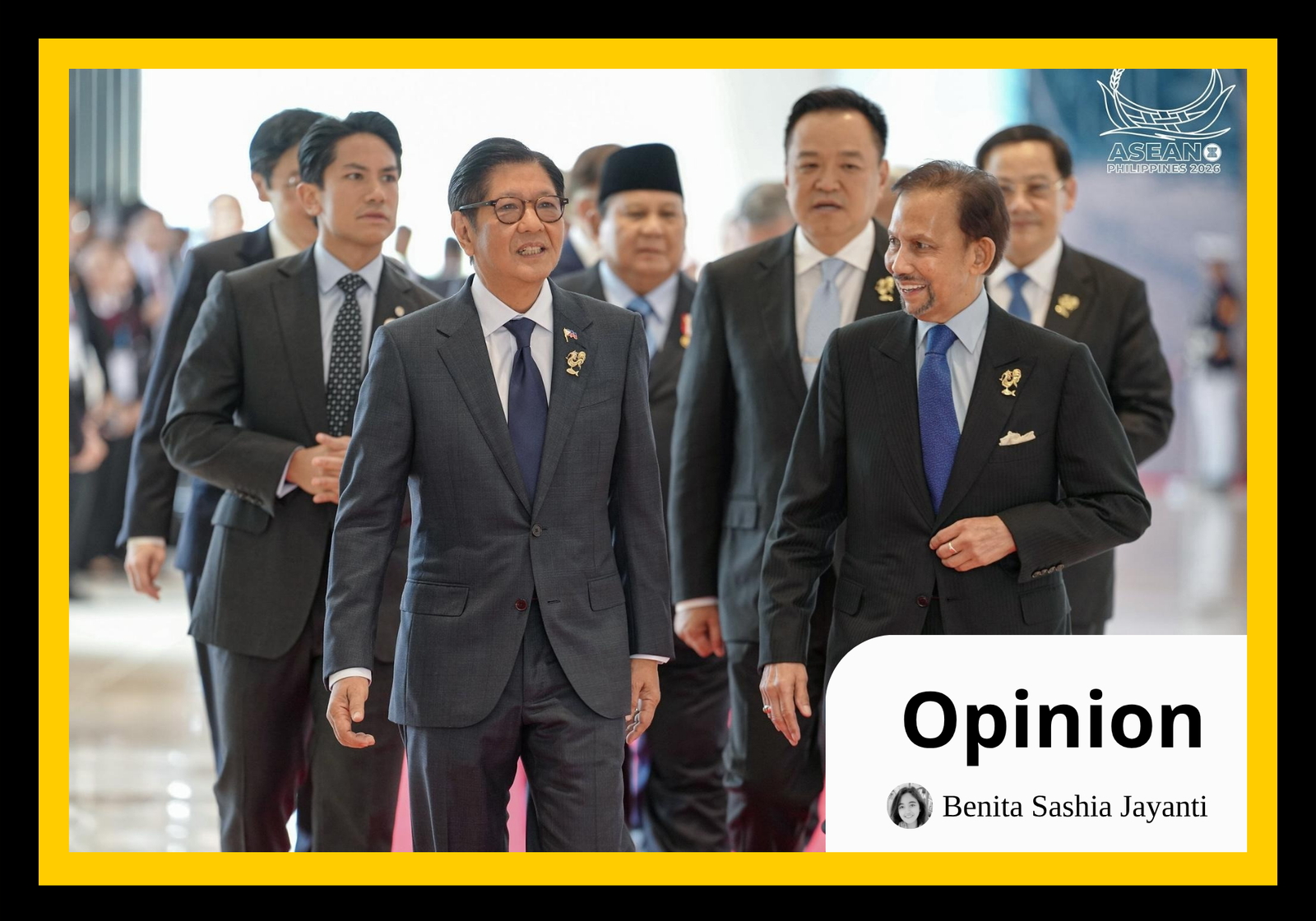
Opening Ceremony of the 48th ASEAN Summit in Cebu, Philippines, in May 2026. (Flickr)
Benita Sashia Jayanti is an analyst with expertise in climate and energy diplomacy, geopolitics, and multilateralism, covering ASEAN and other major multilateral forums. The views expressed are her own and do not represent SEA Daily or that of another organisation.
For some time, a question has hung in the air about how ASEAN would be able to translate its political commitment into implementation. The top-down approach may never fit the “ASEAN way” of doing things. By its institutional nature, ASEAN’s energy security and speed of energy transition will largely depend on the national self-interest of its member states.
There is a classic proverb that says, “never put all your eggs in one basket”. However, when it comes to energy security, Southeast Asia has done precisely the opposite by placing the bulk of its policy orientation in a single fragile “fossil fuel” basket. And just like any other loaded basket, it takes only one shock to cause everything to fall apart.
By 2026, the region’s total final energy consumption is projected to reach 668 million tonnes of oil equivalent, propelled by rapid industrialisation and digitalisation. Around 90% of the region’s transportation sector and 31% of power generation are also reliant on oil and gas.
For decades, this dependence may have seemed robust, underpinning massive-scale economic expansion and industrial growth. But on a ticking clock, the region is running under the illusion of energy security. Today, roughly 55% of ASEAN’s crude oil is imported from the Middle East. During a crisis, as much as 28% of the region’s final oil consumption could be directly affected.
Geopolitics and energy have long been intertwined. The energy dependence of Southeast Asian governments on the Gulf States has always sat uneasily with the foundational tenets of the energy trilemma, which aspires to balance security, affordability and sustainability at all times. Energy has long transformed from a mere commodity into a strategic instrument that is easily weaponised during geopolitical contestation. Thus, in part, it always looms over the Middle East with political instability and armed conflicts. From the 2011 Arab Spring and 2012 Iran sanctions to 2018-2019 US-Iran tensions, and recently the Hormuz Crisis, each episode always triggers oil price volatility and energy supply anxiety.
The region has long ignored the recurring pattern that concentrating such a significant share of energy reliance in a region with a fragile political system is risky under any circumstances. Now, without any clear pathway to redefine energy security, Southeast Asia will continue to anchor its energy lifeline to a region where instability is deeply structural.
From Crisis to Structural Response: If only Southeast Asia learns from Europe’s Costly Lesson
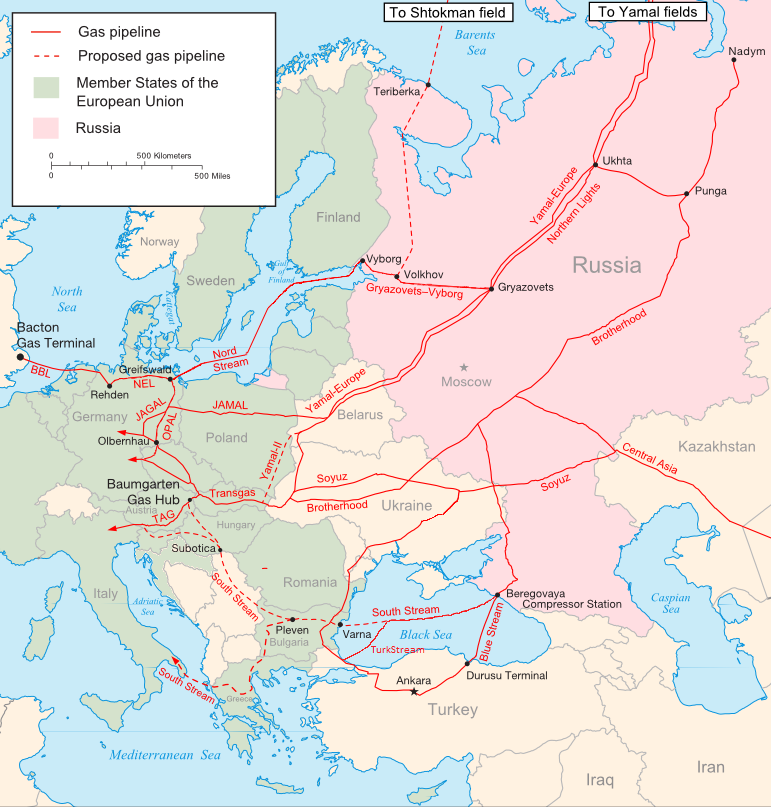
Map of the major existing and proposed Russian natural gas transportation pipelines in Europe by 2009. (Wikimedia/Samuel Bailey)
If Southeast Asia needs a cautionary tale, it needs to look no further. Europe’s entrenched reliance on Russian oil and gas metastasised into an energy crisis following the Ukraine invasion in 2022. While signs of instability had been visible since 2014, energy diversification had been too slow.
Coming so soon after the pandemic, the shock further strained fiscal capacity and hampered low-income families through soaring energy bills. In the UK, households’ energy bills would have surged by 80% without any government intervention. Russian gas, which once accounted for nearly half of Europe’s energy imports, was then drastically reduced within a few years, with a complete phase-out envisaged by mid-2027.
The crisis produced two main outcomes. On one hand, the EU substituted one unreliable energy source for another by importing even more expensive liquefied natural gas (LNG) from the United States. In a better course, the crisis also catalyses Europe’s structural energy reform. Under the RePowerEU, the EU accelerated its transition by targeting a 69% share of renewable electricity in 2030. By 2024, renewables already accounted for around 48% of their electricity mix, with wind and solar now slightly overtaking fossil fuels. Outside the EU, the crisis also sped up the UK’s clean energy shift, with renewables now providing 52.5% of electricity, led by off-grid wind, solar and hydro. Europe’s investment in solar and wind power also proved better at weathering external shocks and saved an estimated 67.5 billion euro in energy costs by 2026.
In times of energy crises, Southeast Asian governments tend to resort to short-sighted reactive policy measures rather than pursuing long-term structural solutions. Rolling out emergency energy-saving measures, tax adjustments and massive fuel subsidies to “cushion” rising energy prices. While these “shock absorbers” mitigate immediate economic pain, overfocusing on short-term fixes never truly mends the underlying vulnerability. As a result, each crisis is managed only temporarily, but never truly resolved.
If the region is to draw any meaningful lessons from Europe’s energy crisis, there are two-fold. First, energy security must be fundamentally redefined from “securing fuel supply” to strategic gradual detachment from imported fuels altogether. Second, is that short and medium-term policy decisions matter as much as long-term ambitions.
Turning crisis into renewables’ momentum: Why Southeast Asia must take different paths
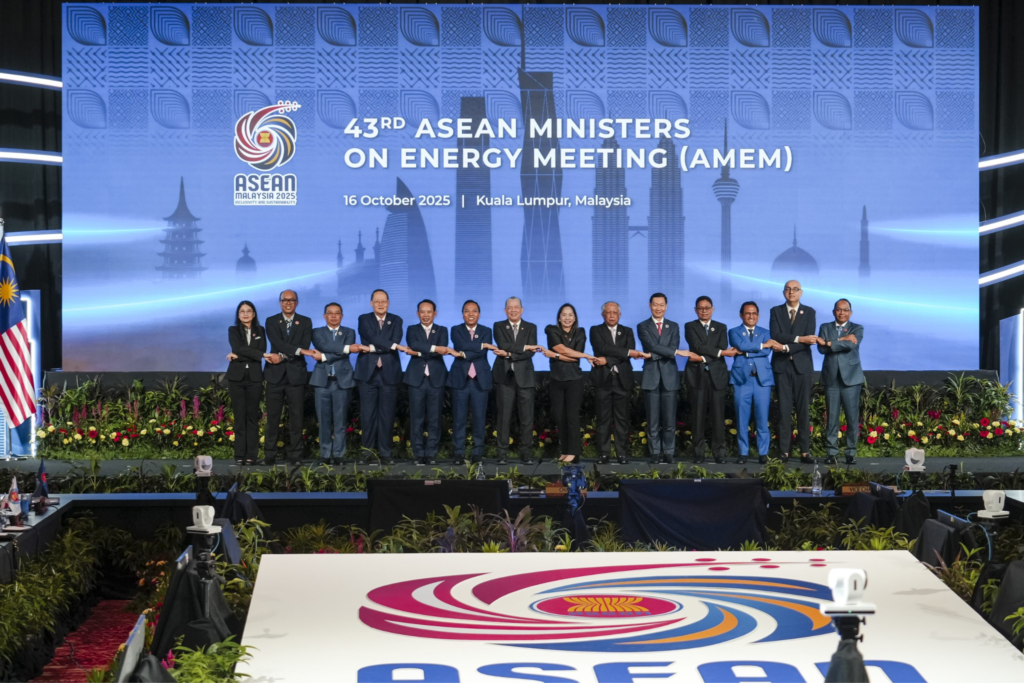
The 43rd ASEAN Ministers on Energy Meeting (AMEM) and its associated meetings in Kuala Lumpur, Malaysia, in October 2025. (ASEAN Secretariat)
The EU and ASEAN are fundamentally different in institutional architecture. Under its 2023 Renewable Energy Directive, the EU can impose a legally binding target for member states to source at least 42.5% of renewable shares in the energy mix in 2030. ASEAN, by contrast, operates under a consensus and voluntary-based commitment.
However, ASEAN’s lack of supranational enforcement should not be overstated as an absolute barrier. The top-down approach may never fit the “ASEAN way” of doing things. Within its mandate, ASEAN has advanced critical frameworks such as the ASEAN Plan of Action for Energy Cooperation 2026-2030, while successive annual chairships have continued to put decarbonisation and energy security as one of their core priorities. Progress in translating commitments has begun, albeit slowly, including through the advancement of an enhanced ASEAN Power Grid (APG) MoU and the establishment of three APG Taskforces tasked to dismantle policy, regulatory and technical barriers.
This underscores a fundamental distinction that while the EU can drive energy security through centralised mandates, ASEAN’s decarbonisation pathways should have begun within its members’ national self-interest. The Middle East crisis could catalyse ASEAN’s renewables momentum, only if member states treat it as a wake-up call that anchoring the energy future in an overloaded “fossil fuels” basket will never be a sustainable option.
By its institutional nature, ASEAN’s regional frameworks can set up direction, but they cannot enforce domestic execution. Eventually, ASEAN’s energy security and pace of energy transition will be largely determined by national policy choices. While it remains imperative for ASEAN to strengthen regional cooperation, leverage existing frameworks, and address regional transition gaps, real momentum will depend on member states’ willingness to treat energy dependence as a core national priority and turn urgency into concrete, actionable policies.
About The Author