
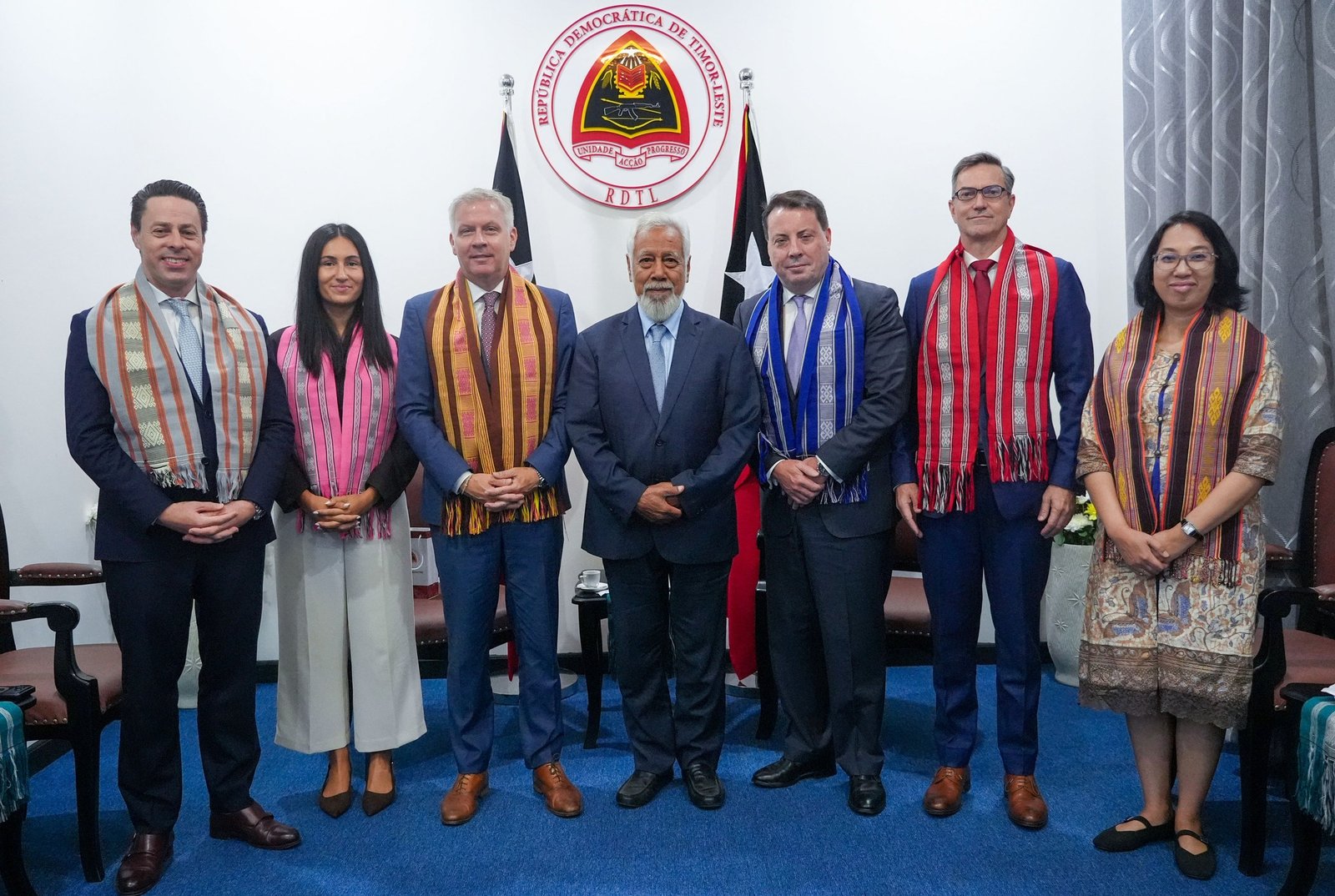
Canadian Ambassador to Indonesia and Timor-Leste Jess Dutton meets with Prime Minister Xanana Gusmão at the Government Palace in Dili on May 21, 2026, to discuss bilateral investment cooperation. (TATOLI)
Timor-Leste and Canada have agreed to elevate their bilateral relations into a special strategic partnership, with Ottawa placing considerable emphasis on expanding investment into the country.
This commitment was demonstrated on May 21, when Canadian Ambassador to Indonesia and Timor Leste, Jess Dutton, convened a meeting between Canadian trade and economic delegations and Timor Leste Prime Minister Xanana Gusmão in Dili. The Canadian delegations compromised representatives from the Canada ASEAN Business Council, Asia Pacific Foundation of Canada, BlackBerry Government Solution, National Bank of Canada and Export Development Canada
Ambassador Dutton stated that Canadian businesses are actively seeking investment opportunities in Timor-Leste. He highlighted that ASEAN’s newest member state holds “significant potential” for foreign investment, particularly across the oil and gas, tourism and agriculture sectors.
The Ambassador further underscored that Timor-Leste’s recent accession to the ASEAN strengthens Dili’s regional standing, as membership grants access to integrated regional markets that broaden the country’s investment appeal.
In addition, Ambassador Dutton announced that Canada is planning to pledge 15 million US dollars towards a solar energy project in Timor-Leste.
Prime Minister Xanana Gusmão welcomed this initiative, pointing to Canada’s strong expertise in both renewable energy and oil and gas as assets well-suited to support Timor-Leste’s development priorities.
What does this mean for businesses?
ASEAN’s newest member presents a compelling, if nuanced, case for investors. The Middle East crisis has laid bare the vulnerabilities of Timor-Leste’s import-dependent economy. Yet the country has demonstrated a degree of resilience as the Asian Development Bank’s (ADB) latest economic outlook projects annual growth of 4% for both 2026 and 2027.
However, structural risks remain. The economy is heavily reliant on withdrawals from its Petroleum Fund (a buffer worth approximately 18 billion US dollars) which is not a sustainable long-term foundation. Without reform, this dependence risks crowding out investment in sectors capable of generating durable growth and employment. For foreign capital to translate into meaningful leverage, Dili must address these structural constraints, and the government’s role in driving that reform will be decisive.
About The Author


One thought on “Canada and Timor-Leste elevate ties to strategic partnership as Ottawa eyes investment push”