
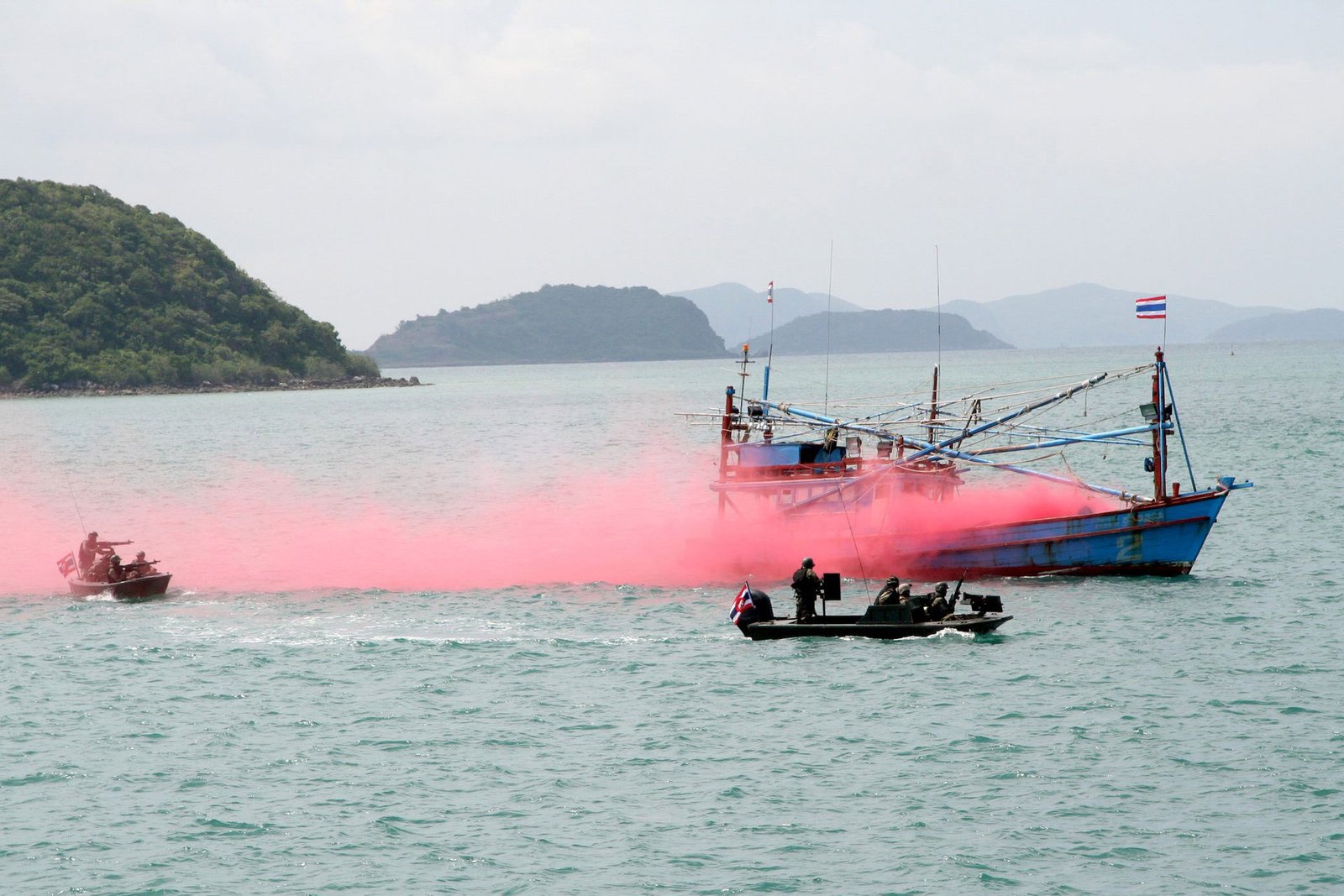
Royal Thai Navy assault boats simulate firing on a fishing vessel with red smoke during a harbor security drill at Sattahip, May 15, 2011, in CARAT Thailand 2011. (U.S. Navy photo by Ensign Lily Daniels)
Admiral Pairoj Fuengchan, the current Commander-in-Chief of the Royal Thai Navy (RTN), revealed that naval troops have been mobilised to Trat province as a direct response to the movement of Cambodian troops near the maritime border on May 22. He emphasised Thailand’s commitment to maintain strict security and conduct multi-layered surveillance, while preparing emergency response for evacuation notices for residents, particularly in Chanthaburi and Trat provinces.
On the same day, Pairoj, together with Mr. Piriya Chantadilok, Governor of Trat Province, reviewed the joint exercises to prepare for a crisis scenario in Khlong Yai District as part of the 2026 Royal Thai Navy Annual Exercise or FTX 69. The drill exercise combined various lines and government agencies, as well as testing warfare capabilities and weapons systems.
Meanwhile, Admiral Suchart Thammapitakvech, Deputy Commander-in-Chief of the Royal Thai Navy (RTN), also monitored the drill conducted in Mueang Trat District. Built on an emergency scenario that overwhelmed the local government and caused severe casualties, the exercise bred the Land-Based Disaster Relief Task Force to prepare mobile humanitarian units, including Urban Search and Rescue (USAR) teams, emergency medical and field hospital units as well as explosive ordnance disposal (EOD) teams. Surchart emphasised that the training mainly aimed to synergise multiple elements of the society—including civilians, police, military, and residents—to act as a tactical backbone during active border war and large-scale disasters.
The mobilisation followed a May 21 incident in Surin Province, where the 2603rd Ranger Company under the Suranaree Task Force reported hearing five rounds of small‑arms fire from the Cambodian territory. No Thai personnel were injured, and troops refrained from returning fire. However, Army spokesman Major General Winthai Suvari announced that the task force would issue a formal protest to Phnom Penh as it violates the bilateral peace agreements.
However, the Cambodian Ministry of Defence slammed these allegations, stating that the claim as “false and misleading”, arguing that the accusations not only undermine the Royal Cambodian Armed Forces, but also threaten existing peace agreements.
Earlier, on May 5, Thailand cancelled the 2001 MoU 44 on maritime boundary negotiations with Cambodia, reigniting tensions over the Overlapping Claims Area (OCA) and the disputed Koh Kut island. While Bangkok pushed for future negotiations under United Nations Convention on the Law of the Sea (UNCLOS), Phnom Penh rejected the move and warned it could pursue international conciliation mechanisms, reflecting the growing strain in bilateral relations despite both sides’ commitment to diplomacy.
These recent drills and incidents mark a fragile truce and tentative conflict settlement, as the situation along the border remains highly volatile amid recurring series of friction and destabilisation. While the high officials had reiterated their commitment to diplomatic means, the reality on the ground still proved otherwise.
About The Author


One thought on “Thailand conducts military drills along naval border with Cambodia”