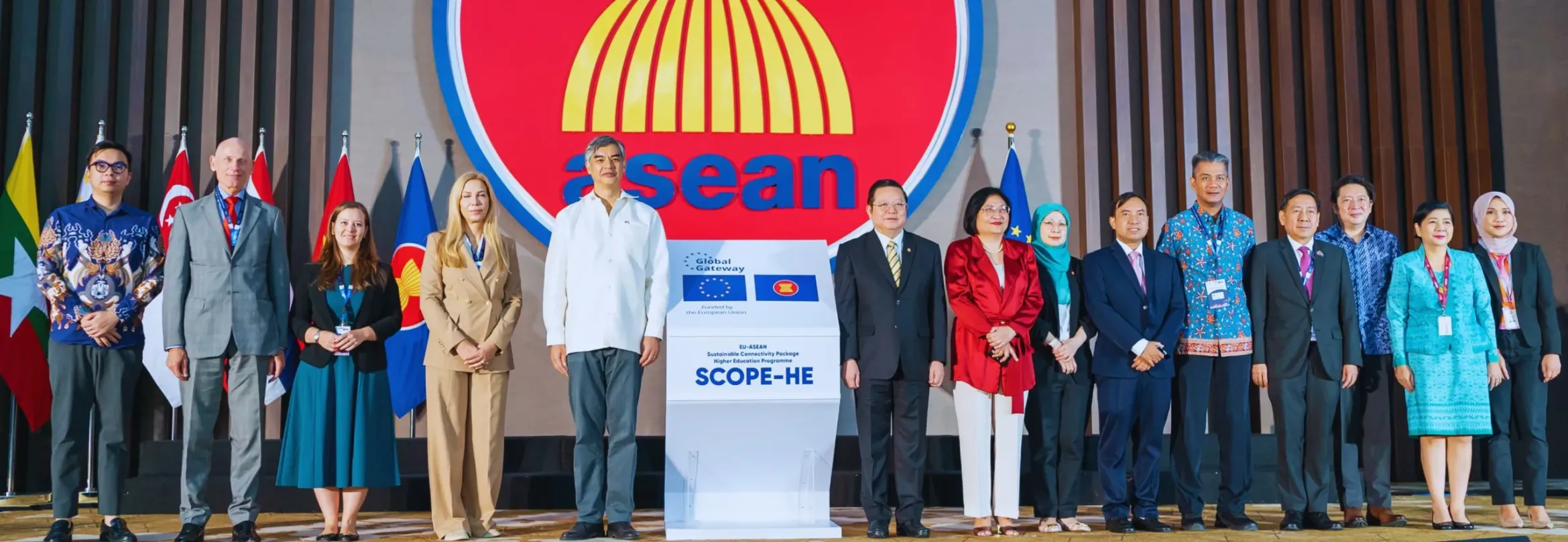
The EU Ambassador to ASEAN and the Secretary-General of ASEAN, together with Ambassadors from the EU and ASEAN Member States, unite at the launch of SCOPE-HE in 2024. (EU Embassy for ASEAN)
Throughout May 12 to 14, ASEAN and the European Union (EU) convened Closing the Gap Workshop 2026 titled “Anchoring Workshop Readiness through Collaboration and Partnership” in Penang, Malaysia. It is part of a joint effort from both regional organisations to forge a more interconnected academic ecosystem.
The Closing the Gap Workshop series is one of flagship projects of the EU-ASEAN Sustainable Connectivity Package – Higher Education (SCOPE-HE) programme. It is an EU initiative implemented by Nuffic (Dutch organisation for education internasionalisation) along with the German Academic Exchange Service (DAAD)). For this year’s edition, SCOPE-HE partnered with the Department of Polytechnic and Community College Education (DPCCE) under Malaysia’s Ministry of Higher Education.
Government representatives from across Southeast Asia, alongside private sector stakeholders and Technical and Vocational Education and Training (TVET) institutions, convened to exchange insights and develop scalable partnership frameworks, with the overarching aim of bridging the gap between education systems and industry needs.
In his opening remarks, EU Ambassador to ASEAN Sujiro Seam described the event as “a concrete step in implementing the ASEAN–EU Plan of Action 2023–2027,” noting that the EU has committed to deepening cooperation on TVET “by sharing best practices and advancing TVET across the region”.
Dr Zamzam bin Mohd Walid, Director of the TVET Coordination Division at DPCCE, echoed this sentiment, affirming that “the future of education must extend beyond classrooms.” He added that Malaysia is “strengthening its TVET ecosystem by integrating technical competencies with critical thinking, adaptability and lifelong learning.”
Over the course of the event, participants engaged in interactive panels, workshops, and exercises to produce collaboration frameworks that will feed into a regional roadmap to be finalised at the concluding Closing the Gap Workshop in 2027. For background, this workshop series first launched in Bangkok in 2024, followed by Phnom Penh in 2025.
What does this mean for business?
The workshop signals a deliberate push to align TVET education more closely with industry expectations across Southeast Asia. As Ambassador Seam highlighted, a skilled local workforce is central to the EU’s Global Gateway strategy (a 300 billion euro infrastructure and investment initiative aimed at building sustainable connections between the EU and partner regions). This means that large-scale investments in green energy, digital connectivity, transport and health are explicitly tied to the quality of technical talent on the ground. For businesses operating in these sectors, this is a signal that the regional education landscape is being shaped with industry outcomes in mind. In practice, this translates to a pipeline of graduates better equipped with both technical skills and workplace-ready competencies.
About The Author