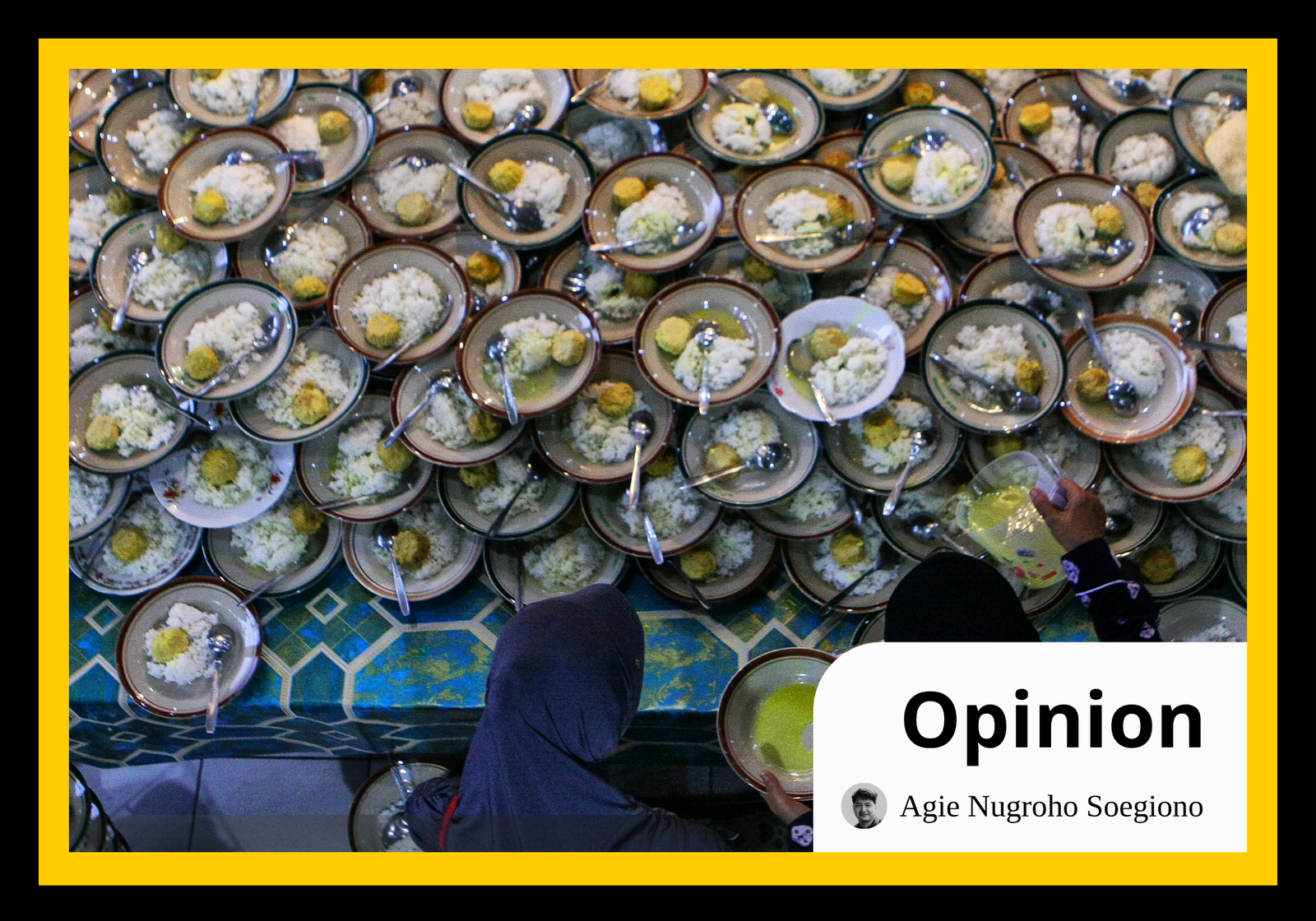
Masjid Jogokariyan staff in Yogyakarta, Indonesia, prepares around 2,500 plates of iftar dishes. (Gudeg.net)
Agie Nugroho Soegiono is a lecturer at the Department of Public Administration, Faculty of Social and Political Sciences, Universitas Airlangga. His research interests vary from public sector reform, digital governance and non-western public administration discussion. He is currently seeking a PhD programme that focuses on transparency and accountability. The views expressed are his own and do not represent SEA Daily or that of another organisation.
Since President Prabowo’s administration took office, the mega-project free meal programme (Makan Bergizi Gratis or MBG) has been launched with politically irresistible promise: feeding more than 80 millions of schoolchildren and vulnerable groups. With such a huge and ambitious target, the Indonesian government has allocated approximately 335 trillion Indonesian rupiah for 2026, or equal to 75 million US dollar per day. However after nearly 16 months in operation, the project keeps drawing persistent criticism from the public despite being supported by Prabowo’s vast coalition in the parliament.
From logistical bottlenecks to inflated costs, from spoiled food to poorly coordinated distribution, the MBG project has been plagued by problems that raise serious doubts about the government’s capacity to deliver large-scale social provision effectively. Despite mounting criticism, the President has insisted on pressing ahead with the programme. With no signs of it being discontinued anytime soon, the question is no longer whether the programme is struggling. The question is: where should policymakers look for answers?
Perhaps the answer has always been there in our neighbourhoods all along, where faith-based communities such as study circles and charity networks in mosques have been providing social assistance and feeding the poor for decades.
A Governance Problem
In our recent study observing how Islamic communities manage their social finances, we found that these religious groups have been significantly filling the gaps in social provision that the government’s social welfare alone cannot address. They are not just informal charities. They represent governance—structured, accountable, and trusted by the communities they serve. This is precisely what the free meal programme has failed to deliver.
At their core, the constant criticisms towards the MBG actually reflect a deeper governance problem: the challenge of delivering social provision at scale through rigid, top-down administrative systems that are disconnected from the communities they serve.
With hundreds of trillions of Indonesia rupiah (equal to tens of billions of US dollar) at stake and efficiency under scrutiny across sectors, it is undeniably urgent that a massive social provision such as the MBG must answer the high-level demands of transparency in procurement, accountability in distribution and a genuine commitment to reaching those most in need.
High social welfare programmes should never become a vehicle for rewarding political supporters or consolidating patronage networks. Yet evidence on the ground suggests otherwise. Reports indicate that many dedicated MBG kitchens (SPPG) facilities have been dominated by entities affiliated with political supporters, police and even military institutions that bear little relevance to nutrition governance. The public also raises eyebrows on the procurement records by the National Food and Nutrition Agency (BGN), the responsible body for the free-meal programme.
Out of 6.31 trillion Indonesian rupiah (362 million US dollar) allocated, public funds were spent on trail bikes, event organisers, shoe polish, undershirts, belts and towels, prompting an obvious question: what do these have to do with feeding children? More troublingly, SPPG kitchens remain concentrated in large urban centers, leaving remote regions (daerah 3T) with significantly fewer beneficiaries.
What Islamic Social Finance Actually Does
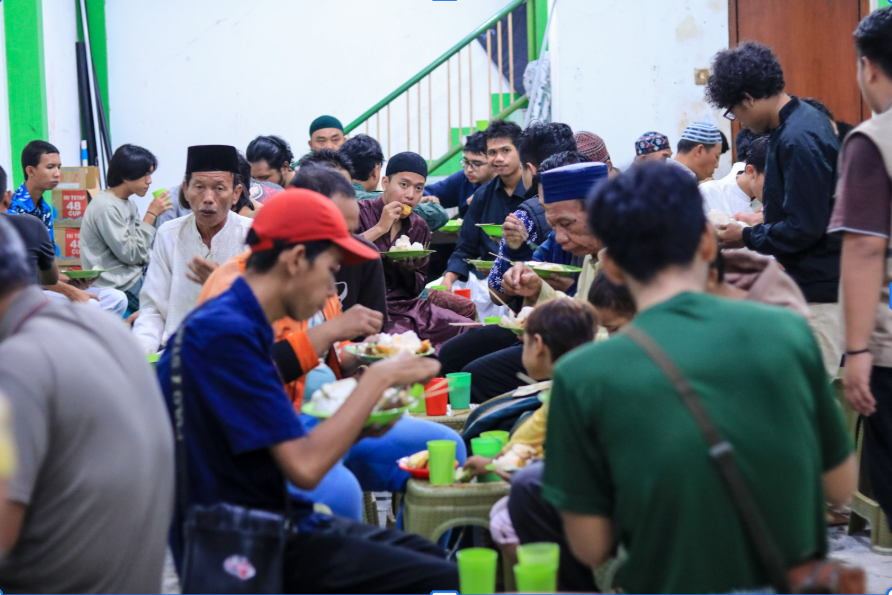
Worshippers break fast together, enjoying a free meal inside the new building of the Masjid Pemuda Indonesia (Indonesian Youth Mosque) in Surabaya, Indonesia on March 2, 2025. (Harian Disway/Moh. Sahirol Layeli)
Our paper argues that formal social provision should learn from best-practices from faith-based social governance which seems to be underestimated as informal or peripheral to serious governance. Across ten Islamic communities comprising study circles and charity organisations that we studied, these groups collectively reached approximately 1.94 million beneficiaries per year, distributing around 7.79 million US dollar in social assistance. They do so through Islamic financing instruments: zakat (mandatory almsgiving), waqf (endowments), infaq and sadaqah (voluntary donations), all governed by transparent financial reporting, community oversight and Sharia-compliant ethical frameworks.
Interestingly, these faith-based organisations do not simply deliver aid. They set eligibility rules, verify recipients through home visits and community deliberation (musyawarah), maintain disbursement logs and in many cases hire independent auditors. Larger organisations submit standardised financial reports; smaller study circles announce fund summaries publicly after Friday prayers. The accountability is not bureaucratic. It is social, spiritual and deeply embedded in neighborhood life. Our coding analysis reveals that these organisations are guided by two interlocking principles: Islamic values such as mutual trust, Sharia compliance and institutional autonomy, as well as recognisable governance values such as deliberative decision-making, targeting accuracy and public accountability in financial reporting.
In Islamic community finance, accountability is not enforced merely by auditors or regulations alone. Instead, the public oversight is enforced by neighbours. When fund managers, donors and beneficiaries share the same streets and the same mosques, every financial decision is relatively visible to everyone. Mismanagement does not just damage an organisation’s credibility. It damages a person’s standing within the neighbourhoods they live in. This, we argue, creates a powerful incentive for transparency than any compliance requirement.
Faster, More Inclusive and Locally Embedded
What distinguishes Islamic social finance from state programmes is not merely its religious motivation, but its informational advantage. Neighbourhood committees continuously update their knowledge of local welfare conditions through direct observation and community discussion. This collapses the information lag that plagues registry-based programmes and enables faster disbursement to households in sudden need.
To provide some illustrations, Masjid Jogokariyan in Yogyakarta and Masjid Pemuda in Surabaya have demonstrated exactly this in practice, earning national recognition not for the size of their wealth, but for how they govern it. Both publish transparent financial reports accessible to their congregants, run systematic food distribution programmes and sustain their operations through community trust rather than government dependency.
Unlike SPPG kitchens appointed through opaque procurement cycles, these mosques tap into their own surrounding communities to produce and distribute food, engaging local vendors and home cooks whose livelihoods also benefit in the process. The hungry get fed, and the neighbourhood economy moves. The contrast with SPPG kitchens could not be starker. Rather than empowering local food producers, the centralised SPPG model has effectively sidelined school canteens and small food vendors who were once the backbone of school food provision. Many have seen their income collapse simply because they were never invited to the table.
And the sustainability question is equally telling. While MBG depends entirely on annual state budget allocations that are vulnerable to political shifts and fiscal pressures, Islamic communities have long developed a more durable financing model through waqf. Assets are invested, returns are reinvested into social programmes and the cycle continues regardless of who sits in government. It is a self-sustaining model of social provision that MBG, for all its ambition and budget, has yet to come close to replicating.
What Policymakers Should Do
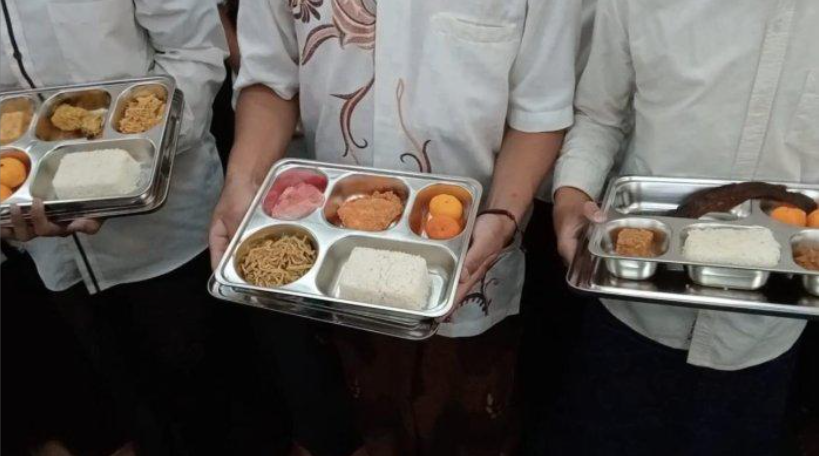
Illustration of a free nutritious meal container. (Tribun Jatim/Anggit Pujie Widodo)
We are not arguing that the free meal program should be abolished or entirely handed over to mosques. The state has obligations that community organisations cannot and should not fully replace. What we are arguing is that policymakers are missing a significant opportunity by designing welfare programmes without seriously engaging with the governance models that already work.
There are concrete lessons to draw. First, community-based eligibility verification through local networks, neighborhood leaders and direct observation could contribute to a programme’s accuracy and inclusiveness. The free meal program could benefit from formal partnerships with local organisations that already possess this knowledge, especially regarding the beneficiary targets in their surroundings. Second, accountability does not require complex bureaucracy. Islamic charitable organisations demonstrate that transparent, trusted governance can be achieved through social embeddedness, public reporting and clear role definition, even at the neighborhood scale. Third, the waqf model offers a viable, proven alternative for generating recurring social financing that is independent of political cycles and fiscal pressures.
Policymakers should also recognise that schools themselves are not empty vessels waiting to be served. They come with existing structures, relationships and local knowledge that MBG has largely ignored. School canteens, parent associations (komite sekolah) and school boards have long been embedded in the daily life of students and families. They know which children skip meals, which families are struggling and which local food vendors can be trusted. Bypassing these structures in favour of centralised SPPG kitchens has not only created logistical inefficiencies, it has squandered a ready-made network of accountability and local knowledge that no procurement tender can replicate.
Indonesia has a centuries-old tradition of community-based social provision grounded in Islamic values. It reaches people the state cannot, moves at a speed that bureaucracies cannot match and sustains itself through moral obligation rather than political will. It is, in the language of public administration, a governance system, not merely charity.
The free meal program’s struggles are an opportunity to rethink how Indonesia designs and delivers social welfare. Rather than reinventing the wheel through costly top-down programmes, policymakers should look to what already works: the mosques, study circles and charity committees that have been feeding, supporting and uplifting communities, quietly, accountably, and sustainably, long before any government program arrived.
About The Author