

An undated picture of a Southeast Asian girl in a school setting (Pixabay)
Joshua Vidal is a Transdisciplinary Research Associate on Coastal Cities at Risk in the Philippines-Ateneo De Manila University, Editor-in-chief for the Electronic Paper for Science and Technology Education-The Publication Office and a Non-resident Research Scientist Fellow at the Department of Science in Basic Education-Unida Christian Colleges. The views expressed are his own and do not represent SEA Daily or that of another organisation.
If Southeast Asia wants responsible AI, it must stop treating schools as the last mile of digital policy and start treating them as the first test of public readiness.
Southeast Asia is no longer short of artificial intelligence (AI) language. The region already has frameworks, principles and now a roadmap. Yet the harder question is not whether ASEAN can speak the language of artificial intelligence. It is whether its schools, teachers, public institutions, and communities are ready to carry that language responsibly. If readiness remains unequal, the region’s AI push will deepen existing divides rather than close them.
On paper, ASEAN’s policy momentum is real. The ASEAN Guide on AI Governance and Ethics was launched in February 2024, the Expanded ASEAN Guide on AI Governance and Ethics – Generative AI was unveiled in January 2025, and the ASEAN Responsible AI Roadmap 2025–2030 now promises actionable steps for policymakers and stakeholders across the region. The direction is ambitious and, in many respects, necessary. ASEAN cannot afford to be absent from global debates on AI safety, standards, governance, labour, education, and innovation.
When ambition becomes a form of misrecognition
The more ASEAN talks about AI competitiveness, the more it risks sounding as though the region’s main problem is speed. It is not. The deeper problem is uneven readiness. AI policy can be regional, but readiness is lived locally: in whether a teacher can meaningfully guide students through generated text, whether a rural school can stay connected during climate disruption, whether a ministry can govern data and ethics without outsourcing judgment, and whether citizens can distinguish assistance from manipulation.
The evidence is sobering. According to UNICEF East Asia and Pacific, more than 183 million school-aged children in the region lacked internet at home before the pandemic. The same UNICEF regional summary, drawing on a survey across ten ASEAN countries, reported that 61% of students did not receive digital literacy education in school. In other words, even before the current generative AI rush, the baseline conditions for meaningful digital participation were already thin.
The inequality is not only between countries; it is also within them. A joint UNICEF–ITU analysis found that in East Asia and the Pacific only 23% of children and young people from the poorest households had internet access at home, compared with more than 80% among the richest households. This is the real AI divide. It is not merely the presence or absence of a chatbot. It is the distance between those who can integrate new tools into strong learning environments and those who meet them through scarcity, patchy access and fragile support systems.
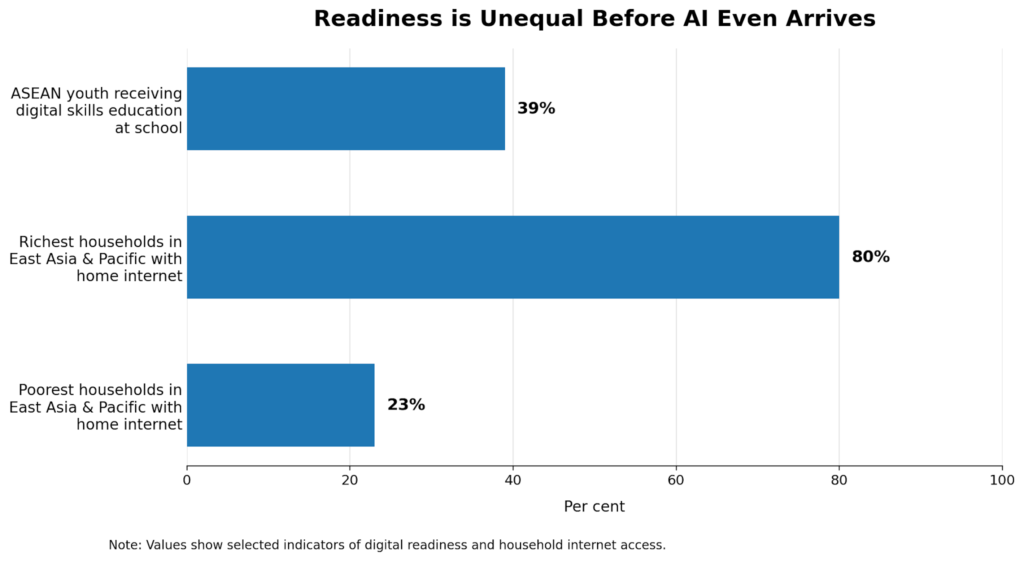
Figure 1. Readiness is unequal before AI even arrives. Author’s chart based on UNICEF East Asia and Pacific and UNICEF–ITU data.
This is why the region should stop treating schools as downstream beneficiaries of digital policy. Schools are upstream infrastructure. If AI enters classrooms where connectivity is weak, teachers are under-supported, and digital literacy is shallow, the result will not be transformation. It will be automation layered on top of inequality.
Even ASEAN’s own institutional architecture hints at this. The Expanded Guide on Generative AI explicitly frames policymaking as a balance between innovation, safety and regional harmonisation, while the ASEAN Digital Masterplan 2030 goes further by tying AI governance to digital literacy, future skills, climate resilience and green digital transformation. That is a crucial admission. The AI agenda cannot be separated from education capacity, workforce preparation or resilience to disruption.
National readiness assessments point in the same direction. In Indonesia, UNESCO’s AI readiness assessment examined five dimensions, including scientific and educational as well as technical and infrastructural readiness. In the Philippines, UNESCO’s Readiness Assessment Methodology likewise spans legal, social, economic, scientific, educational and technological dimensions. The lesson is obvious: AI readiness is not a single ministry issue, and it is certainly not just a procurement issue. It is an ecosystem issue.
Public capacity before technical excellence
Climate pressure makes the urgency even sharper. A UNICEF global snapshot for 2024 found that at least 242 million students in 85 countries had their schooling disrupted by extreme climate events in a single year, A UNICEF global snapshot for 2024 found that at least 242 million students in 85 countries had their schooling disrupted by extreme climate events in a single year, with heatwaves alone affecting at least 118 million children in April. The Asian Development Bank’s Climate Change and Education Playbook also notes that extreme heat and other calamities caused 32 days of school closures in the Philippines during the 2023–2024 school year. This matters for AI policy because fragile schooling systems cannot be the foundation of trusted digital futures. A region facing climate shocks cannot afford to imagine digital transformation as if infrastructure, attendance, electricity and public health were stable background conditions.
| Signal | What the data say | Why it matters for ASEAN’s AI push |
| Connectivity | 183 million school-aged children in East Asia and the Pacific lacked internet at home | AI access is still filtered by infrastructure, not just policy |
| Inequality | 23% of the poorest households had home internet, versus 80%+ of the richest | The region’s AI divide is fundamentally distributive |
| School capacity | 61% of surveyed ASEAN youth were not receiving digital skills education at school | Classrooms are not yet ready to absorb AI evenly |
| Climate disruption | 242 million students globally had schooling disrupted by climate events in 2024 | Education resilience is now part of digital readiness |
Table 1. Evidence snapshot derived from UNICEF, UNICEF–ITU, UNESCO, ASEAN, and ADB sources cited online.
So what should ASEAN do if it is serious about responsible AI? First, treat teacher capability as core public infrastructure. UNESCO’s digital education work consistently emphasises human agency, critical thinking and ethics for students and teachers in the age of generative AI. That should not be read as a soft add-on. It is the governance layer inside the classroom. Teachers are not simply end users of AI tools; they are the first interpreters of whether those tools deepen learning, weaken judgement or normalise intellectual passivity.
Second, stop separating AI policy from climate resilience. The region’s digital transition is now unfolding in conditions of heat stress, flooding, interrupted attendance and uneven electricity reliability. If ASEAN wants trustworthy AI for public good, it must invest in school-level resilience: cooling, connectivity redundancy, offline access, teacher support and curriculum continuity. A classroom that repeatedly shuts down under extreme heat is not an incidental education issue. It is a digital governance issue.
Third, build an ASEAN public-interest model of readiness rather than a branding model of competitiveness. The region should absolutely pursue AI innovation. But innovation that outpaces civic literacy, public oversight and educational capacity will not look like leadership; it will look like dependence. The most dangerous outcome is not that Southeast Asia moves too slowly. It is that it moves quickly while borrowing tools, standards and narratives that its citizens have little power to interrogate.
Therefore, the right question is not whether ASEAN has entered the AI race. It has. The evidence shows that readiness is profoundly unequal across households, schools and systems. The necessary synthesis is that the region’s AI future will not be secured merely by publishing roadmaps. It will be secured by building public capability strong enough to use AI without surrendering judgement, equity or resilience.
If Southeast Asia wants a genuinely responsible AI future, it should begin with a simple political truth. The region will not be made trustworthy by what its leaders announce in conference halls alone. It will be made trustworthy by what students can question, what teachers can guide, what communities can access, and what institutions can protect when the heat rises, the connection drops or the machine answers too confidently.
About The Author




One thought on “Southeast Asia’s AI Future Will Be Decided in Its Classrooms, Not Its Boardrooms”