
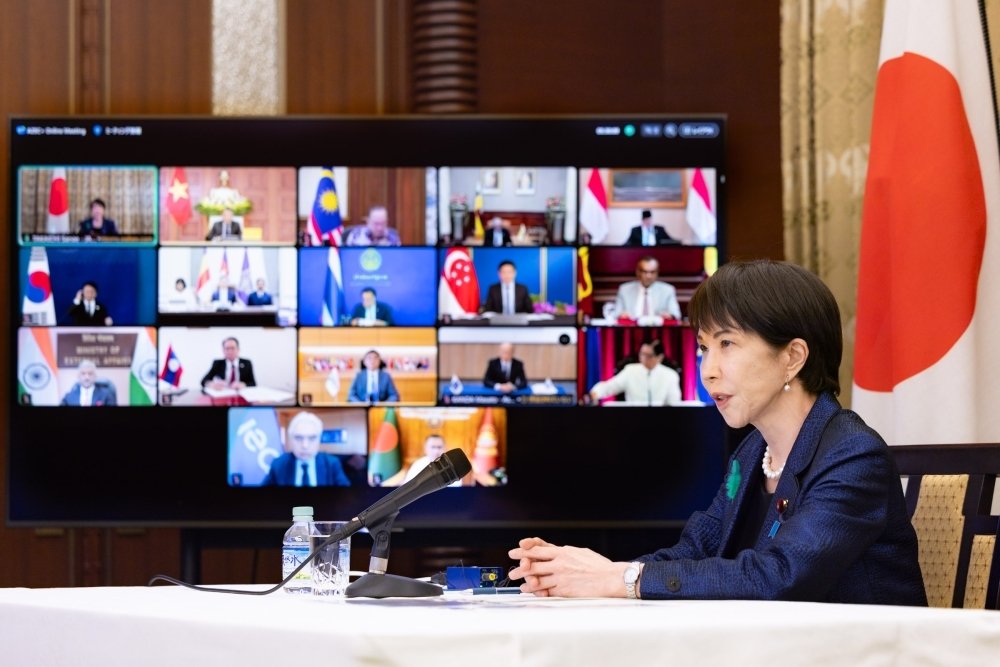
(Japanese Prime Minister Sanae Takaichi chairs the AZEC Plus Online Summit on Energy Resilience, April 15, 2026. (Prime Minister’s Office of Japan)
Southeast Asian leaders joined Japan on April 15 for the Asia Zero-Emission Community (AZEC) Plus Online Summit on Energy Resilience, a high-level emergency meeting aimed at securing the region’s energy future. The virtual gathering featured a broad coalition of 15 nations, including the ten core AZEC members—Japan, Australia, Brunei, Cambodia, Indonesia, Malaysia, the Philippines, Singapore, Thailand and Vietnam—alongside delegations from South Korea, Bangladesh, India, Sri Lanka and Timor-Leste. Key global observers from the Asian Development Bank and the International Energy Agency also participated.
The summit serves as a proactive response to the escalating Middle East crisis and ongoing disruptions in the Strait of Hormuz, which have triggered severe energy shocks across Asia. Prime Minister Sanae Takaichi emphasised that collective action is vital for “strengthening the supply chain on energy and important materials.” Highlighting the region’s deep integration, she noted that Japan and its Asian neighbors share a “mutually dependent relationship” through these critical trade networks.
A landmark outcome of the hour-long session was the establishment of the Partnership On Wide Energy and Resources Resilience (POWERR Asia). To back this initiative, Japan pledged a substantial 10 billion US dollar financial package. This funding is roughly equal to the total annual cost of oil imports for the entire ASEAN region. Rather than a direct grant, the capital will be deployed through specialised Japanese institutions. Japan Bank for International Cooperation (JBIC) will manage project financing, Nippon Export and Investment Insurance (NEXI) will provide trade risk coverage and JICA/JOGMEC will offer technical support for infrastructure.
Furthermore, leaders agreed to transition into an “AZEC 2.0” framework, designed to harmonise urgent energy security needs with long-term decarbonization targets. During the summit, Philippine President and current ASEAN Chair Ferdinand Marcos Jr. delivered a speech, calling for a regional joint oil stockpiling initiative. This plan would be executed under the ASEAN Petroleum Security Agreement (APSA) with research and logistics support from the Economic Research Institute for ASEAN and East Asia (ERIA).
What does this mean for businesses?
For businesses operating in Southeast Asia, this move points to a more stable and coordinated energy environment, which could help limit sudden price spikes and supply disruptions. Energy-intensive industries like manufacturing, transport and heavy industry may benefit from easier access to financing and risk protection through institutions such as Japan Bank for International Cooperation and Nippon Export and Investment Insurance. At the same time, the shift toward an “AZEC 2.0” framework means companies will need to keep pace with decarbonisation goals, likely increasing spending on renewables and efficiency improvements.
The launch of POWERR Asia and ideas like shared oil reserves under the ASEAN Petroleum Security Agreement could change how companies think about risk and supply planning. There may be new openings in infrastructure, storage and regional energy projects, especially with support from groups like the Economic Research Institute for ASEAN and East Asia. Simultaneously, businesses will be expected to strengthen resilience, diversify suppliers and adjust to evolving regional rules around both energy security and sustainability.
About The Author


One thought on “Japan commits US$10 billion for Southeast Asia’s energy security”