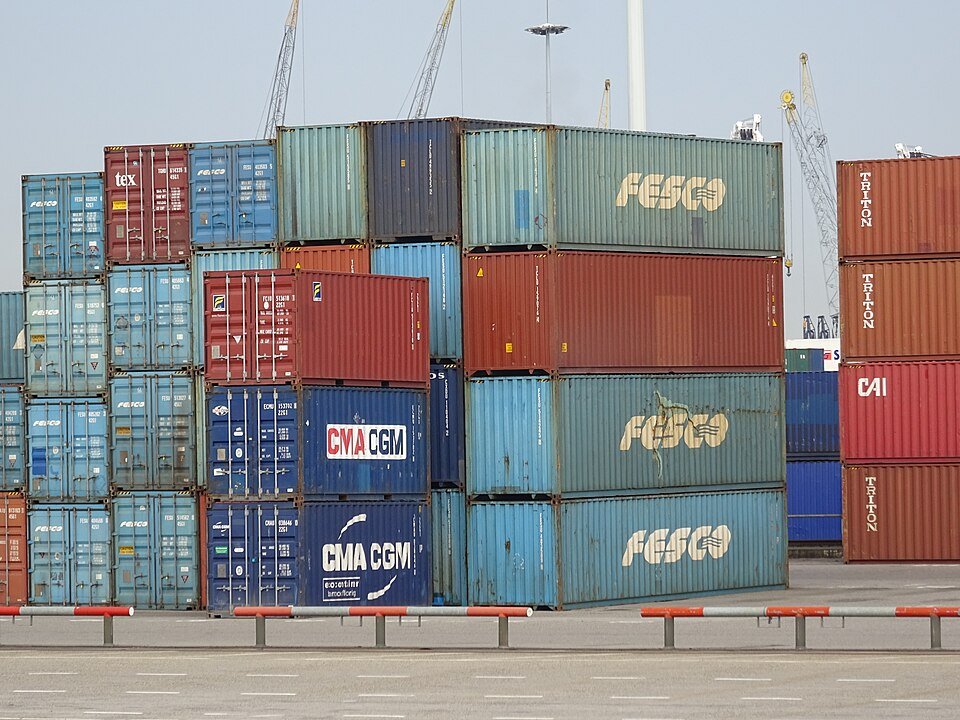
Shipping containers at a port. (Wikimedia)
Vietnam will introduce revised regulations governing cross-border trade from September 5, alongside a new prohibition on imports of goods produced wholly or partly using forced labour under Decree No. 292/2026/ND-CP.
Issued on July 22, the decree replaces Decree 69 of 2018 and updates provisions covering temporary import for re-export, temporary export for re-import, border-gate transfer, transit and goods processing involving foreign parties.
Under the revised regulations, Provincial-Level People’s Committees will have authority to issue licences for temporary import, re-export and border-gate transfer activities. Licensing authorities must issue a decision within five working days of receiving a complete and valid application or provide reasons for refusing it.
The decree also permits Vietnamese enterprises to process goods for foreign traders and to rent or borrow machinery and equipment from foreign partners to support production. Enterprises registered for freight-forwarding services will also be able to provide services for transporting goods in transit.
A significant addition is the prohibition on the importation of products and goods extracted, produced or manufactured wholly or partly through forced labour. Vietnam’s Ministry of Industry and Trade said the measure strengthens the country’s legal framework on forced-labour imports and supports its international commitments, including those under the International Labour Organisation (ILO).
The decree assigns the relevant government authorities responsibility for issuing detailed lists of prohibited goods and their HS codes. However, several aspects of implementation, including how forced-labour links will be identified and how individual shipments will be assessed, remain subject to further guidance.
The revised rules come as Vietnam faces increasing requirements for supply-chain transparency and responsible sourcing in international trade. The Ministry of Industry and Trade said the US had included Vietnam in a Section 301 investigation concerning countries’ measures against imports produced with forced labour. Vietnam is subject to an additional US tariff rate of 12.5% on goods within the measure’s scope, after applicable exclusions.
As Vietnam becomes more integrated into global supply chains, the credibility and consistency of these measures will be important to maintaining market access and evolving trade requirements. The new decree also simplifies cross-border trade procedures with tighter regulations on the origin and production of imported goods. Greater licensing authority at provincial-level could reduce administrative delays for businesses, while the forced-labour prohibition requires importers and manufacturers to strengthen supplier checks and supply-chain documentation.
About The Author