A landscape of Indonesia’s capital Jakarta (Unsplash/Rafli Raihan)
Ika Puspa is a communications strategist from Indonesia. The views expressed are her own and do not represent SEA Daily or that of another organisation.
On paper, Indonesia is Southeast Asia’s “unbreakable” economy. Growth holds steady at around 5%, domestic consumption remains resilient and foreign investment continues to flow despite a tightening global environment. But global capital does not invest in paper. It invests in signals and those signals are becoming harder to read. Yet, beneath this reassuring picture, a quieter but more consequential issue is emerging, namely a growing deficit of trust. This is not a question of whether Indonesia can grow. It can, and likely will. The more pressing concern for the global market is whether investors fully trust the rules that underpin that growth, and whether those rules will remain consistent when political or economic winds shift.
The “Say-Do” Gap
Recent scrutiny from global market observers reflects a fundamental tension. Reviews of market accessibility and governance signals are not questioning Indonesia’s potential; rather, they highlight a “say-do gap”, the distance between what policies promise and how they are experienced by those on the ground.
We see this most clearly in the country’s ambitious industrial downstreaming agenda. While the strategic intent to move up the global value chain is sound, the journey has often been marked by sudden shifts in export quotas and technical requirements—as seen in recent shifts in mining quotas and export requirements affecting mineral exports. For a global investor, the risk is not the policy of downstreaming itself. It is the secondary tremors of “regulatory recalibration” that occur with little warning, turning a long-term capital commitment into a moving target.
Trust as a Functional Currency

A shopping centre in Indonesia’s capital Jakarta (Unsplash/Eugenia Clara)
In the context of global capital, trust is not a moral virtue; it is a functional currency. It is built on predictability, the sense that policies will be applied uniformly, that regulatory changes will be communicated with sufficient lead time, and that institutional processes will function as expected.
In Indonesia, this issue is magnified by the country’s scale. As Southeast Asia’s largest economy— accounting for more than one-third of the region’s GDP—Indonesia sets the tone for the entire region. When questions arise around policy consistency, they do not remain local; they shape the broader perception of risk across emerging markets.
One of the most visible friction points is the “last mile” of investment, the space between a high-level Memorandum of Understanding (MoU) and the actual issuance of permits. Whether it is the evolving framework of the New Capital City (IKN), where regulatory structures and investment schemes continue to be refined, or the implementation of recent omnibus reforms, where interpretation can vary across institutions, investors often find that a “green light” at the ministerial level can still turn “yellow” when it reaches the complexities of inter-agency coordination, particularly in areas such as permitting processes and regulatory approvals.
Communication is Policy
As a communications strategist, I have often observed a structural misunderstanding in governance: the idea that communication is a final step taken after a policy is decided. In reality, communication is part of the policy itself. This is not a theoretical gap, it is one repeatedly encountered at the operational level, where policy intent meets institutional reality.
Investors respond to signals, timelines that shift without explanation, regulatory interpretations that vary across institutions or announcements that lack context. When communication is fragmented or reactive, uncertainty fills the space. And in financial markets, uncertainty is quickly priced into risk.
Where there is a lack of coherence between ministries, the market perceives not just a coordination problem, but a governance risk. Countries that provide not just growth, but clarity and coherence, are the ones that will stand out as global capital becomes increasingly selective.

A night shot in Indonesia’s capital Jakarta (Unsplash/Wasis Riyan)
Closing the Gap
Closing this gap is not about introducing new policies, but about executing existing ones with greater coherence. In Indonesia, this is reflected in the length of investment cycles, where permitting and approval processes can take years before projects are realised, creating uncertainty for long-term investors.
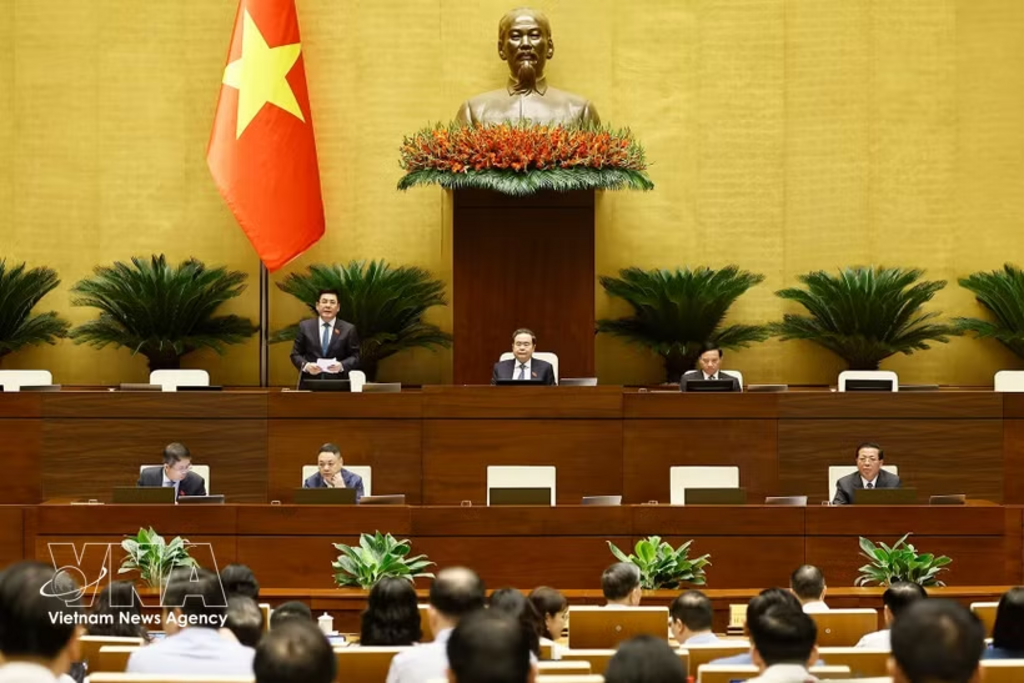
Across Southeast Asia, similar dynamics appear in different forms. In Vietnam, for instance, ongoing administrative reforms have been welcomed as necessary, yet investors continue to anticipate delays in project approvals as institutions adjust to new regulatory structures.
It requires clearer signalling, tighter coordination across institutions, and a more disciplined approach to how policy is communicated and sequenced over time.
The stakes are not an immediate crisis, but a gradual erosion. Across the region, permitting delays and policy uncertainty have increasingly been cited by investors as factors that raise financing costs and reduce investment appetite. A persistent gap between performance and perceived credibility can, over time, reduce competitiveness and increase the cost of capital.
Indonesia’s growth story remains compelling. But for it to be fully convincing, it must be supported by a level of institutional trust that matches its massive ambition.
In the end, growth attracts attention.
But trust sustains it.
About The Author