
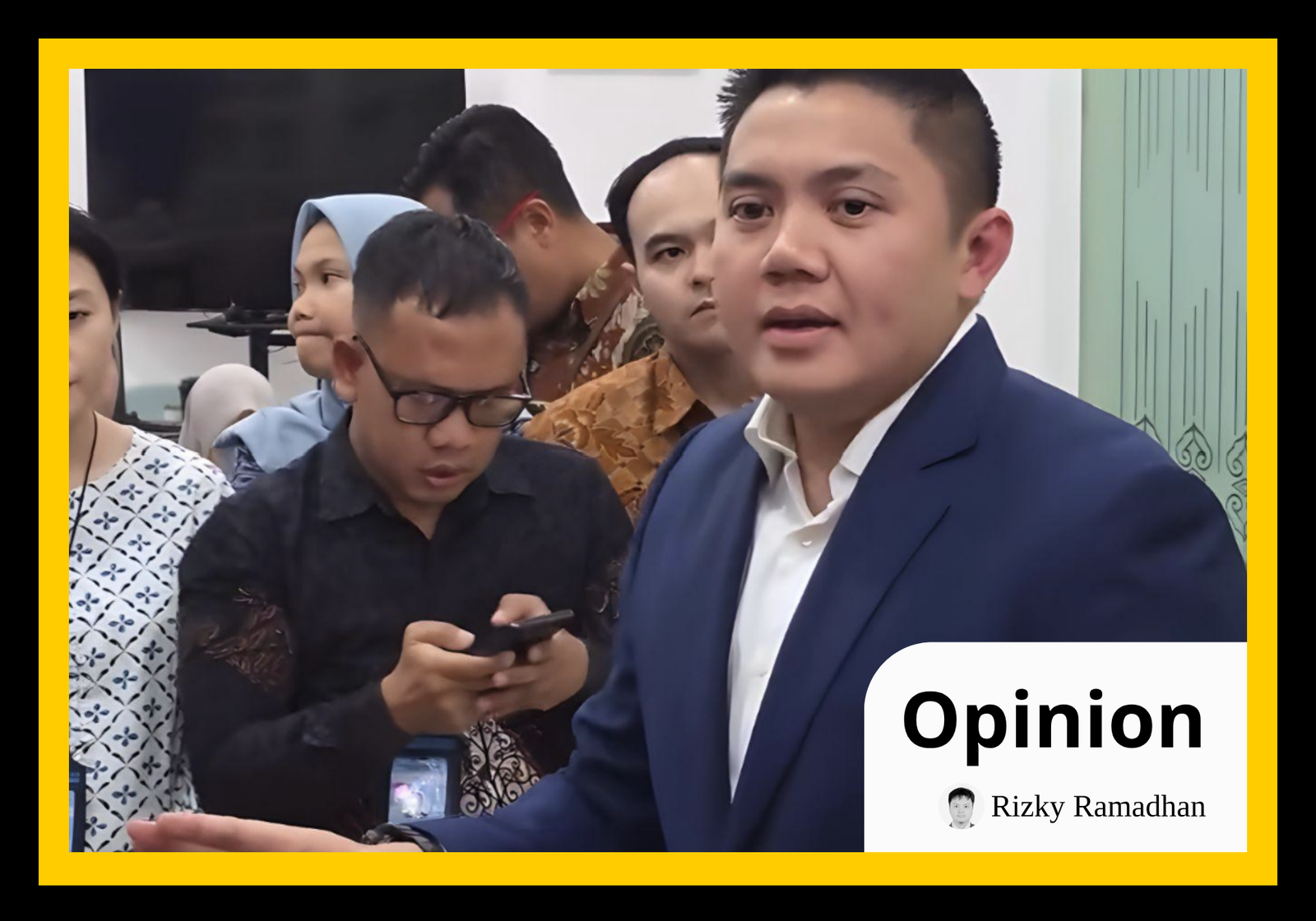
Cabinet Secretary Teddy Indra Wijaya (KPPD) delivering a press statement at the Presidential Palace Complex in Jakarta on April 10, 2026 (Cabinet Secretariat of the Republic of Indonesia)
Rizky Aditya Ramadhan is an independent writer specialising in international relations, public policy, and Indonesian politics. The views expressed are his own and do not represent SEA Daily or that of another organisation.
“Do you want me to be corrupt like everyone else?” Sugeng shouted, and the echo of that shout lashed against his head now, ceaselessly.
“By God,” he swore in his heart, “I know I have fought with all my might against every temptation to be wicked. But if Hasnah wants a house, and a house can only be obtained through corruption… For Hasnah, for the baby that will be born—my baby!”
He clenched his fists.
“How unjust this world is. A man who wants to be honest is given no opportunity for honesty. Only one house, a simple one and a man should not have to violate his honour for it. No, I will not give in. Let Hasnah be angry, let Hasnah hate me!”
—Mochtar Lubis, Senja di Jakarta
On March 9, 2026, Indonesian President Prabowo Subianto sat in his private residence as he was accompanied by his personal aide in announcing the construction of more than 200 bridges via a Zoom conference. This moment is more profound than bridge-building, both figuratively and literally. Addressing the House of Representatives , the president insisted that the nation’s formidability and its vast, untapped wealth demanded a far more rigorous standard of governance. “For that,” he proclaimed, “I reassert that we have to declare war on corruption on every level.”
The actual vernacular he chose, memerangi korupsi or as I’ve translated it to “declaring war on corruption” is no short an effort to address to what must be an awkward status for the current Indonesian administration that was just, a month prior to the speech, \ranked 109th in Transparency International’s Corruption Perceptions Index (with first position being perceived least corrupt). This was a significant downturn since Indonesia used to occupy the 99th rank with a score of 37/100 for 2024 before attaining the horrendous 34/100 for 2025. Of course, this is not the first time the Indonesian state—being led by a former general—has declared their intentions to combat corruption in whichever form they may take.
The Origin: Soeharto’s New Order
The true war broke out on 24 July 1970. The Indonesian media outlet, Sinar Harapan, ran a headline regarding Commission of Four (K-4)’s recommendations to the President. The news article was titled, “K-4’s Recommendation to the President of the Republic of Indonesia: The Corruption Rate Will Become Very Negative If…” (Saran K-4 kepada Presiden RI: Ladju Korupsi Akan Djadi Sangat Minus, Djika…). What made this—seemingly benign by current day standards—article a declaration of war was the fact that the article contained classified reports made by K-4, a group created by the Soeharto administration in response to popular anti-corruption protests in the early 1970s. The report contained findings about mismanagement of state-owned entreprises like Bulog (rice), Perhutani (forest products), and notably Pertamina (oil and gas). In one instance related to the latter, it was found that Ibnu Sutowo—managing director of Indonesia’s premier gas and energy firm and also Soeharto’s golden child—had been siphoning more than 10 million American dollars for the military and personal gain. The anomaly, however, was the fact that this document was disseminated to the public without the president’s consent.
President Soeharto himself already had access to the information contained therein by June 1970. The former general planned to disclose this fact to the public himself via a planned speech later in August that year. Given the upbringing of Soeharto’s New Order being a military-dominated polity, in which a select few of individual generals held great influence and used such power to enrich themselves and their families, it makes sense that the Australian scholar, J.A.C Mackie, stated that Soeharto had been reluctant in taking “action against these men at the behest of New Order radicals in the early years when his political authority was still precariously based and when the national economy was still in chaos.”
However, in what would be known as the Malari Incident, thousands of students peacefully demonstrated in the Jakartan streets regarding corruption and socioeconomic inequality that were facilitated through foreign investments, only to be provoked by provocateurs working for the Indonesian military’s Special Forces, turning the demonstration into a violent riot. In the wake of the incident, media outlets such as Sinar Harapan had their publishing rights revoked with intellectuals such as Mochtar Lubis detained. There is no room, therefore, for the barest of arguments proclaiming somehow the innocence of Soeharto’s regime in the war on corruption. They were not on the side of the intellectuals nor were they interested in getting rid of corruption.
This authoritarian vivisection of the press constitutes as the loss of Indonesia’s intellectual underbelly, an anti-intellectual turning point as Soeharto’s regime embraces draconian policy-making as a way to suppress and resolve the insoluble dissent against his efforts to implant his closest circles into essential institutions of the Indonesian state for his personal benefits. Interestingly enough, even media outlets who were vocal in legitimising coercion and state irruption into the intellectual sphere were not exempt from these policies such as the case of Ekspres, a newspaper which nearly a week prior to the incident ran headlines claiming that student intellectuals had been “manipulated by external anti-Soeharto forces” (dimanipulir kekuatan-kekuatan luar anti-Soeharto).
Indonesian Anti-Intellectualism
The case of Sinar Harapan and the subsequent happenings of the Malari Incident is but a microcosmic instance of how the Indonesian state cultivates anti-intellectualism, going as far as infiltrating intellectual movements to maintain an oppressive, corrupt power structure for the sake of obstructing the war on corruption. The American postwar historian Richard Hofstadter wrote of a similar phenomenon from another side of the world just six years before Sinar Harapan’s disastrous whistleblowing in his landmark book, Anti-intellectualism in American Life.
Writing with a level of depth and reverence deadly to the mental apparatus of the corrupt, Hofstadter tells us that anti-intellectualism has two complementary meanings. First, a distrust and hostility towards what he calls the life of the mind and those who represent it. Second, a persistent tendency to downplay the value of intellectual pursuits. Yet unlike more neatly defined social constructs such as unemployment or nationalism, anti-intellectualism is not something that can be measured as an independent, self-contained subject. It is not naturally singular because anti-intellectualism relies on overlapping sources of constitutions, thus precluding many scholars’ efforts to categorise it with operational parameters unlike tracing the personal biography of a particular individual.
Cabinet Secretary Teddy Indra Wijaya’s statement on 10 April regarding the state of Indonesia and his narrative of a supposed inflation of observers (inflasi pengamat) is perhaps the most recent addition to the plethora of apparatchik statements that tell us of the rampant anti-intellectualism which has defenestrated the current Indonesian administration’s intellectual legitimacy. To imply that there is a reasonable limit on the number of intellectuals who may or may not have an opinion on the current state of the country is to derogate and conflate the criticisms as nothing more than sentiments, ignoring the substance, coherence, and validity of these intellectuals’ analyses. In the wider context of the statement, Wijaya goes as far as to claim that the two Eid Al-Fitr celebrations (lebaran) conducted in both 2025 and 2026 went smoothly with the price of basic commodities stabilised according to “real” economic data.
What he does not convey to the public—likely hoping Brandolini’s Law would save him from the wrathful scrutiny of intellectuals who are aware of his tactics – is monitoring data from the Institute for Development of Economics and Finance’s Center of Macroeconomics and Finance published in March 2026 which reveals that not a single region in Indonesia had an average wage sufficiently high enough to cover the basic cost of living. Furthermore, it is paradoxical to affirm socioeconomic stability when the source of that very short-term stability is a decision to stunt long-term growth of the economy.
This trend of not wanting to be bothered by an intellectual struggle for sincere lucidity of a problem is the true bane of Indonesia’s anti-corruption efforts. If Indonesia’s political elites indeed possess more than a modicum of empathy for the war, then the citizenry would have a working legislation for re-appropriating assets of corruption. In this regard, one ought to be disappointed at the stalled Draft Law on the Confiscation of Criminal Assets. Instead, the Indonesian people have no such legislation, both on criminal and non-conviction-based forfeiture, nor an urgently-discussed bill in the House of Representatives.
The first necessary step in any serious campaign against the banal and fatal corruption of the Indonesian republic is not the posturing of career politicians and military men cynically scoffing at the unapologetic tools of its intelligentsia. Simply put, to win a war, one must have weapons. And one of the best weaponry against corruption is one which can reverse the damage it had wrought via the torment of corrupts with competent legislations. Until the Indonesian establishment concedes that a free, adversarial and intellectually armed and alarmed citizenry is the only genuine antidote to systemic corruption, grandiose declarations of “war on corruption” will remain exactly what they have always been: a festival for a distracted audience whose pockets are to robbed blind.
About The Author



One thought on “Indonesian anti-intellectualism is incapacitating the war on corruption”