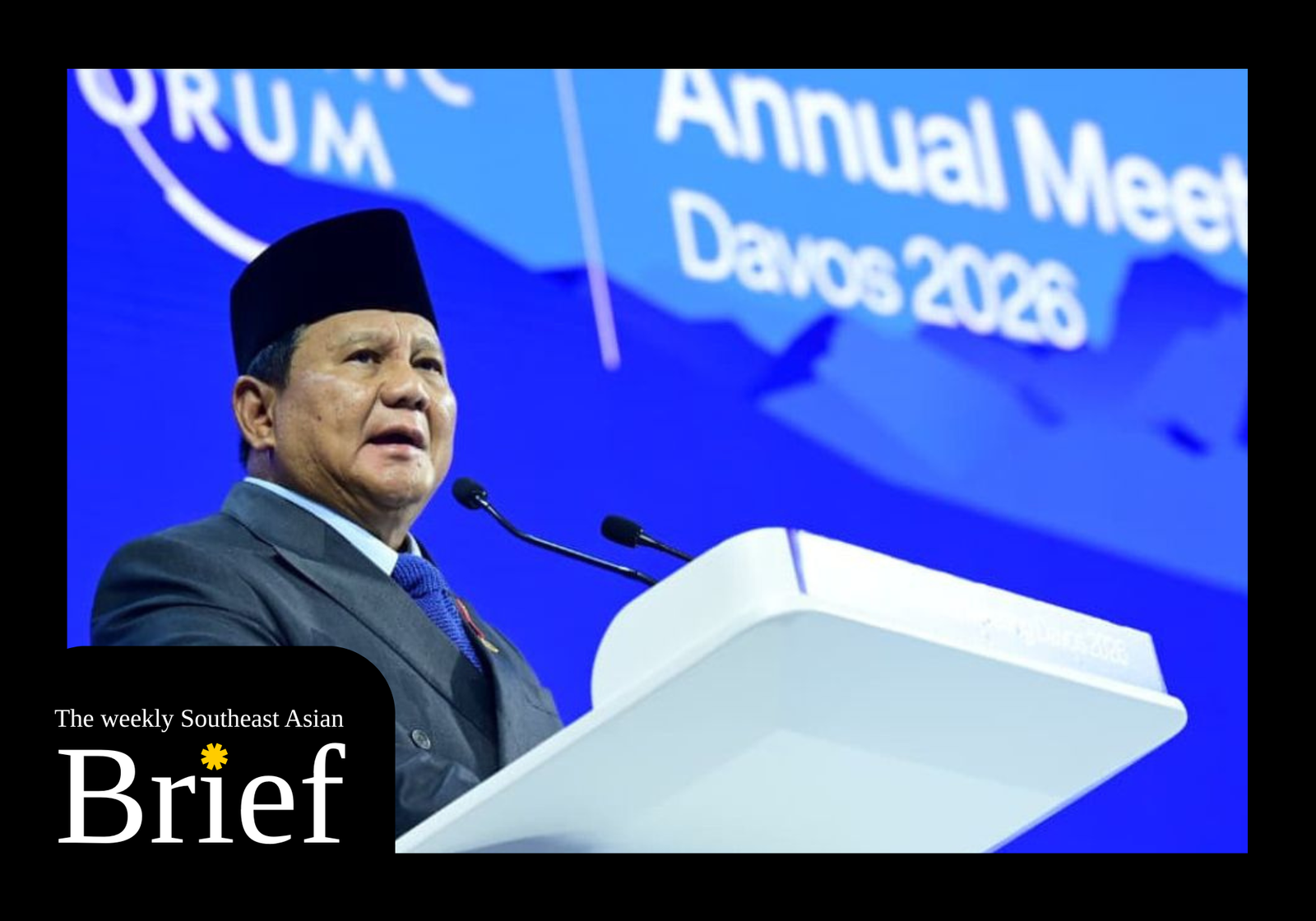
Indonesian President Prabowo Subianto speaking at the World Economic Forum (WEF) 2026 Meeting in Davos, Switzerland, on January 22, 2026. (Presidential Media Team)
On 22 January, Prabowo Subianto departed for Davos, Switzerland, following an official meeting with UK Prime Minister Keir Starmer in London, to deliver a special address to the World Economic Forum (WEF) 2026 Summit.
Speaking before world leaders and international economic stakeholders, Prabowo used the global stage to highlight what he framed as key achievements of his administration.
He pointed to macroeconomic indicators such as steady annual growth of around 5% and inflation contained at 2%. He also promoted his flagship initiatives, including the US$900 billion Danantara sovereign wealth fund (SWF), free education, and the Free Nutritious Meals (MBG) programme for children.
Beneath these headline achievements, however, lie significant structural concerns. Observers have raised questions regarding the fiscal sustainability, transparency, and long-term impact of both the Danantara SWF and the MBG programme, with the latter reportedly absorbing more than 30 percent of Indonesia’s education budget.
These concerns challenge the narrative of unprecendented success presented in Davos.
Prabowo further claimed that his administration is committed to equitable and sustainable economic growth. While these are indeed important, his speech was marked by an overwhelming emphasis on economic opportunity, with little focus to Jakarta’s foreign policy stance or idealist guidance.
This over-pragmatic approach risks being detrimental to Indonesia’s foreign policy, as it prioritises short-term economic gains while sidelining foundational values and strategic direction.
Notably absent from Prabowo’s address was any acknowledgement of recent developments that have tested the credibility of his administration: deforestation that exacerbated the catastrophic 2025 floods, which killed at least 1,200; cases of food poisoning linked to the MBG; and the growing military presence within civilian government institutions.
The omission of these issues raises questions about the government’s willingness to confront its own shortcomings on the international stage.
Overall, Prabowo’s Davos speech reflects Jakarta’s increasingly transactional approach to foreign policy, which emphasises selectively curated achievements while downplaying or concealing inconvenient realities in order to portray Indonesia as an ideal destination for investment.
If the pattern continues, Indonesia risks eroding its international credibility, thus undermining Prabowo’s stated ambition to elevate Jakarta’s role and contribution in global affairs.
About The Author