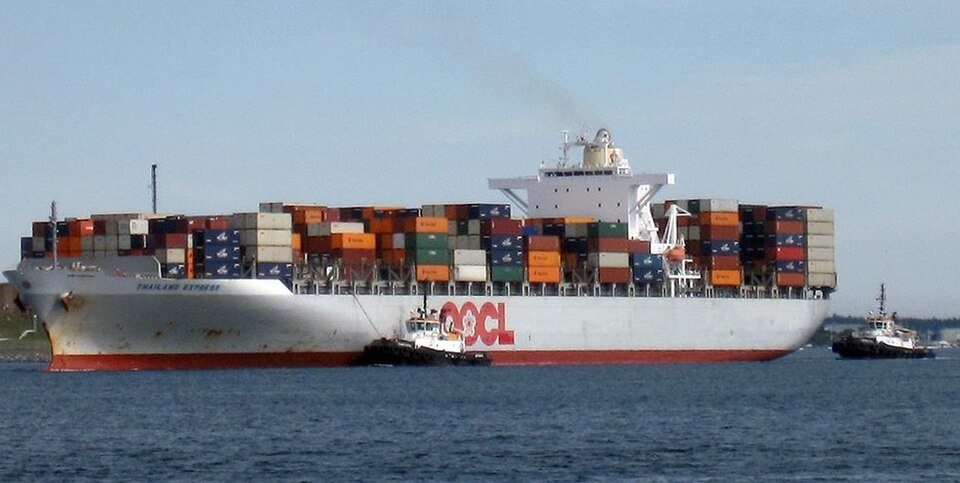
Thailand Express container ship. (Wikimedia/Michael Stout)
Thailand’s ambitious one-trillion Thai baht (30 billion US dollar) land bridge project will be scrapped due to financial unviability and environmental concerns, Thai Deputy Prime Minister and Finance Minister Ekniti Nitithanprapas disclosed on July 24.
The announcement came following a 90-day committee review which concluded that the megaproject would not yield a sufficient return and carried huge operational and ecological risks.
Initially, the southern land bridge was envisioned as a 90-kilometre overland transit corridor connecting the Gulf of Thailand and the Andaman Sea. The cancellation marks a setback as just three months ago in April, the Royal government planned to accelerate the venture to seize greater maritime trade control amid Strait of Hormuz disruptions.
Though fiscal constraints have persisted ever since, the government had proposed a public-private partnership (PPP) scheme. However, a recent statement by the National Economic and Social Development Council (NESDC) Secretary-General Danucha Pichayanan revealed the project’s unfeasibility, as the projected financial return rate has dropped to 4.8% from the initial 8%. The net present value (NPV) has also reversed from an anticipated positive 637.7 billion Thai baht (19 billion US dollar) to a negative 10.3 billion Thai baht (305 million US dollar).
He further explained that nine out of ten world’s major transhipment hubs are undergoing similar expansions, which undoubtedly narrows Bangkok’s prospect for attracting massive cargo volumes.
Operational and environmental concerns added complexity. Infrastructure inadequacies coupled with threats to the marine ecosystem further triggered international pushback and dampened investor sentiment.
Reportedly, the committee will shortly file its review to Prime Minister Anutin Charnvirakul, with a recommendation to scale down the initiative. It is highly likely that the government will instead pivot to upgrading the existing Ranong Port and expanding rail networks, with no direct investment losses incurred.
What does this mean for businesses?
Waves of geopolitical volatility (stretching from the Covid-19 pandemic and the Russia-Ukraine conflict to the recent Hormuz disruptions) have fundamentally upended strategic economic growth models for developing countries like Thailand. While the immediate fiscal damage is contained because construction had not yet commenced, this dramatic scaling down signals a permanent shift in regional logistics planning. Today’s global market complexities have intensified, particularly regarding Environmental, Social and Governance (ESG) standards where multinational firms are held publicly accountable. Consequently, logistics firms and investors must accept that future state-backed infrastructure plays will favor low-risk, incremental upgrades over speculative, multi-billion-dollar megaprojects.
Kala Advisory helps investors navigate shifting state priorities and turn infrastructure pivots like these into targeted, country-by-country entry plans across Southeast Asia. Visit kala-advisory.com.
About The Author