
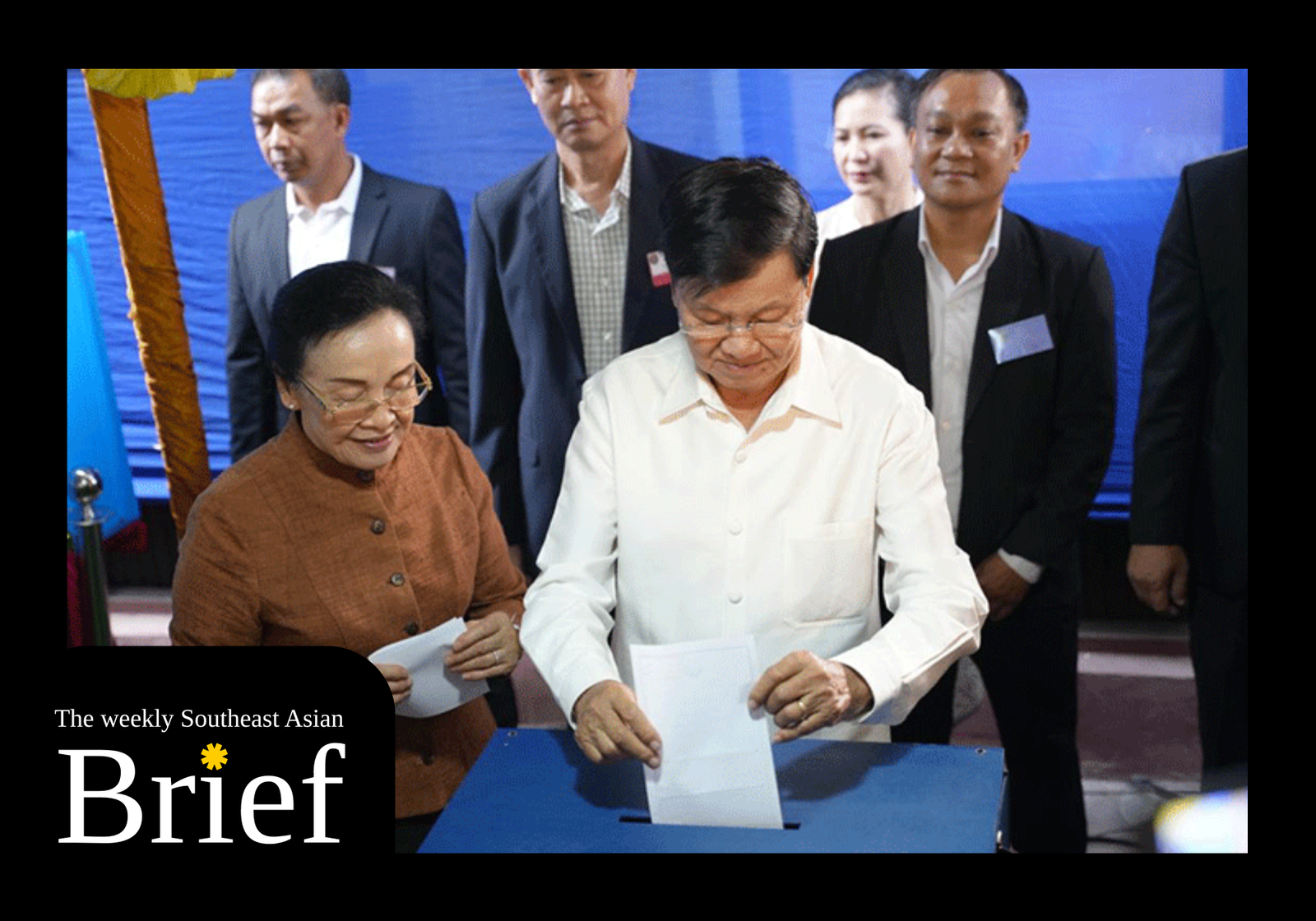
President Thongloun Sisoulith casts his ballot at a polling station in Vientiane, Laos, on February 22. (Vientiane Times)
On February 22, Laos held general elections for its 10th National Assembly and 5th Provincial People’s Councils, with 60% of its population—equal to 4,764,384 voters—eligible to vote. Results are not expected to be announced before March 25, but in a political system deemed a closed autocracy by the V-Dem Institute, the elections are expected to maintain the status quo rather than bring significant change. “Everything is controlled by the LPRP (Lao People’s Revolutionary Party),” Laotian sources told SEA Daily.
As a single-party state, LPRP is the only legal party in Laos and only candidates from the party—or independents vetted by it—are allowed to run in elections. The National Assembly would then appoint the President, who is typically also the party’s General Secretary—including the incumbent Thongloun Sisoulith.
In practice, the National Party Congress, which appoints the General Secretary—the last of which was held in January—remains the more consequential political event. Conversely, elections attract little attention with the state-owned Lao News Agency publishing only three updates on the 2026 vote.
Democratic distraction appears to be the last priority for the LPRP in what is a critical political and economic year. Consequently, activist Bao Mo Khaen was reportedly detained in Vientiane on February 14 and found dead six days later. Meanwhile, outspoken independent parliamentarian Valy Vetsaphong resigned citing “more personal time,” though many suspect Party pressure.
In 2026, the LPRP will roll out its 2026–2030 Socio-Economic Development Plan, central to maintaining its legitimacy in a political logic that trades freedom for prosperity.
This is particularly important as the Party seeks to graduate from the Least Developed Country category by 2030. Laos begins the year on relatively strong footing as 2025 saw GDP growth of 4.8%, inflation easing to 5.6% after years of double-digit rates, and public debt projected at 90% of GDP, down from 130% in 2022.
Looking forward, economic self-reliance is shaping up as the guiding theme. Past measures, including domestic preference in state investment and selective foreign partnerships, are set to be strengthened. On the other hand, manufacturing, agriculture, and tourism are expected to be central to the strategy.
Close partners China and Vietnam stand to benefit from ongoing joint projects, including the Laos-China Railway and the Vientiane-Hanoi Expressway, both scheduled to continue through 2026.
About The Author


One thought on “Laos holds symbolic elections in pivotal political and economic year”