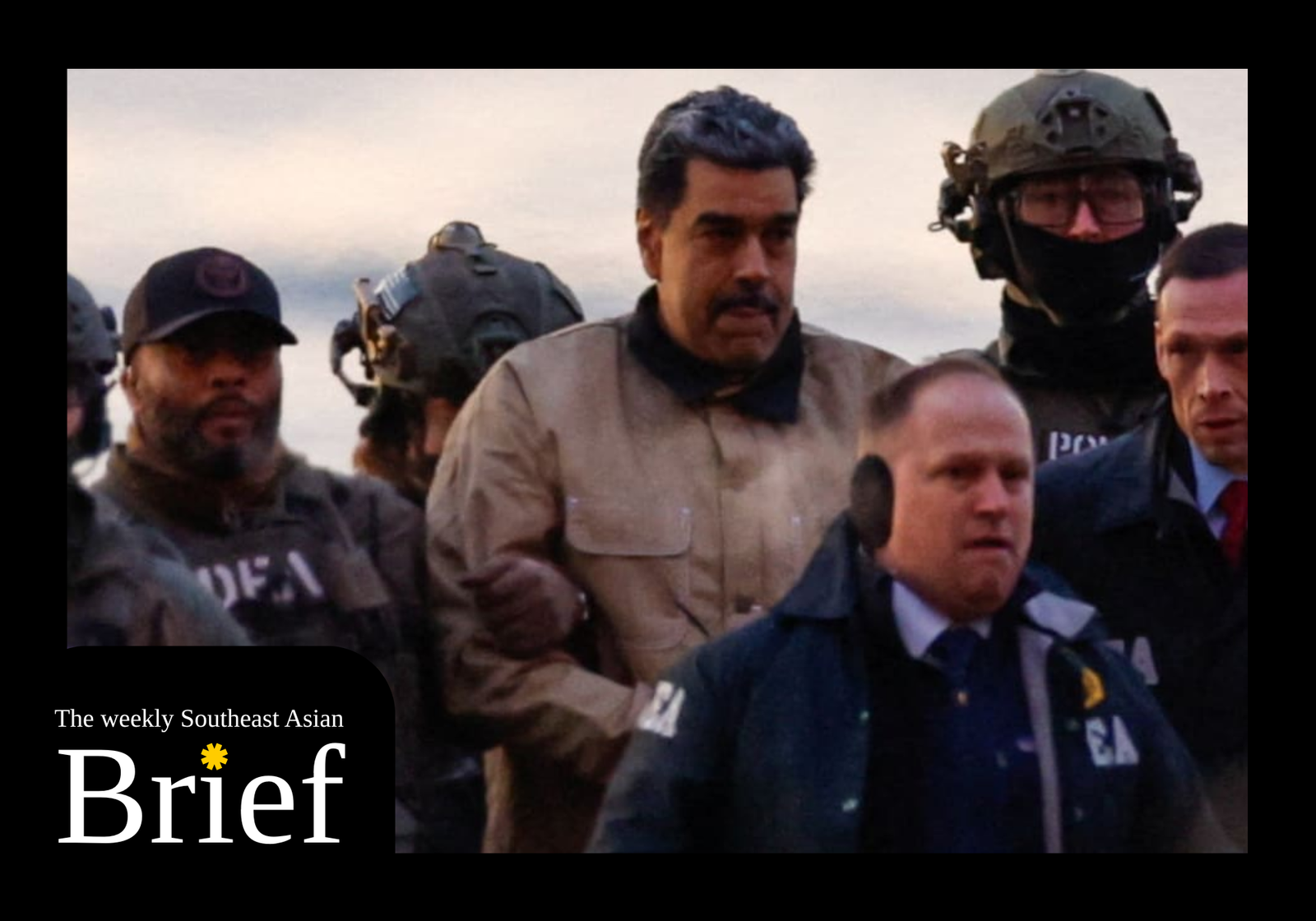
Venezuelan President Nicolas Maduro arrived at a New York City court where he is set to be arraigned on drug, weapons, and narco-terrorism charges, along with his wife, Cilia Flores, on January 3, 2026. The US operation has been widely condemned as a violation of international laws and norms. (Reuters)
On January 3, the United States (US) executed a military operation in Venezuela that resulted in the capture of its President, Nicolas Maduro, who will face charges and be tried in the US.
The operation is a clear violation of sovereignty and the concept of non-interference, two principles upheld by ASEAN, which puts into question how the regional bloc should respond to the incident.
Following this intervention, ASEAN member states were divided on their stance. Close US partners, such as Singapore, barely criticised the attack, while Indonesia, Malaysia, and the Philippines expressed “grave concern”. Other ASEAN members opted to issue statements with moderate language, referring to the UN Charter.
However, ASEAN as a regional bloc has remained conspicuously silent. This echoes a recurring pattern within the grouping’s approach to international conflicts. Following the Russian invasion of Ukraine in 2022, ASEAN issued their usual considerable diction: not bluntly condemning, but also did not endorse the attack.
This silence despite ASEAN’s Treaty of Amity and Cooperation in Southeast Asia (TAC) stressing respect to national sovereignty and adherence to international law.
Moreover, the US is a signatory of that treaty, which then raised questions when an ASEAN condemnation or even criticism of their intervention in Venezuela was absent.
Although ASEAN rarely reacts vehemently, a brazen breach of sovereignty constitutes the most paramount issue. If ASEAN regards itself as a regional bloc that advocates sovereignty and non-interference, it should have condemned US unilateral action.
If ASEAN cannot take a stance in external matters that have considerably low stake to its interests, let alone more impactful internal affairs. The non-interference principle enshrined in the TAC is not equivalent to passivity.
While the US is one of the bloc’s most reliable partners, it should not be allowed the privilege to undermine the principle it is a party of.
Ultimately, if ASEAN is to be consistent to maintain its commitment to mutual respect for sovereignty and international norms rooted in their treaty and principles, the bloc’s response to unilateral interventions like this will require a more staunch stance or it will risk becoming complicit in similar actions in the future through neglect.
As the saying goes, “silence is agreement”.
About The Author