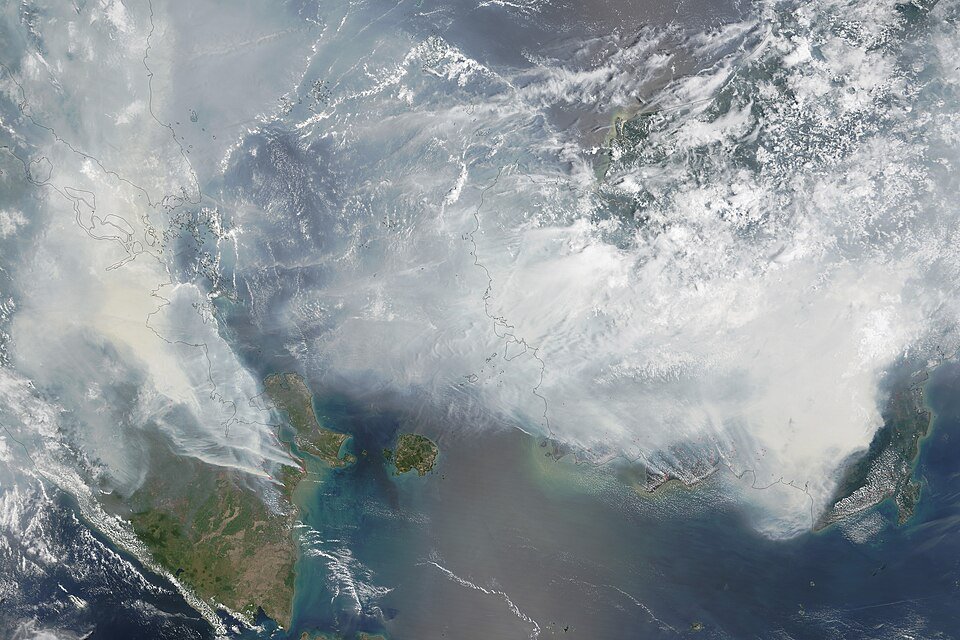
Satellite imagery showing transboundary haze across Southeast Asia. (Wikimedia/Adam Voiland)
On September 9, Malaysia offered to provide assets to help Indonesia tackle forest and land fires and haze, as Indonesian authorities continue firefighting and prevention efforts across several regions.
Malaysian Government Spokesperson Fahmi Fadzil said that Malaysia had submitted a list of available assets to Indonesian authorities through diplomatic channels, but had not yet received confirmation that they could be used.
Malaysia said its Natural Resources and Environmental Sustainability Ministry and Foreign Ministry were involved in coordinating the offer. The proposed assistance is to support efforts to control fires and haze in Indonesia, with any deployment subject to agreement between the two governments.
Indonesia has been conducting ground and aerial firefighting operations while monitoring hotspots and strengthening preventive measures. Indonesian President Prabowo Subianto has instructed government agencies to improve coordination, investigate suspected deliberate fires and take earlier action at hotspot locations.
Indonesian President Prabowo Subianto said the government needed to strengthen disaster preparedness and called for a significant increase in funding for disaster mitigation. The government has also continued efforts to manage forest and land fires amid dry conditions and the risk of further smoke.
Against this backdrop, the ASEAN Specialised Meteorological Centre said El Niño conditions were present and could bring below-normal rainfall across much of Southeast Asia between September and November, increasing the risk of hotspots, smoke haze and transboundary pollution. Malaysia has said its assistance could also be coordinated under the ASEAN Agreement on Transboundary Haze Pollution, subject to Indonesia’s request and approval.
Malaysia’s offer adds a bilateral mechanism to existing regional efforts to manage transboundary haze. For Indonesia, external support could provide additional operational capacity if requested, while keeping the response under national coordination. The prolonged dry conditions and fires in one country can affect air quality across borders can be a regional challenge, making early warning, coordinated response and prevention important for Southeast Asian states.
About The Author