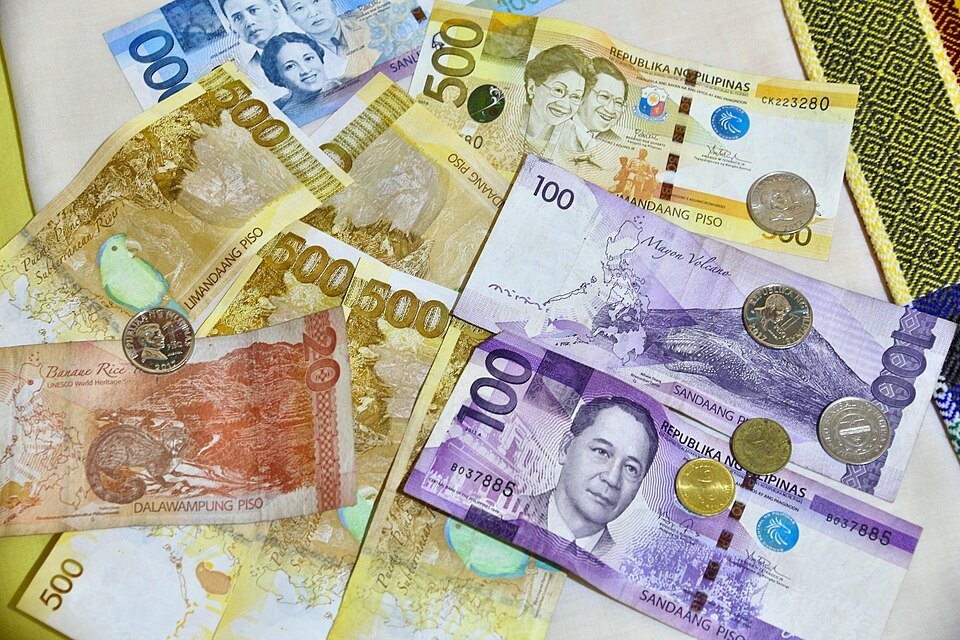
Philippine peso. (Wikimedia/Marek Ślusarczyk)
The Philippine government is planning a massive, record-breaking surge in its national debt as a 3.3 trillion Philippine peso (54 billion US dollar) borrowing proposal awaits the congressional green light.
Submitted by the Department of Budget and Management on August 11, the amount represents a 20% increase from the revised 2026 borrowing programme of roughly 2.5 trillion Philippine peso (40 billion US dollar). According to the Budget of Expenditures and Sources of Financing (BESF)’s projection, the accumulated unpaid debts of the country will breach the 21 trillion Philippine peso mark for the first time.
For context, by the end of the first half of 2026, the Philippines’ debt-to-GDP ratio had been pushed to 60% (its highest since 2004). In contrast, the nation’s economic growth sits at a 2.3%, its weakest pace since the post-pandemic recovery of 2021, after weathering the Middle East volatility.
In his budget message, Philippine President Ferdinand Marcos Jr. stated the revision is “more than a financial plan,” framing it as a “strategic investment in the Filipino people and in our country’s future”.
Reportedly, funding sources will rely heavily on domestic financing from Filipino institutional investors, banks and citizens, counting on them to contribute over 70% of the borrowing scheme or roughly 2.3 trillion Philippine peso (38 billion US dollar). A lesser portion is envisioned to be obtained from external funds, expected to reach over 900 billion Philippine peso (15 billion US dollar), to protect the country from global currency fluctuations.
Crucially, the proposal came with the National Expenditure Programme (NEP) which budgeted a historic high 7.2 trillion Philippine peso spending plan. However, the government’s projected revenues are at 5.2 trillion Philippine peso (85 million US dollar), leaving a fiscal deficit of nearly 2 trillion Philippine Peso ($30 million US dollar).
What does this mean for businesses?
Previously in July, the Philippine government lowered its GDP growth bar for 2027 to a modest 5% to 6% after the country witnessed compounding economic shocks stemming from severe energy constraints. The overwhelming Strait of Hormuz disruptions have indeed drastically impacted the Southeast Asian nation, which imports 90% of its fuel from the Middle East. For a growing, middle-income market like the Philippines, deploying aggressive fiscal spending to combat declining household purchasing power is a rational countermeasure. However, analysts scrutinise the framework because a massive PHP 1.59 trillion chunk of this debt plan is earmarked strictly for debt amortisation, which effectively watering down its capacity to reignite the economic engine through new, productive development. In the end, the ultimate imperative remains robust debt management to guarantee that liabilities accumulate at a slower velocity than macroeconomic expansion. The primary structural milestone must be that economic growth consistently outpaces debt accumulation.
Kala Advisory helps investors turn macro shocks into targeted, country-by-country defensive entry plans across Southeast Asia, capitalising on shifting fiscal and infrastructure landscapes. Visit kala-advisory.com.
About The Author