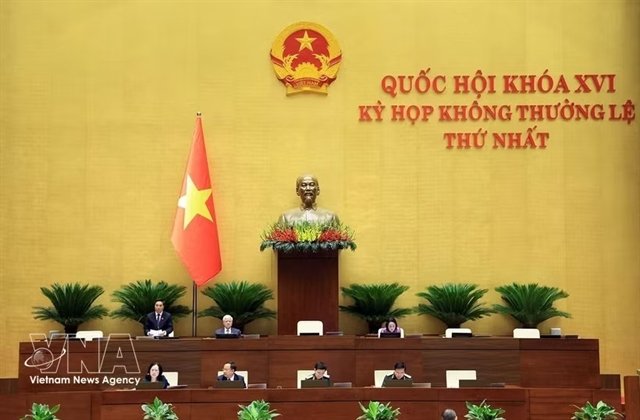
Vietnamese lawmakers attend the first extraordinary session of the 16th National Assembly. (Vietnam News Agency/VNS Photo)
On August 8, Vietnam’s 16th National Assembly reviewed a draft law on the prevention and control of the proliferation of weapons of mass destruction (WMDs), seeking to strengthen the country’s legal framework for preventing the spread of nuclear, chemical and biological weapons and related delivery systems.
Many Vietnamese lawmakers broadly supported the legislation, saying it would help Vietnam fulfil its international commitments while strengthening national security and maintaining a peaceful environment for development.
Some other lawmakers supported a priority mechanism for businesses with strong compliance records, allowing them to face fewer inspections and simplified reporting while enabling authorities to focus on higher-risk entities.
Vietnamese Deputy Trịnh Thị Tú Anh from Lam Dong proposed expanding controls to include brokering, consulting and other intermediary services involving controlled goods, technology and equipment, citing UN Security Council Resolution 1540. She also called for extending emergency control measures from 24 to 48 hours, with a possible further extension for complex cases requiring technical verification.
While Vietnamese Deputy Lê Thị Thanh Lam from Can Tho called for clearer responsibilities for provincial authorities in responding to WMD-related alerts and inspections, proposing a shared database to reduce duplicate reporting by businesses and improve information-sharing between government agencies.
Deputy Prime Minister and Defence Minister Phan Văn Giang said the Government would continue revising the bill to ensure consistency with Vietnam’s legal system and international treaties. He stressed that the law should strengthen national defence and security without unnecessarily restricting legitimate civilian activities, scientific research, innovation and trade.
The proposed legislation comes as ASEAN is strengthening its wider regional non-proliferation agenda. At the 33rd ASEAN Regional Forum in July 2026, regional officials called on nuclear weapon states to fulfil their disarmament obligations under Article VI of the Treaty on the Non-Proliferation of Nuclear Weapons and recognised the complete elimination of nuclear weapons as the only guarantee against their future use.
Vietnam’s legislation complements regional diplomatic efforts by translating international non-proliferation commitments into stronger domestic controls. Tighter regulation of WMD-related materials, technology and intermediary activities could reduce proliferation risks while strengthening ASEAN’s credibility in addressing complex security threats. The initiative demonstrates how ASEAN members can combine national-level enforcement with regional cooperation to support strategic stability and prevent emerging proliferation risks.
About The Author