
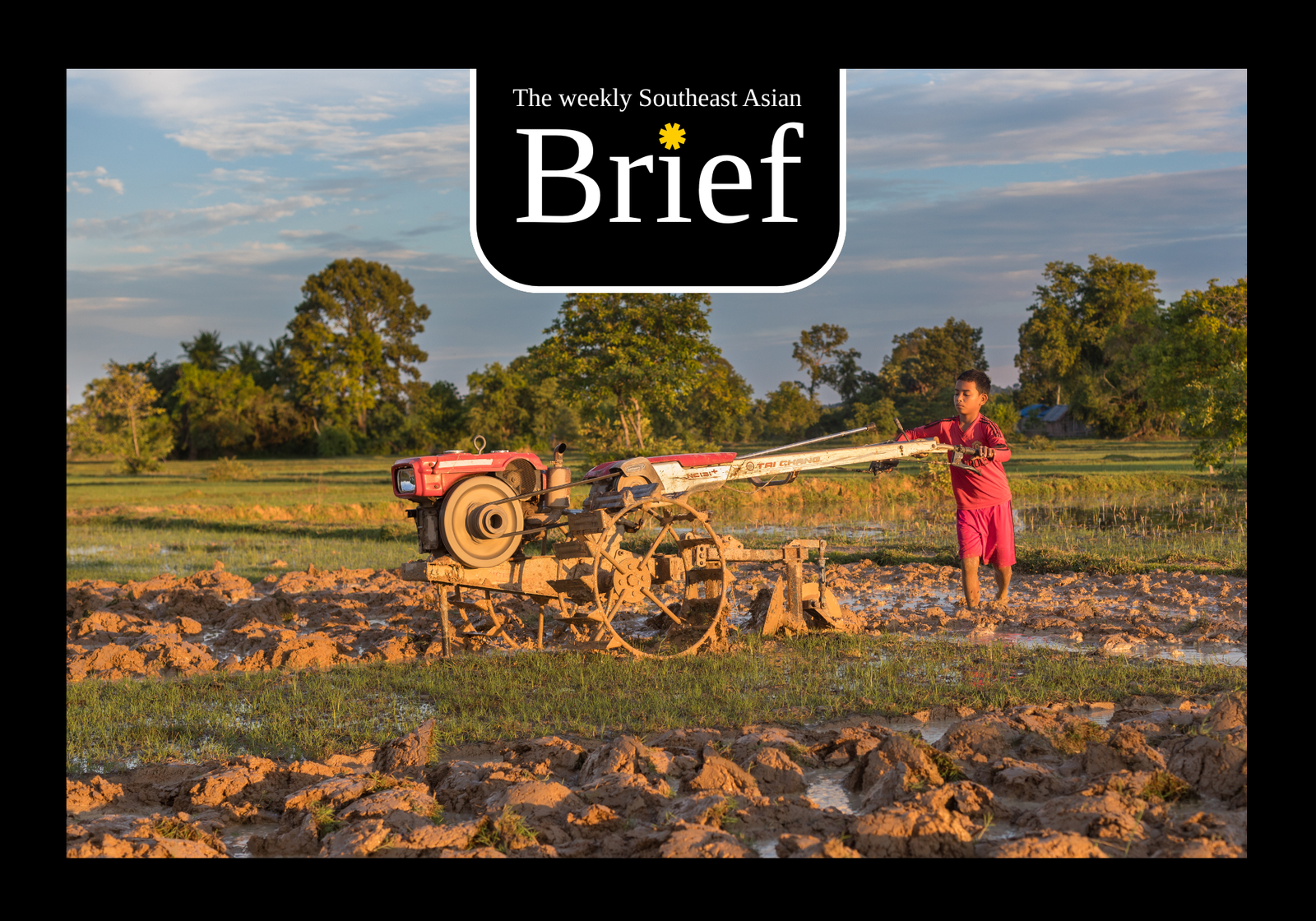
A boy plowing a paddy field in Don Det, Laos. (Wikimedia/Basile Morin)
In summary, the national economy recorded a 5% expansion as state revenues reached 52% of the annual projection, whilst average inflation was firmly anchored at 8%.
Prominent milestones were achieved in terms of the crisis management of global energy disruptions. To begin with, Laos managed to maintain a considerably stable domestic fuel supply despite global energy volatility, further recording a gradual decline in the national fuel import bill.
On top of that, the country reportedly has accelerated initiatives for nationwide electric vehicles (EVs). This was complemented by the recent import ban, effective from June 1, in which the government temporarily suspended the importation of all petrol- and diesel- powered passenger vehicles until the end of 2026.
The most remarkable performance came from the agricultural sector, the bedrock of the Laotian economy. Crop commodity exports generated 752 million US dollars within the first five months of 2026 to secure 62.6% of the annual benchmark. Livestock products provided another robust fiscal indicator, with exports climbing beyond 80 million US dollars, representing 40.6% of the yearly forecast. Concurrently, forestry revenues (encompassing timber and non-timber forest products) yielded nearly 160 million US dollars, fulfilling 31.7% of the stipulated objective.
Over the coming six months, the government will prioritise executing the 12th Party Congress resolutions and the 10th Five-Year National Socio-Economic Development Plan (2026-2030). Both initiatives focus on advancing economic self-reliance and achieving annual fiscal and development benchmarks.
These priorities reflect a broader context of the country’s effort to address the structural vulnerabilities exposed during the late 2021 economic crisis, when an over-reliance on foreign-currency-denominated investments severely destabilised local markets.
For context, throughout the 2010s, Laos engaged in aggressive large-scale infrastructure projects (most notably high-speed railways and numerous hydroelectric dams under China’s Belt and Road Initiatives). These projects were heavily financed using foreign currency, primarily US dollar and Chinese yuan.
While this capital-intensive model initially made Laos one of the world’s fastest-growing economies, the country faced a subsequent downturn as external liabilities mounted. Poor domestic management meant that neither state revenues, tourism, nor investment returns generated enough foreign currency to service the debt. Consequently, the Lao kip collapsed, triggering hyperinflation that peaked at 31% in 2023 before moderating to 23% in 2024 and hitting 8% by the end of the first half of 2026.
Although this recent inflation figure represents a slight uptick from the previous year’s lowest 7.7%, the 8% figure is arguably resilient, considering the economic fallout stemming from the Middle East since late February. This stability can be attributed to Vientiane’s 2026 National Congress, which decisively pivoted away from foreign-investment-driven growth to operate under the official banner of “Proactively Building an Independent and Self-Reliant Economy”.
The congress also birthed the 10th Five-Year Plan, a framework that targets a minimum GDP growth rate of 6%, strict inflation controls to keep rates below 5% by 2030 and aggressive debt mitigation to reduce outstanding public debt below 70% of GDP from the previous 130% in 2022.
To nurture this incipient momentum, Laos plans to leverage its salient agriculture sector. The objective is to transform Laos into a regional agricultural exporter, capitalising on the 84 newly opened product corridors across its neighbouring trading partners (41 to China, 19 to Vietnam, 17 to Thailand and 7 to Cambodia). Accordingly, the Lao Ministry of Agriculture and Environment has officially targeted an agricultural growth rate of 4.1% for 2026, aiming for the sector to make up 20.7% of the nation’s GDP.
In parallel, Vientiane will pursue smart industrial upgrades and green technology rollouts to substantially decrease the massive financial drain caused by foreign energy imports. Moreover, having previously invested massively in hydroelectric dams, Laos has gained an enormous surplus of domestic electricity, earning it the nickname “Battery of Southeast Asia”. Upgrading to EVs will allow Vientiane to power its own economy using its homegrown renewable energy.
Nevertheless, before executing any of these measures, the most immediate step remains to restructure the indebted and extractive State-Owned Enterprises (SOEs).
As highlighted by the World Bank in its 2021 report, Lao SOEs contribute a consequential amount to the total Public and Publicly Guaranteed (PPG) debt. A stark case is the nation’s state-owned electricity utility, Électricité du Laos (EDL), where in just five years between 2013 and 2018 the borrowing surged from a modest 13% of GDP to 42% of GDP. Crucially, these off-budget liabilities were not previously captured in official fiscal accounts. Therefore, on the domestic front, Laos must improve its weak fiscal reporting practices and investment management. Furthermore, the World Bank has suggested that the government partially divest its SOE holdings to the private sector and/or foreign investors with proven expertise in their respective fields.
Complementing that, Vientiane must simultaneously pursue debt restructuring. The government should negotiate directly with bilateral creditors (particularly China, the nation’s largest lender) as well as through multilateral channels. This strategy is vital to extend loan maturities and reduce the overall interest burden.
That said, if executed efficiently, the government’s targeted economic interventions are poised to yield a highly positive domino effect across the country’s trade landscape, which is particularly vital given Laos’s structurally vulnerable position as a landlocked nation. Having already secured 84 cross-border corridors to regional markets, this enhanced connectivity will serve as a catalyst, driving immediate and intensive domestic demand for modern cold-chain logistics, state-of-the-art processing facilities and robust regional transport infrastructure.
For international businesses, this combined policy package means that the era of unchecked, high-leverage foreign investments in Laos is closing. Moving forward, the government will favour investments that directly reduce imports, use green technologies, process local raw materials inside the country and directly assist Laos in its planned milestone graduation from Least Developed Country (LDC) status.
About The Author


2 thoughts on “Laos is set for an agricultural export boom but must first resolve its debt crisis”