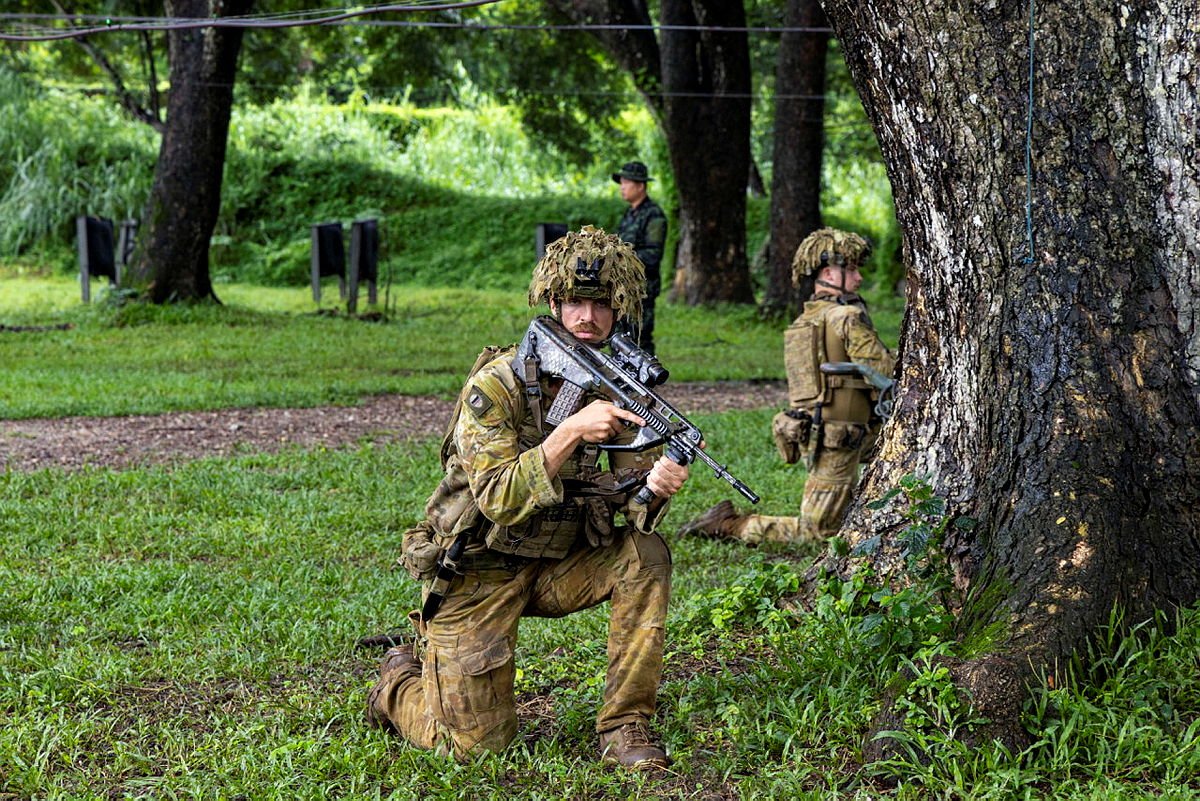
Australian Army’s Rifle Company Butterworth rotation 144 demonstrates harbour occupation with Royal Thai Army troops during Exercise Chapel Gold 2024 in Chiang Rai, Thailand. (CPL Nakia Chapman/Australian Defence Force)
In total, 550 troops were participating in the drill, with 400 personnel from the 1st Army Area Command of the Royal Thai Army and 150 personnel from the Australian Army’s Rifle Company Butterworth 148 (RCB 148).
Both armies are engaged in tactical drills such as tropical forests warfare mastery, live-fire ambushes, deployment of armoured units and high-intensity combat simulations. To enhance military readiness, both sides are also exchanging prior combat experience and relevant knowledge.
This year’s iteration marks a collaborative effort to further strengthen the bilateral defence sector. Established in the 1980s, Exercise Chapel Gold is an annual agenda initiated by Thailand and Australia intended to build common trust, test soldiers in multiple environments and improve the way both armies operate together.
Established in 1945, the defence ties between Canberra and Bangkok have evolved since. Eighty years later, the Australia-Thailand Security Dialogue was launched in order to elevate high-level security conversation, operational environments, community service and threat assessments. Australia and Thailand’s ties in security cooperation reached a status of Strategic Partnership in 2020.
Annually, both also consistently hold major exercises in the army, air force, navy and joint domains, including Exercise Chapel Gold, Exercise Thai Boomerang, NavyExercise AusThai and Exercise Cobra Gold or Talisman Sabre.
Beyond defence cooperation, both countries regularly hold law enforcement cooperation, such as Taskforce Storm to eradicate narcotics trafficking and money laundering and efforts to combat human trafficking, such as the Bali Process on People Smuggling, Trafficking in Persons and Related Transnational Crime.
Overall, the 2026 iteration marks an important reinforcement of the defence relationship between Canberra and Bangkok. Moreover, it also signifies the position of Australia as a middle power for the Southeast Asian nation, highlighting its growing role by being involved in shaping the security architecture.
About The Author