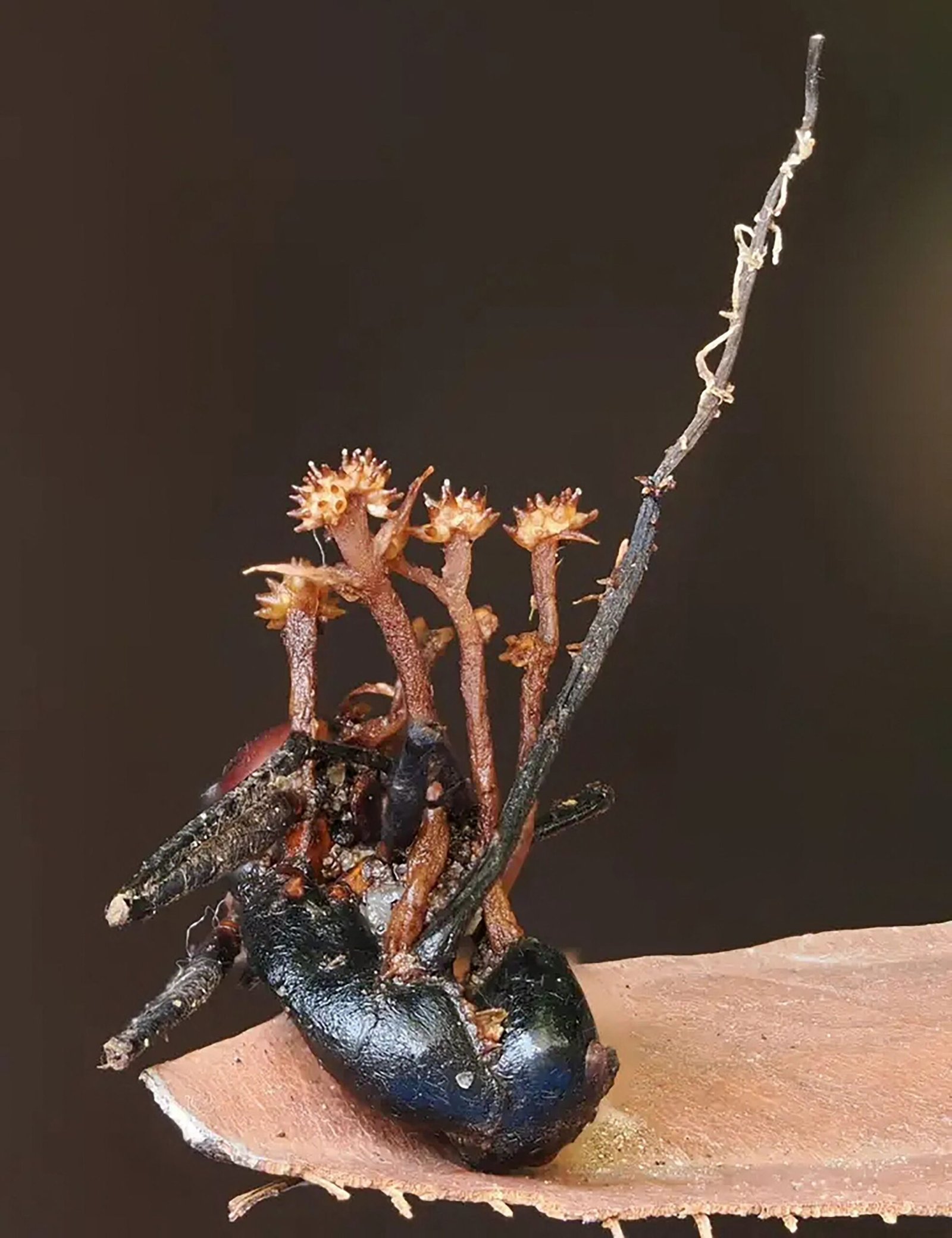
A specimen of Pleurocordyceps cornusynnemata found on a dead ant in the Danum Valley Conservation Area in Lahad Datu, Malaysian Borneo. (Universiti Malaysia Sabah via AFP)
On June 19, recent findings in scientific discovery conducted by the University of Malaysia Sabah’s Institute for Tropical Biology and Conservation unveiled a new species of contagious fungus in the Malaysia Borneo forest. Also known as “zombie fungus”, the species contaminates insects which later leads them to death.
The zombie fungus infects ants by taking control of their nervous system. It changes the ants’ behaviour before killing them and growing out of their bodies. However, the newly discovered Pleurocordyceps fungus does not affect the ant directly. Instead, it grows inside the infected ant by feeding on the zombie fungus already living there.
The new species has been named Pleurocordyceps cornusynnemata because of its unusual horn-shaped structure. It was found on a dead ant collected in Danum Valley, a remote rainforest in southern Sabah. The discovery was published in the April issue of Phytotaxa, a scientific journal.
The institute’s Deputy Director Jaya Seelan said that while similar hyperparasitic fungi have been found before, this is the first known species in the Pleurocordyceps genus with this distinctive horn-like shape.
The research team also found a new fungus that infects spiders during the same field study. The fungus spreads through the spider by releasing spores before eventually killing it.
According to Deputy Director Jaya Seelan, both newly discovered fungi could be useful in the future. They may help scientists develop new antimicrobial medicines and could also be used as natural ways to control pests that damage crops.
About The Author