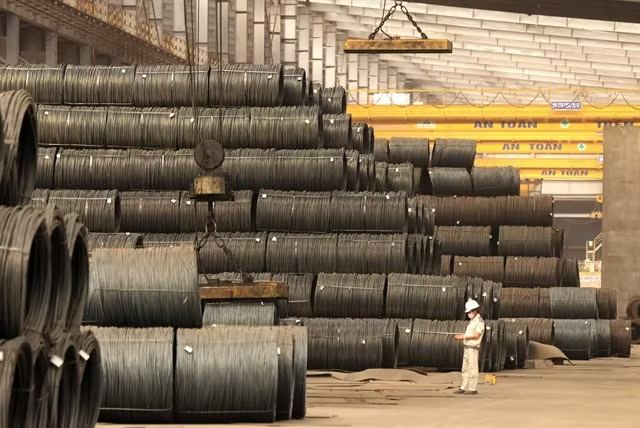
Inside a steel factory in northern Vietnam. (Vietnam News Agency)
For the first time, Vietnam entered the top 10 of the world’s crude steel producers, according to a report published by the World Steel Association (Worldsteel) on 22 May.
Worldsteel disclosed April 2026 crude steel production figures, in which Vietnam’s output was estimated at 2.1 million metric tonnes, marking a 4% year-on-year increase. The figure means that Vietnam has overtaken Italy and broke into the global top 10 steel producers.
The result marks a significant milestone for the country’s rapidly expanding steel industry. According to the Vietnam Steel Association (VSA), the sector has undergone accelerated development in recent years, characterised by scaled-up production and broader product diversification.
Within just the first decade of the 21st century, Vietnam shifted from being heavily dependent on crude steel (billet) imports to achieving self-sufficiency. Today, the industry is advancing even faster.
In the first quarter of 2026, Vietnam produced 8.5 million metric tonnes of billet, an 8.4% increase from the same period the previous year.
VSA further projects an 8%–10% expansion for the domestic steel sector in 2026, bringing estimated finished steel output to approximately 33 million metric tonnes.
Among the dominant domestic players is the well-known conglomerate Hoa Phat Group.
What does this mean for business?
Vietnam’s rise into the global steel top 10 reflects genuine demand-driven growth as domestic consumption reached 24.1 million metric tonnes in 2025, nearly matching record output of 24.6 million metric tonnes. This near-parity between production and consumption signals a healthy, demand-driven expansion rather than speculative overbuilding.
For downstream industries such as construction and manufacturing, greater supply and product variety could ease procurement and moderate input costs. Exports, meanwhile, totalled 3.15 million metric tonnes last year, reinforcing Vietnam’s credentials as a competitive sourcing alternative for foreign buyers.
Nevertheless, the industry faces a confluence of pressures. Chinese producers offloading surplus supply amid weak domestic demand have flooded regional markets with competitively priced steel, undercutting local manufacturers and threatening jobs. Global trade policy (tightening technical standards and climate-linked regulations) compounds the challenge. Domestically, many firms have pivoted towards the home market in response to weakening export demand, with some recording revenue gains by late 2025, though the shift has intensified competition and compressed gross margins industry-wide.
About The Author