
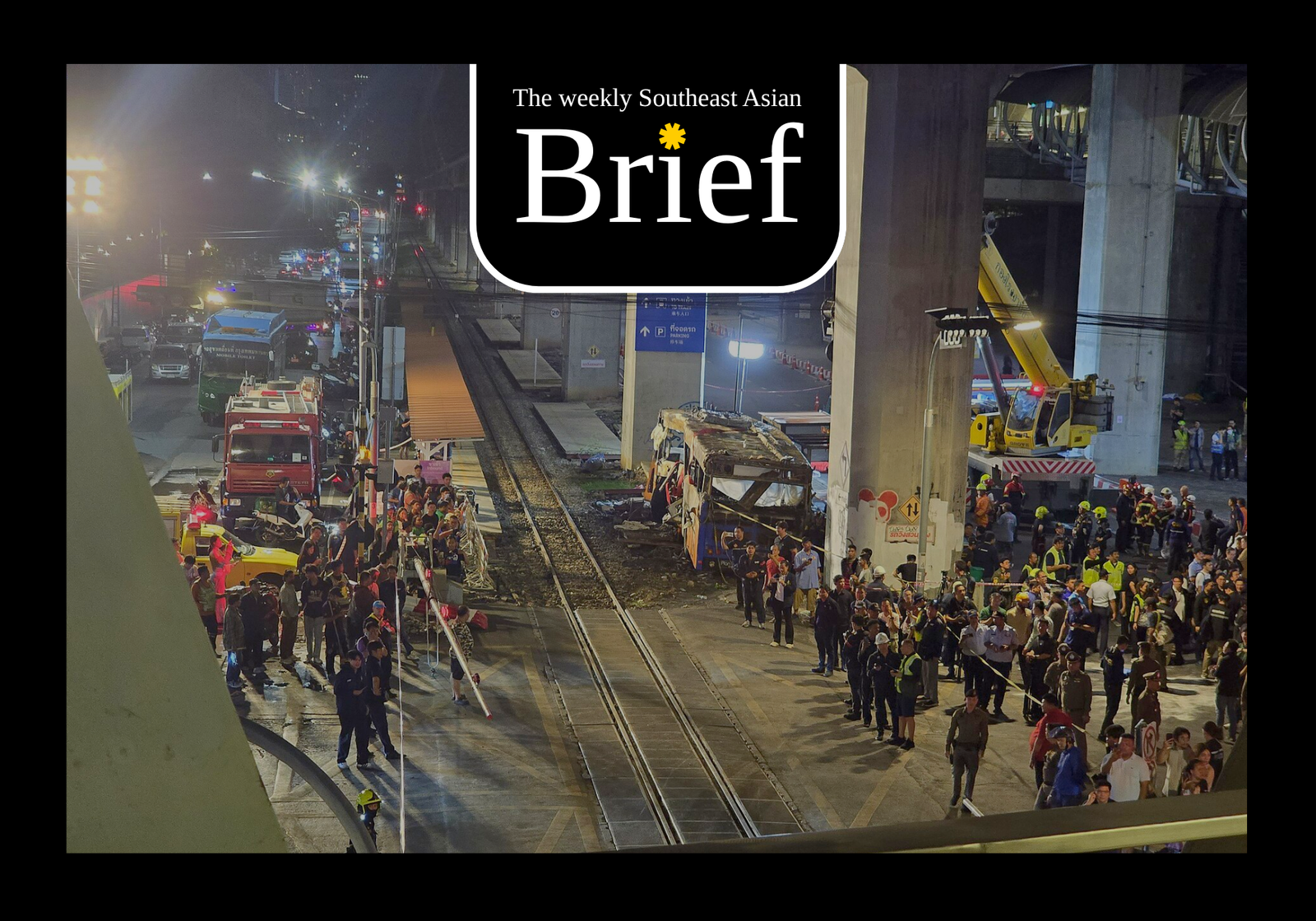
The aftermath of the fatal train accident on May 16 in Bangkok, Thailand. (Wikimedia/Thithat Juttano)
Near-misses and accidents are an everyday reality for Thais.
According to the World Health Organisation (WHO), Thailand ranks among the highest in the world for road fatalities as traffic accidents claim approximately 20,000 lives annually, meaning an average of 50 deaths per day.
Bangkok’s recent fatal collision between a cargo train and a passenger bus on May 16 demonstrates that, despite some progress, current road safety measures remain woefully inadequate. The major accident is the second one that took place in the country. Last January, a falling crane struck a moving train in the Sikhio district of Nakhon Ratchasima province, killing 32 people.
For context, the crash’s chronology indicates that crossing keepers were late to lower the barrier, allowing the passenger bus to become stuck on the railway as the road was heavily congested. The cargo train, having braked too late, then collided with the bus, causing a fire to break out and engulf nearby cars and a motorcycle.
To date, eight people have been confirmed dead and over 30 injured. Though immediate investigations were launched, authorities hastily attributed the crash to human error.
Currently, accountability for negligence is being pursued against the bus driver, the train driver as well as the barrier operator. These allegations have, subsequently, drawn scrutiny towards the responsible institutions, namely the Bangkok Mass Transit Authority (BMTA) and State Railway of Thailand.
Whilst the judicial process must be closely monitored, prosecution alone will not prevent such accidents from occurring in the future. It is therefore essential to identify the underlying structural factors behind what is a chronic, yet entirely preventable, problem.
There are three intersecting, layered problems that contribute to the high number of road fatalities.
First, behavioural factors do, indeed, partly explain the accident. Thais are notorious for reckless disregard of traffic rules, speeding, ignoring road signs and drink-or drug-driving are all too common.
The scale of this is stark during Songkran, Thailand’s New Year celebration held each mid-April, consistently marking one of the deadliest periods on the country’s roads, as congested homecoming traffic and tourist arrivals drive a surge in crashes. The period has been grimly nicknamed the “Seven Dangerous Days,” and the 2026 celebration alone recorded 216 deaths across 1,108 accidents.
The recent Bangkok collision is a case in point as well, as police investigations revealed that the train driver tested positive for drugs.
Secondly, however, such behavioural failures are, to some extent, enabled by the flaws in road regulations. Traffic rules carry little weight when enforcement is weak and inefficient. The collision itself illustrates this plainly. The train driver was found not to hold a valid licence from the Thai Department of Railway Transport. Another illustration is the January accident which was rooted in corporate operational negligence, namely skipped safety procedures and unauthorised deviations from protocol.
Beyond such railway incidents, multiple reports suggest that traffic law enforcement is further undermined by bribery, with money changing hands between culprits, police and local authorities.
Thirdly, and equally significant, is the matter of inadequate road and railway infrastructure. According to the Asian Development Bank (ADB), Thailand’s transport networks have historically suffered from structural imbalances and an inadequate road layout that has failed to keep pace with rapid urban expansion. This has been worsened by persistent public financing constraints that left a prominent infrastructure investment gap that the Royal Thai Government is still actively trying to bridge.
The fact that the May 16 accident occurred on one of Bangkok’s busiest roads of Asoke-Din Daeng raises serious questions about safety measures elsewhere, particularly in suburban areas. Notably, barriers at even such busy crossings are still operated manually.
These are all structural failures. Authorities ought to have had such measures in place long before any accident occurred. Without sufficient and equal infrastructure development and automation, supported by robust regulation and strong enforcement, the system creates the conditions for such accidents to occur across Thailand, not only in its capital.
Of immediate importance for the recent crash is ensuring that those responsible for the collision are charged and held fully accountable, including through compensation to victims and their families.
At the very least, the state must act to prevent what might be called the “hit-and-run” tendency of Thai justice, whereby strict compliance appears to be reserved for ordinary citizens whilst the ultra-wealthy routinely manipulate institutions to evade accountability.
Beyond individual cases, the state must also oversee the implementation of post-crash response systems in line with international road safety standards. This includes establishing clear protocols for emergency response, crash investigation and data collection, ensuring that every incident is systematically recorded, reviewed and used to inform future prevention efforts. Thailand does, in fact, have a Road Safety Master Plan (2022–2027) with stated targets, yet as the Asian Transport Observatory notes, practical implementation and enforcement remain the critical gap between policy and reality.
In addition, the urgency of reform extends beyond the human toll. Road accidents impose a substantial economic burden on Thailand, draining an estimated 3% to 7% of the country’s annual Gross Domestic Product (GDP), equivalent to up to 36 billion US dollars per year. According to the Thailand Development Research Institute (TDRI), the financial damage caused exclusively by road deaths and severe injuries routinely exceeds 530 billion Thai baht (16.2 billion US dollar) annually.
About The Author




One thought on “Why Thailand’s roads keep killing”