
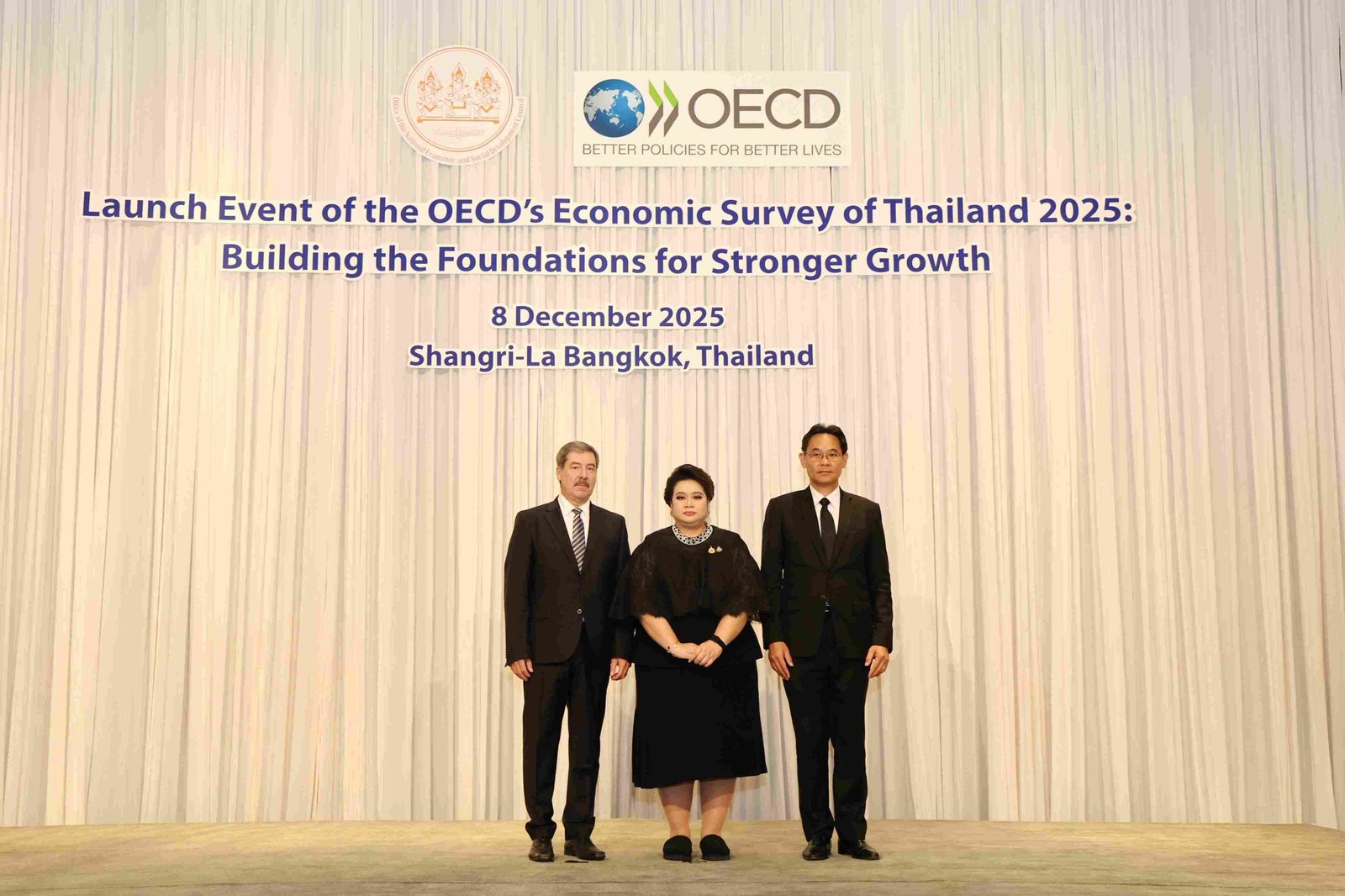
Thailand’s National Economic and Social Development Council and OECD host a seminar to launch the Economic Survey of Thailand 2025 in Bangkok, on December 8, 2025. (National Economic and Social Development Council)
As Thailand aims for full membership status to the Organisation for Economic Co-operation and Development (OECD) by 2028, the Thai Cabinet approved the establishment of a national committee to fast-track its accession on May 19, during its weekly meeting.
Thailand’s Prime Minister Anutin Charnvirakul is set to chair the committee, alongside three vice chairpersons: Ekniti Nitithanprapas, Sihasak Phuangketkeow and Pakorn Nilprapunt.
To ensure comprehensive policy coverage, the committee also integrates top officials spanning law, foreign affairs, budgeting, public administration and finance. They include the directors and secretaries-general from the Bureau of the Budget, the Council of State, the Public Sector Development Commission, the National Economic and Social Development Council, the Ministry of Foreign Affairs as well as the Joint Standing Committee on Commerce, Industry and Banking.
Deputy government spokesperson Rachada Dhnadirek stated that under Prime Minister Anutin’s direction, the council will serve to supervise, monitor and synchronise the actions of all relevant government agencies.
For background, Thailand submitted its formal letter expressing its intent to join the OECD on February 12, 2024, with members voting to open accession discussions later that year. Subsequently, the OECD Secretariat customised a blueprint for Bangkok to align its domestic frameworks with the organisation’s standards. Self assessments were completed and Bangkok submitted its initial memorandum in December 2025.
Currently, Thailand enters the intense technical review phase. This is the longest and most demanding stage. Experts from 25 to 26 specific OECD technical committees will scrutinise Thailand’s willingness and functional capability to enforce OECD instruments.
Spokesperson Rachada expressed that this vision is “not merely a symbolic goal, but a reform process that will make the Thai economy more transparent, more competitive and directly beneficial to the people in the long term”.
What does this mean for business?
Under Prime Minister Anutin’s administration, joining the OECD has become a central national priority. The government contends that accession will strengthen institutional credibility and signal to international markets that Thailand is committed to transparent, rules-based governance.
For businesses operating in or considering entry into Thailand, the implications are tangible. OECD alignment typically drives improvements in regulatory predictability, intellectual property protections, and anti-corruption enforcement. These are factors that reduce operational risk. Over time, this could attract higher-quality foreign direct investment, deepen Thailand’s integration into global supply chains and eventually improve living standards.
About The Author


What’s up, everything is going sound here and ofcourse every one is
sharing facts, that’s actually good, keep up writing.
I every time spent my half an hour to read this website’s articles all the time along with a cup of coffee.
Hi everyone, it’s my first pay a quick visit at this website, and article is
truly fruitful in support of me, keep up posting such posts.
Hello it’s me, I am also visiting this website on a regular
basis, this website is actually good and the people are genuinely sharing nice thoughts.
Pretty component of content. I simply stumbled upon your site
and in accession capital to say that I get actually enjoyed account your blog posts.
Anyway I’ll be subscribing in your feeds and even I fulfillment you get right of entry to constantly quickly.
Oh my goodness! Impressive article dude! Many thanks,
However I am having troubles with your RSS. I don’t understand why
I cannot subscribe to it. Is there anybody else having identical RSS issues?
Anyone that knows the answer will you kindly respond?
Thanx!!
This web site truly has all the information and facts I needed concerning this subject and didn’t
know who to ask.