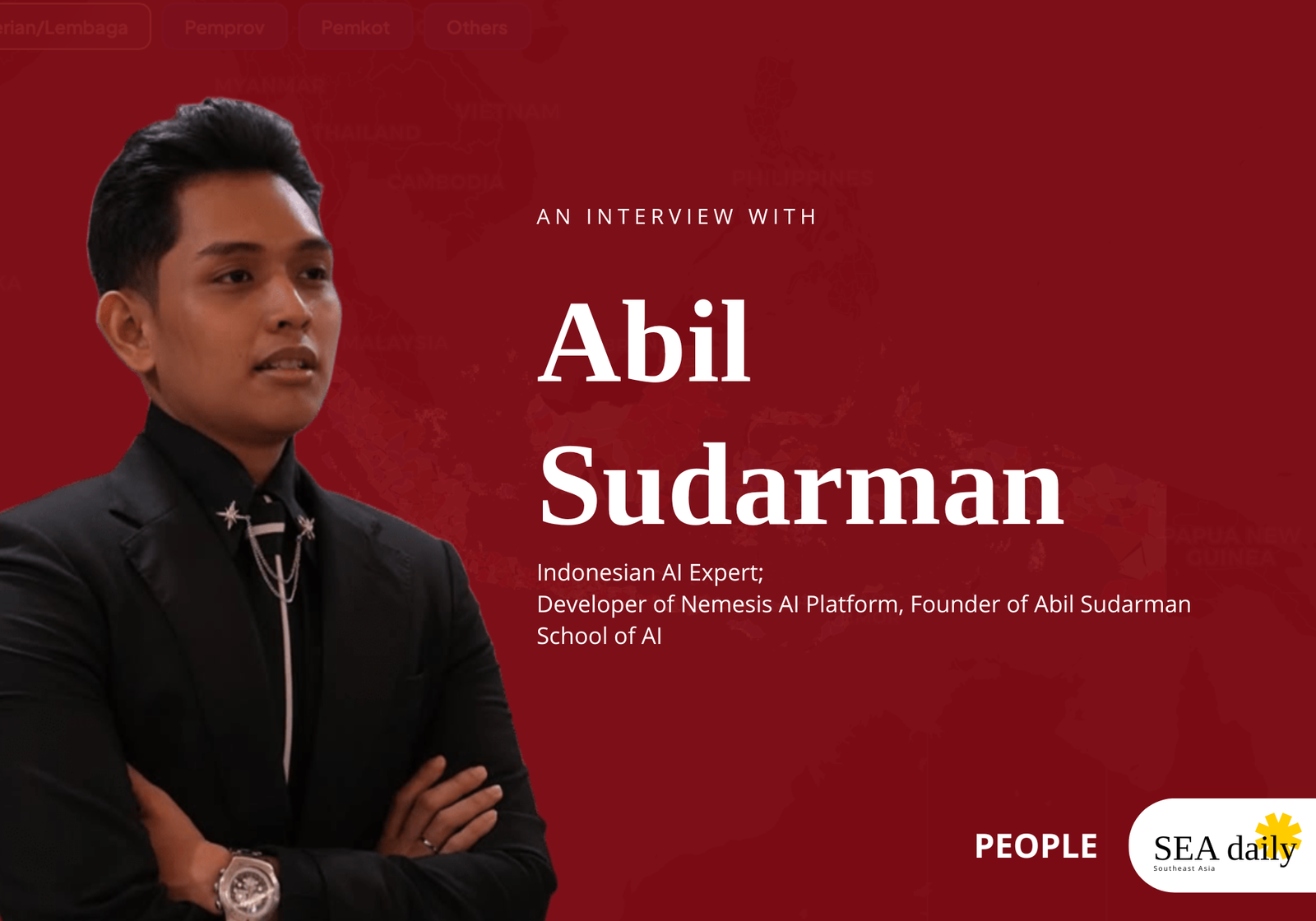
An artificial intelligence (AI) tool called Nemesis, built by Abil Sudarman, is reshaping the conversation around public accountability in Indonesia, and what it reveals about the country’s broader ambitions.
There is a detail about Nemesis that Abil Sudarman keeps returning to, almost as if he wants to make sure no one misunderstands what he has built. “An IT student could make this in a week,” he says, during a video call from Jakarta. He is not being modest. He is making a point: that the most startling thing about Indonesia’s most talked-about government procurement transparency tool is not how sophisticated it is, but how straightforward it is, and how long it took for anyone to build it at all.
Abil Sudarman is the kind of person who describes himself not as a civic tech pioneer or an anti-corruption activist, but simply as a content creator who happens to work in AI. He founded ASSAI, the Abil Sudarman School of AI, a training centre launching its first programme, AI for Data Analysts, in May 2025. He is also a Responsible AI Fellow at Microsoft, a role that takes him across continents to think about what safe and ethical AI looks like when you factor in the voices of the Global South.
The story of how Nemesis came to exist is inseparable from that biography. It is a tool born not from a formal grant or an institutional mandate, but from curiosity, publicly available data and a clear-eyed frustration with the gap between what Indonesia’s government publishes and what anyone actually looks at.
The problem hiding in plain sight
Indonesia’s government procurement data is, technically, public. The national procurement planning system, known as SiRUP (Sistem Informasi Rencana Umum Pengadaan or Procurement Planning System), managed by LKPP, the government’s procurement policy agency, is legally required to make its data publicly available. It uploads millions of line items: the names of projects, the institutions that commissioned them, the budget allocated. In theory, this is exactly the kind of transparency that accountability advocates have spent decades demanding. In practice, the data amounts to a downloadable table containing over three million entries, none of which are cross-referenced, flagged, or meaningfully filtered. As Abil puts it: “Who wants to look at that? Staring at each one.”
What Nemesis does is deceptively simple. It takes those three million entries and runs them through a detection logic built around three variables: the name of the procurement item, the budget allocated and the relevance of that item to the institution purchasing it. The tool assigns a colour code, low, medium, high, or “absurd,” to indicate its assessment of how anomalous the item appears to be.
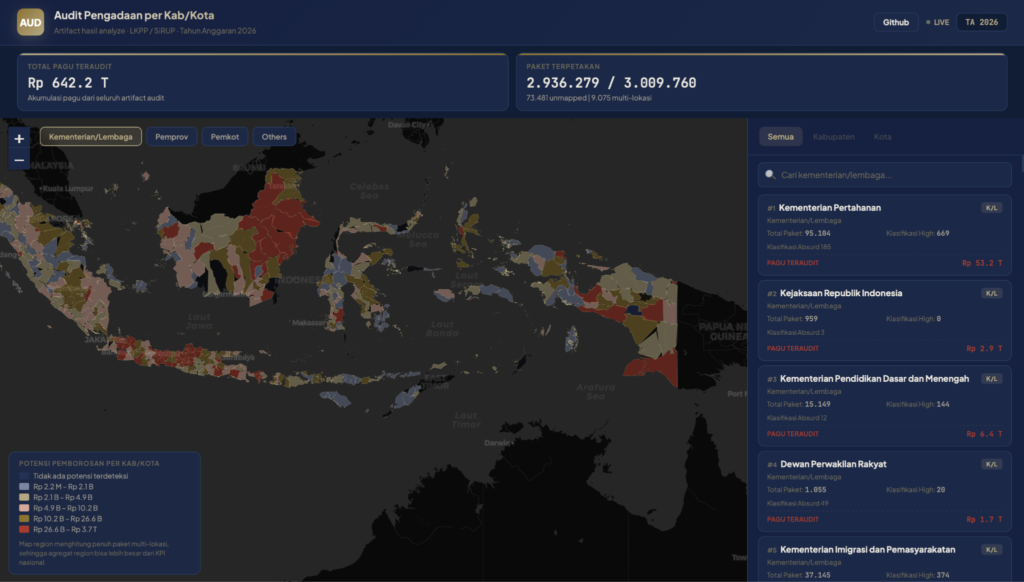
The Nemesis dashboard mapping Indonesia’s 2026 procurement data across the archipelago. (via https://nemesis.assai.id/)
The results, when Abil began sharing them through short videos on social media, landed with unexpected force. Visible on the dashboard behind him during the call, the Indonesian province of East Kalimantan appeared coded red across the board. Among the entries that drew public attention: a mosque cleaning service in West Java budgeted at 22 billion rupiah (1.2 million US dollar) with 273 staff on its payroll, a 153 million rupiah (8,742 US dollar) aquarium maintenance contract for the seventh floor of the Ministry of Communication and Digital Affairs, and a 1 billion rupiah (57,200 US dollar) ornamental plant rental on the same floor.

One of the videos by Abil highlighting a Rp 1.17 billion ornamental plant rental at the Ministry of Communication and Digital Affairs went viral, the data came directly from Nemesis. (via: https://www.instagram.com/abilsudarman/)
What made these findings resonate was not the complexity of the analysis behind them, but the clarity of what they revealed. They did not require sophisticated AI inference, only a functioning filter and a public willing to pay attention.
A tool built for the media
One of the more revealing things Abil says during our conversation is that Nemesis was never really designed for him to use. “Nemesis is for the media,” he explains. “If you look lately, there are many media outlets highlighting strange procurements. It’s much easier now. Why? Because some of them already have access to Nemesis.” He has quietly given access to a number of journalists and newsrooms, providing them with an interactive dashboard that transforms an unwieldy government spreadsheet into something navigable. Procurement stories that have since gained public traction, he notes, increasingly trace back to data that Nemesis has already processed.
This design choice, to sit behind the publication rather than in front of it, is deliberate. The source code has also been published openly, meaning that other developers can independently run and maintain the tool regardless of what happens to the original.
The limits of the possible
For all the attention Nemesis has generated, Abil is careful to frame what AI can and cannot do in this space. The tool, he acknowledges, can be deceived. Its current effectiveness depends partly on the element of surprise: officials are only now beginning to realise that procurement data can be audited at scale, in near-real time, by a single person with modest compute resources. As awareness of that possibility spreads, the incentives to manipulate the data, or to make procurement entries more deliberately opaque, will grow. “AI can be tricked if you already know where its weaknesses are,” he says. “This year it was a shock. Next year they might start to realise they’re being monitored.”
The deeper structural problem, however, is not technical. It is that the procurement data Nemesis ingests is only as useful as its underlying format allows. When entries are filled out carelessly, without itemisation, without stated rationale, with vague descriptions, even the best detection logic produces unreliable signals. Addressing that requires a mandate from the Ministry of Finance standardising how budget plans are recorded, a policy intervention that has not happened and that Abil, by his own admission, has little power to compel.

Purbaya Yudhi Sadewa, Indonesia’s Minister of Finance. A standardised procurement data mandate from the Ministry of Finance remains one of the key policy steps that would allow tools like Nemesis to detect anomalies more effectively, a reform that has yet to materialise. (Photo by: kemenkeu.go.id)
This brings him to a tension he returns to repeatedly: the gap between what is technically achievable and what the Indonesian government is institutionally willing to do. “Indonesia is ready,” he says, when asked which Southeast Asian country is best positioned to adopt a system like Nemesis at scale. Then, after a pause: “But it just doesn’t want to.”
He describes reaching out through official channels after Nemesis gained public attention, and receiving no meaningful response. The system, he concludes, is not broken in the way that makes reform straightforward. It is bureaucratically inert in ways that are harder to fix than a technical bug.
Indonesia, AI and the question of who builds
The conversation around Nemesis opens outward into a broader set of questions about where Indonesia sits in the regional AI landscape and the picture Abil paints is neither optimistic nor dismissive. He is direct about the asymmetry: most of what gets described in international coverage as a “Southeast Asian AI boom” is, in practice, a Singaporean one. Roughly 90% of AI investment in the region flows into Singapore, where capital has materialised into actual companies, actual products, and actual infrastructure. Indonesia has memorandum of understandings (MOUs), announced data centre agreements and semiconductor partnership frameworks that have yet to produce visible results at comparable scale.
“I’m afraid of being misled if we say it’s good now,” he says. “Maybe it still needs time.”
AI is theoretically the new frontier, but Abil notes that funding has not yet followed the stated enthusiasm. His own training centre, ASSAI, is self-funded, and Nemesis was built on personal resources, a reminder that meaningful tools can be built without institutional backing, though scaling them is another matter.
The deeper policy question, Abil argues, is whether Indonesia wants to be a builder of AI or a market for it. He suggests that if the government were to direct a meaningful share of its own budget towards domestically built AI applications, the ecosystem would shift considerably. The state is, after all, a large enough customer to move an industry. Building that kind of public-private collaboration, he acknowledges, will require time and a stronger foundation of mutual trust between government and the private sector.
What comes next
Abil is, at core, a technical person who stumbled into civic impact. He is not an activist by orientation or aspiration. He describes himself as someone who throws a pebble into the water and then watches to see how far the ripple travels, but he is clear that he does not want to be the one swimming.
His hope is that what Nemesis has demonstrated, that public data can be turned into public accountability by a small team with modest resources, will eventually be picked up by others better positioned to make it institutional. Legislators, he suggests, could push for this to be formally adopted and refined. Media organisations could scale their use of the tool. Other developers, who already hold copies of the source code, could build on it and extend it further.
Whether Nemesis becomes a model for Southeast Asia or remains a local phenomenon will depend less on the technology which, as Abil himself insists, is not the point, and more on whether the political and institutional conditions for transparency tools to be welcomed, rather than merely tolerated, can be built over the next several years.
About The Author