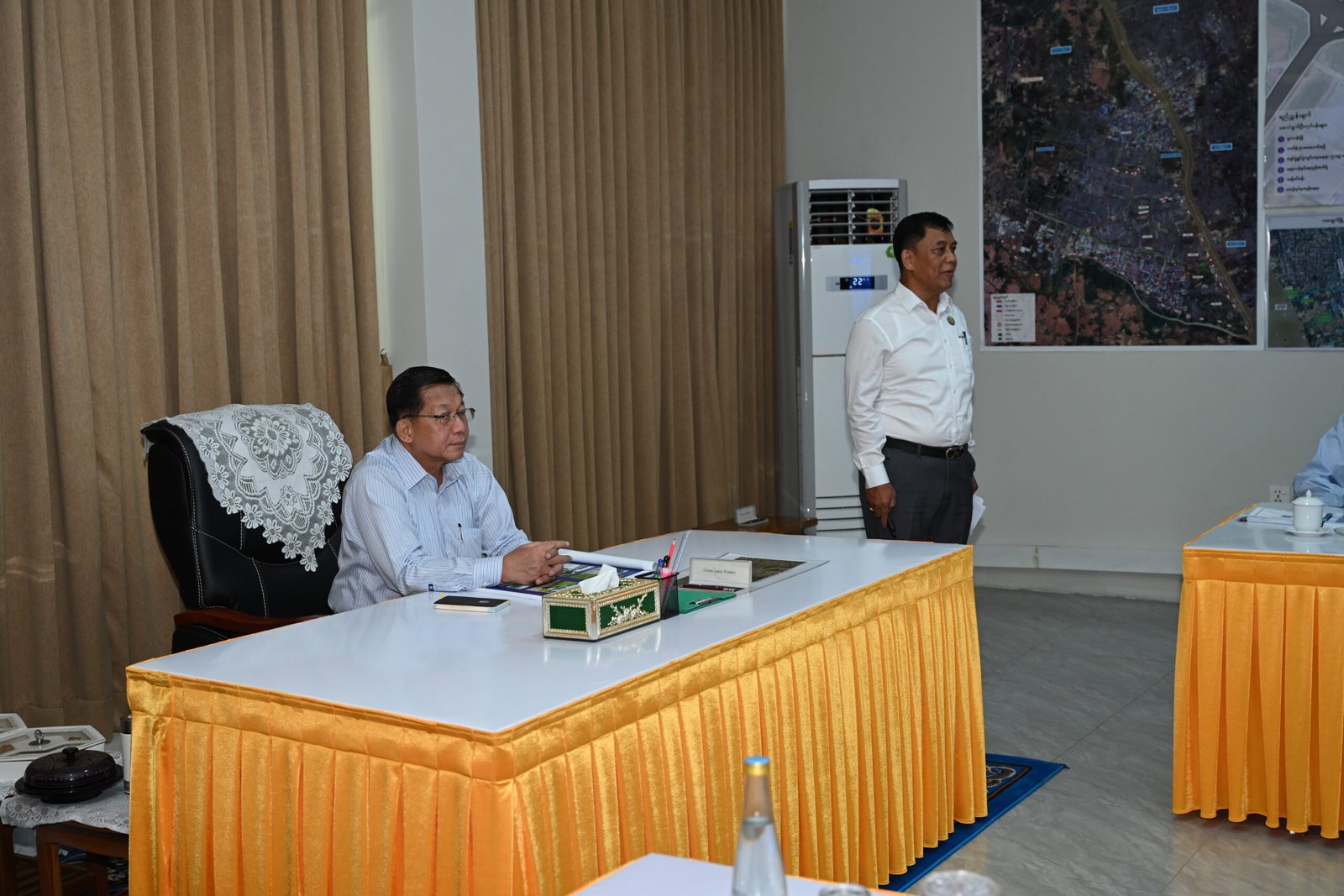
President Min Aung Hlaing receives a report from the Chief Minister of Yangon Region at Bayintnaung Park ahead of the inspection tour, May 2. (Global New Light of Myanmar)
Upon his arrival at Bayintnaung Park in Hlinethaya Township—along with Commander-in-Chief of Defence Services General, Union Ministers and senior Tatmadaw officers—the President received a briefing from Aung Naing Thu, Chief Minister of the Yangon Region, on the fulfilment of development targets mandated during the previous Head of State inspection tour in November 2025.
The reports covered progress across three key areas: (1) the systematic installation of telecom cables serving industrial zones; (2) the construction of drainage systems, including reinforced concrete box culverts across the area; and (3) ensuring proper water flow along Shwepyitha Bridge Road. Aung Naing Thu noted that all road-widening and upgrading works are being carried out in accordance with urban standards—and that authorities have integrated goals of “cleanliness and beautification” across the Yangon Region.
In response, the President commended the accomplishments, noting that the efforts had “achieved a certain level of improvement”. Notably, he instructed that a “proper town plan” must be formulated to ensure a well-regulated city layout, supported by advanced research from relevant engineering departments.
The President also stressed the importance of cultivating public awareness regarding traffic safety to foster a culture of compliance with existing regulations.
Furthermore, to align urban development with economic growth, the President called for the establishment of public recreation centres, parks and sports grounds, tailored to meet the needs of the growing residential population.
What does this mean for businesses?
The push for structured urban development signals a more investable Yangon. Better infrastructure—roads, drainage, telecoms—lowers operational costs and improves connectivity for businesses in and around the region’s industrial zones. Recreational and public amenity developments, meanwhile, tend to lift surrounding property values and support workforce retention, particularly as residential populations expand.
That said, the President’s emphasis on a “proper town plan” and coordinated research suggests that significant development activity remains contingent on clearer policy frameworks. For investors and businesses, the key variable is execution. Well-planned government intervention can catalyse growth, but the timeline and consistency of that planning will determine whether these initiatives translate into durable economic opportunity.
About The Author