
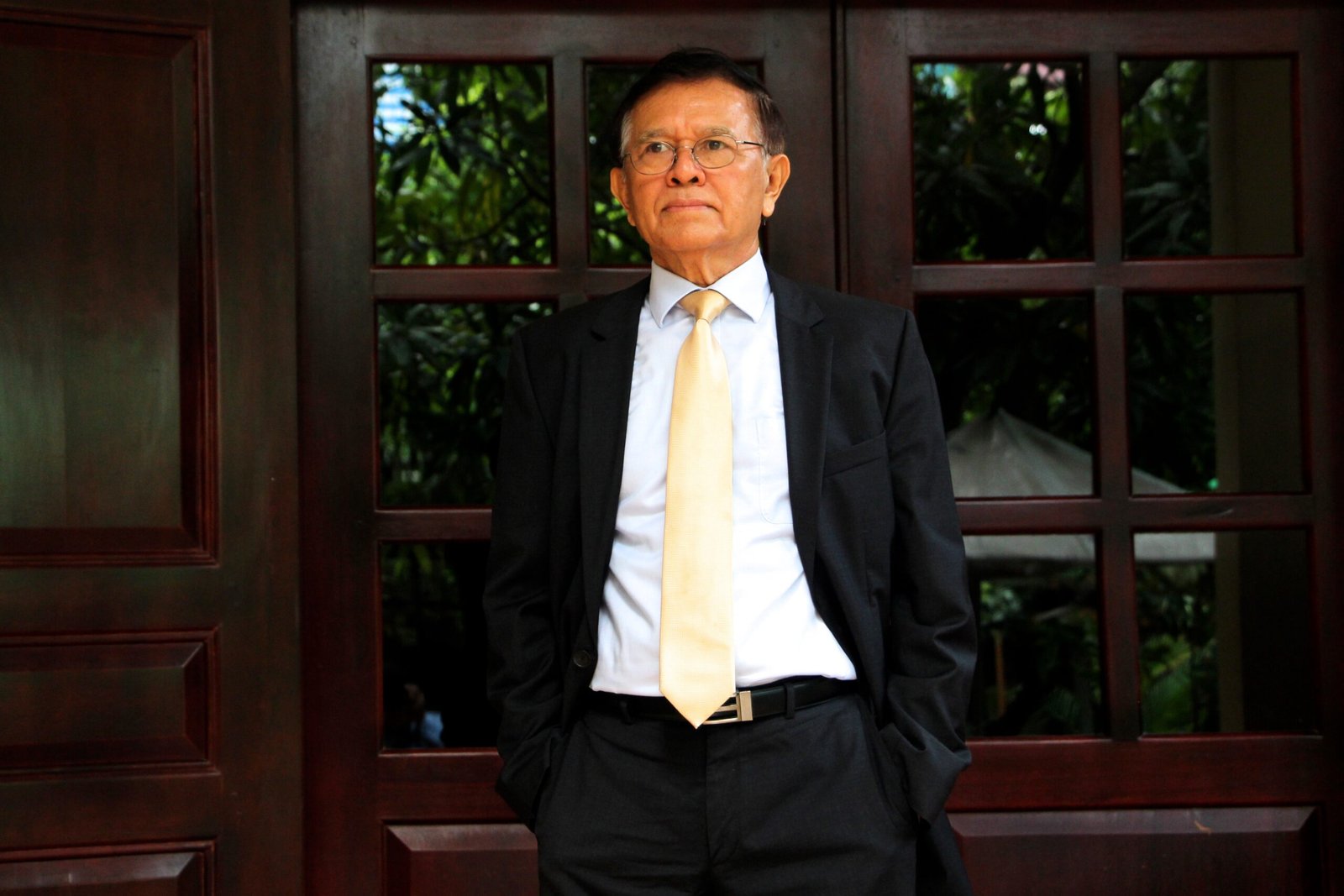
Kem Sokha waits at his residence in Toul Kork to meet French Ambassador Eva Nguyen Binh, November 11, 2019, following the Phnom Penh Municipal Court’s relaxation of his bail conditions. (Bunnarith Chhea via Wikimedia)
A Phnom Penh court rejected Kem Sokha’s appeal on April 30, upholding his conviction for treason. Sokha, a 72-year-old former president of the now-dissolved Cambodia National Rescue Party (CNRP), was found guilty under Article 443 of Cambodia’s Criminal Code for ‘conspiracy with foreign power’. Under this code, conspiracy with a foreign power is considered a grave offence, carrying penalties of up to 30 years in prison.
Sokha was first arrested at midnight by the authorities in 2017 and initially detained during the preliminary hearing in a remote prison before being transferred to house arrest, where he was barred from any political activities. Later that year in November, the Supreme Court also dissolved the CNRP altogether, effectively removing the country’s main opposition force.
His trial formally began in 2020 and was postponed due to the COVID-19 pandemic. In 2023, Sokha was sentenced to 27 years in prison and banned from travelling abroad upon the completion of his sentence. Prosecutors also invoked Article 498 against him as an additional punishment, which suspended his political rights.
The latest ruling formally extends Sokha’s de facto house arrest and upheld the 27-year sentence pronounced in March 2023, while also imposing a five-year ban on international travel.
Until early April 2026, the Phnom Penh Appeal Court continued hearing his appeal. During one hearing session, Sokha declared his innocence, stating, “I, Kem Sokha, have absolutely not betrayed the Khmer nation. I have not conspired with America, Europe, or any foreign country.”
Sokha’s case drew criticisms from international watchdogs and multilateral institutions. The Working Group on Arbitrary Detention (WGAD), mandated by the United Nations Human Rights Council, requested “the Government of Cambodia to take the steps necessary to remedy the situation of Mr Kem Sokha without delay” and to align its actions with the existing international norms, including the Universal Declaration of Human Rights and the International Covenant on Civil and Political Rights.
Similarly, UN High Commissioner for Human Rights, Volker Türk, also called on Cambodian authorities “to promptly release Kem Sokha and ensure his human rights are fully respected, including his right to a fair trial and to participate fully in the conduct of political affairs.”
About The Author

2 thoughts on “Phnom Penh court rejects Kem Sokha’s appeal, upholds treason verdict”