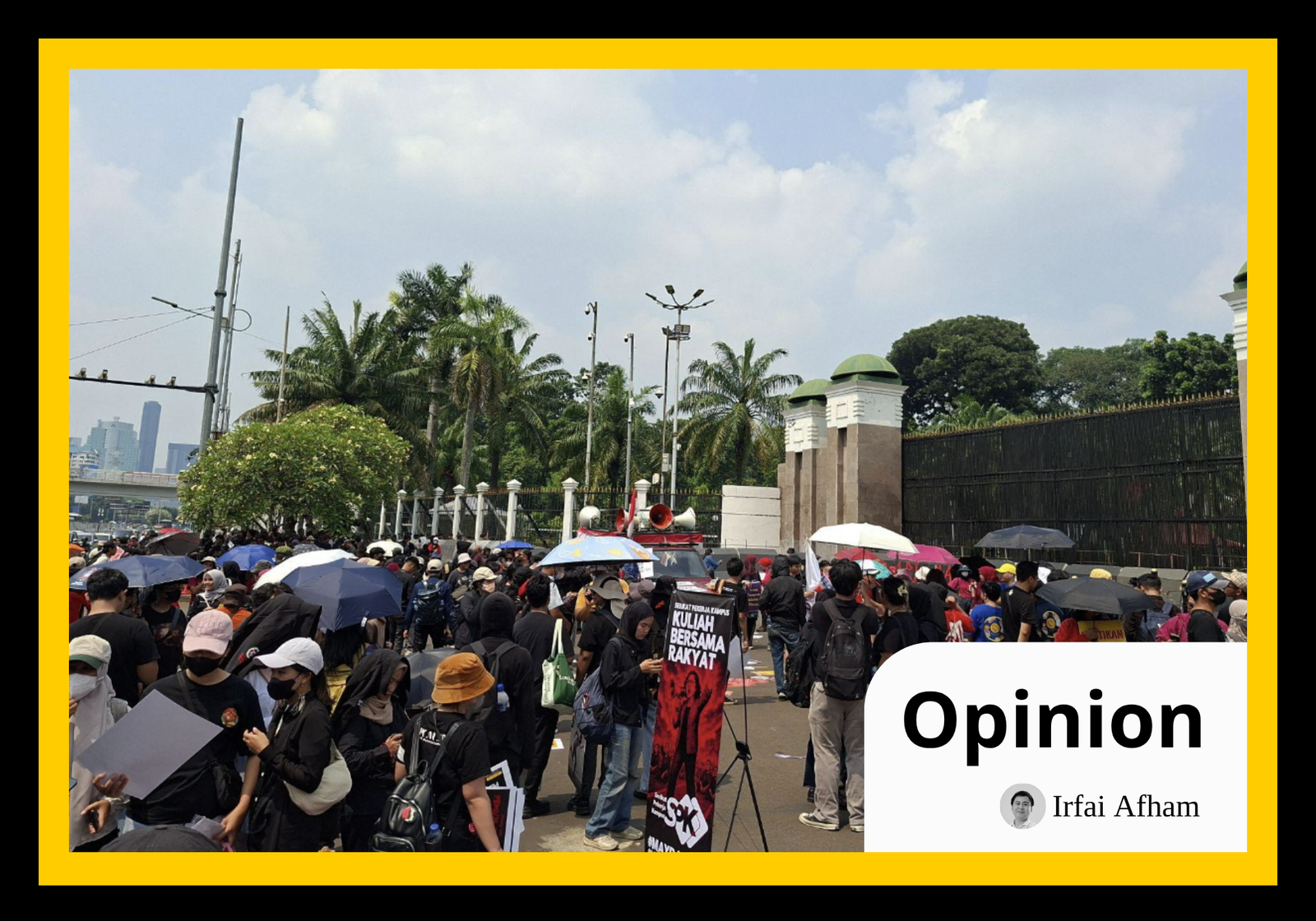
Protesters gather outside the Indonesian Parliament Building during May Day 2025 in Jakarta, 1 May 2025. (author’s documentation)
Irfai Afham is a lecturer at the Department of Politics at Universitas Airlangga. The views expressed are his own and do not represent SEA Daily or that of another organisation.
Freedom of thought was central to Europe’s social and political transformation. Intellectuals such as Voltaire and Spinoza established the principle that societal progress depends not on enforced conformity, but on the protection of reason, criticism and open disagreement. Voltaire identified intolerance and imposed uniformity as sources of violence and despotism, while Spinoza argued that a genuinely free polity must safeguard the liberty to think and speak, since domination over the mind forms the basis of tyranny. Freedom of thought was therefore not merely a philosophical ideal; it was integral to the broader historical struggle that enabled the development of more rational institutions, greater toleration, and the gradual expansion of political freedom in Europe. In a similar manner, Indonesia’s development was shaped not by obedience, but by argument, dissent and the political courage to challenge domination. Freedom of thought should thus not be regarded as an imported luxury separable from Indonesian political life, but as a core element of the nation’s republican promise. Citizens are not subjects to be managed, but thinking individuals capable of evaluating power.
However, social progress is not solely intellectual. Spinoza provides the foundation for free thought, Hegel emphasises the necessity of institutionalising freedom and Marx contends that these achievements are insufficient if material life remains structured by domination and insecurity. Collectively, these perspectives offer a critical lesson for Indonesia in 2026: a society cannot be considered advanced solely on the basis of innovation, economic growth or national pride. It must also ensure that individuals can think critically without intimidation, that institutions protect this freedom, and that those who sustain knowledge production can live with dignity.
This context underscores the core of Indonesia’s academic crisis. Although academic freedom is formally protected by law, the Indonesian Institute’s 2026 policy paper identifies a significant gap between legal guarantees and actual practice. According to the Academic Freedom Index, Indonesia scores 0.59 out of 1, with particularly low ratings for university autonomy and academic and cultural expression. The same study documents violations from 2019 to mid-2025, including physical and psychological repression, restrictions on criticism of public policy, administrative sanctions, and criminalisation. Scholars at Risk, in collaboration with the Indonesian Caucus for Academic Freedom, has also warned that repression targeting outspoken scholars and students threatens both academic freedom and the future development of Indonesian higher education.
Accordingly, the issue should not be regarded solely as an internal campus dispute. When security forces deploy tear gas and rubber bullets near university grounds, as occurred in Bandung city in West Java during the 2025 protest wave, the central concern extends beyond the maintenance of public order. The more significant question is whether the campus continues to serve as a protected civic space for intellectual engagement, refuge and dissent. According to Reuters, students at UNISBA and Pasundan University reported that their campuses no longer felt safe. In addition, Indonesia’s state rights bodies identified patterns of arbitrary arrest, unlawful detention, torture, intimidation and abuse of minors during the broader crackdown on the August 2025 protests. A state that responds to students, scholars, and protesters primarily through coercion is not merely policing unrest; it is actively suppressing criticism.
A notable legal development occurred in April 2025, when the Constitutional Court narrowed the scope of Article 27A of the ITE Law, clarifying that only individuals, rather than institutions, corporations, or state bodies, may file complaints under the defamation provision. Human Rights Watch described this as a significant step, given that criminal defamation has historically been used by officials and influential private actors to silence critics. However, the significance of this ruling should not be overstated. While it removes one mechanism for suppressing dissent, it does not address the broader political tendency to equate criticism with disorder and dissent with threat. Formal legal protections remain insufficient when anti-critical culture, bureaucratic retaliation, and securitised responses persist.
This context also underscores why the lawsuit brought by the Indonesian Campus Workers’ Union (Serikat Pekerja Kampus, SPK) has implications that extend far beyond salary concerns. In its judicial review petition to the Constitutional Court, SPK contends that the phrase “income above the minimum cost of living” in the Teachers and Lecturers Law is too vague to provide effective protection for lecturers. The union has requested that the Court interpret lecturers’ basic pay as at least equivalent to the regional minimum wage and has insisted that no lecturer’s salary should fall below this threshold. The government’s response has been revealing; for non-civil-service lecturers, it maintains that remuneration is already governed by labour law and the existing minimum-wage framework. This exchange highlights the underlying issue: the state continues to regard many lecturers as public intellectuals when demanding performance, accreditation, and output, but as disposable labour when addressing material security.
May Day 2026 should not be viewed exclusively as a day for factory workers and picket lines. University workers represent a vital segment of the broader labour movement. SPK emphasised this stance in its May Day 2025 statement, noting that campus workers, including lecturers, administrative staff, librarians, outsourced workers, cleaners and security guards, face structural exploitation, excessive workloads, inadequate compensation, anti-union pressures, and what it termed increasing militarism on campus. This viewpoint is important because it contests the assumption that universities are detached from class dynamics. In practice, universities operate as workplaces, and when these environments become insecure, academic freedom is jeopardised.
The material dimensions of this crisis are evident. The government has recognised its continued reliance on freelance and non-civil servant (Aparatur Sipil Negara, ASN) teachers, with approximately 70,000 to 80,000 teachers retiring annually while shortages persist. In 2026, the Social Security Administrator for Employment (BPJS Ketenagakerjaan) reaffirmed that freelance teachers are entitled to employment protections, including work accident insurance (Jaminan Kecelakaan Kerja, JKK), pension fund (Jaminan Hari Tua, JHT) and life insurance(Jaminan Kematian, JKM). This reiteration highlights that these protections are not yet universally accessible to all education workers. The implementation of a performance allowance for lecturers under Presidential Regulation (Perpres) No. 19/2025, benefiting 31,066 civil servant lecturers in select public institutions, represents a tangible improvement. However, this policy also reveals persistent systemic hierarchies: while some lecturers receive state-backed remuneration, many others, especially those in private institutions or non-civil servant roles, remain exposed to institutional budget constraints, limited bargaining power and precarious welfare.
From this perspective, academic freedom and worker welfare are closely linked and mutually reinforcing. Lecturers facing wage insecurity, unstable employment status or inadequate social protection are more vulnerable to disciplinary actions. Campuses dependent on precarious labour are more readily controlled through fear. As a result, the university risks becoming a paradoxical institution: publicly lauded as a catalyst for national development yet internally characterised by insecurity, hierarchy and enforced silence. These conditions hinder social progress and instead promote intellectual domestication.
The repression following the August 2025 protests highlights the gravity of the situation. Civil society groups documented 6,719 arrests, with 703 individuals still subject to judicial proceedings as of February 2026. An investigation by state rights bodies subsequently revealed widespread abuses, including the mistreatment of minors. The significance of these events lies not only in the scale of repression but also in its primary targets: the younger generation, particularly those identifying as Generation Z, who already express concerns regarding declining economic security, shrinking democratic space and the increasing normalisation of force in civilian life. The criminalisation of politically engaged youth threatens democratic stability by conveying that public reasoning may result in penal consequences.
For Indonesia to achieve substantive social progress, academic freedom should not be viewed as an exclusive privilege of elite institutions. Instead, it serves as a fundamental component of democratic infrastructure. Academic freedom allows societies to test truth, critique authority and consider alternatives before crises escalate into violence. At a minimum, this requires three measures: universities must be protected from coercive interference; education workers must be provided with dignified material conditions rather than vague assurances and the criminalisation of protest, particularly against youth and critics, must be reversed rather than normalised. National advancement depends not only on economic growth or increased public discourse, but also on cultivating an environment in which individuals can think freely without fear. In contemporary Indonesia, this foundational confidence remains uncertain.
About The Author